Astronomers spotted something rare on New Year's Eve 2020: two galaxy clusters in the middle of a cosmic collision, and they named it the Champagne Cluster because the moment felt worth celebrating.
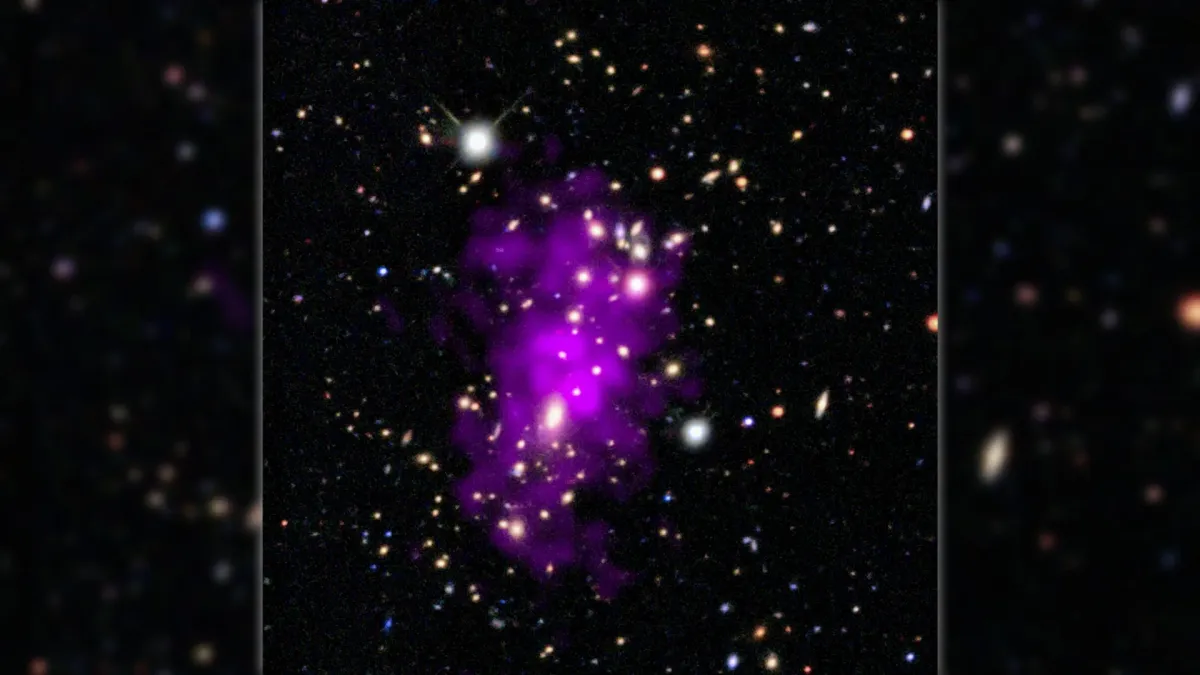
The discovery came from combining data from NASA's Chandra X-ray Observatory with optical telescope images. What looked like a single cluster at first glance revealed itself to be something far more dramatic — two massive structures of galaxies and superheated gas slamming into each other.
The Collision Revealed
You can see the evidence in the stretched-out shape of the hot gas, which appears in purple in the composite image. Most galaxy clusters show gas heated to millions of degrees in roughly circular or oval patterns. The Champagne Cluster's gas stretches vertically in an unmistakable way, a telltale sign of two objects colliding. Below the surface, you can spot two separate concentrations of galaxies — one above center, one below — marking the two groups involved in the merger.
We're a new kind of news feed.
Regular news is designed to drain you. We're a non-profit built to restore you. Every story we publish is scored for impact, progress, and hope.
Start Your News DetoxWhat makes this collision particularly striking is its rarity. The Champagne Cluster belongs to a small category of merging galaxy clusters that behave in an unusual way. In these events, the hot gas from each cluster slams together and slows down, creating a visible offset between the hot gas and the most massive galaxies. The famous Bullet Cluster, discovered decades ago, showed this same signature.
Astronomers ran computer simulations to figure out what happened here. Two scenarios emerged: either the clusters collided more than two billion years ago, drifted apart, and are now being pulled back together by gravity for a second collision. Or they experienced a single collision about 400 million years ago and are currently moving away from each other — though the timescale makes the first scenario more likely based on what they're observing.
What This Teaches Us
The mass inside the Champagne Cluster tells another story. The hot gas alone outweighs all the hundred-plus galaxies combined. But even that pales beside the dark matter — the invisible material that makes up most of the universe's mass. During a high-speed collision like this, dark matter behaves in ways that are still not fully understood. Studying the Champagne Cluster could help astronomers figure out how this invisible material moves and influences cosmic structure.
The research, published recently in The Astrophysical Journal by scientists at UC Davis, represents the kind of discovery that reminds us the universe is still actively reshaping itself on scales almost impossible to comprehend. Two galaxy clusters, each containing billions of stars, colliding billions of light-years away — and we can see it happening.