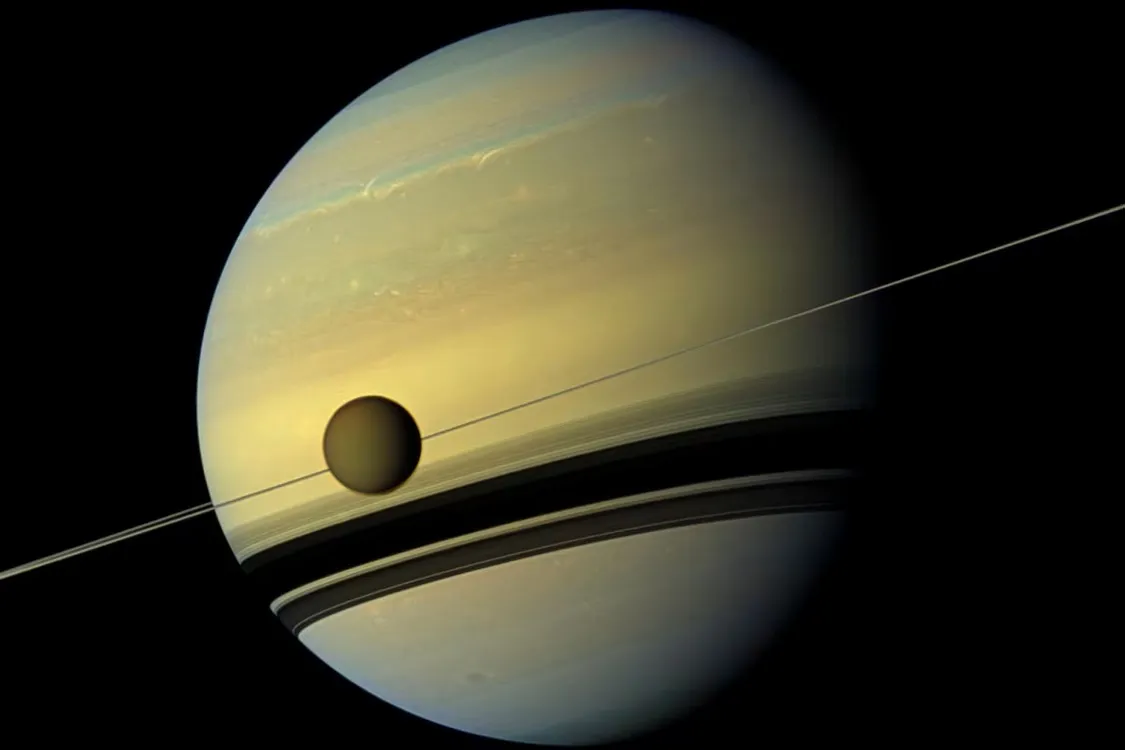
Saturn's largest moon, Titan, is bigger than Mercury. Yet for decades, astronomers couldn't explain why it's so massive—or why Saturn itself tilts and wobbles in ways that don't quite match the math. A new theory, built on data from NASA's Cassini spacecraft and refined through computer simulation, may have finally cracked it.
Matija Ćuk, a research scientist at the SETI Institute in California, proposes that roughly half a billion years ago, another moon—about 1,000 times larger than Saturn's moon Hyperion—collided with Titan. The impact merged the two bodies into one, and the gravitational ripple from that ancient crash explains not just Titan's outsized presence, but Saturn's characteristic wobble and even its famous rings.
How the pieces fit
For years, astronomers thought Neptune's gravitational pull explained Saturn's tilt through a phenomenon called orbital resonance—the way one planet's gravity can nudge another into a rhythmic pattern. But data from Cassini (which orbited Saturn from 2004 to 2017) showed Neptune's influence wasn't quite strong enough. The wobble was too fast, the math too loose.
We're a new kind of news feed.
Regular news is designed to drain you. We're a non-profit built to restore you. Every story we publish is scored for impact, progress, and hope.
Start Your News DetoxCuk's insight was to work backwards. If you subtract time and imagine Saturn as it was around 100 million years ago—when its rings are thought to have formed—the wobble aligns almost perfectly with Neptune's pull. But only if Saturn had an extra moon in its system back then. Add that collision into the model, and suddenly the numbers work. The impact between the proto-Hyperion moon and proto-Titan sped up Saturn's rotation just enough to account for what we observe today.
"From this event, Titan could have perturbed some of the inner moons into more collisions, which created the rings sometime later," Ćuk explained. His research, accepted for publication in The Planetary Science Journal, refines an earlier theory about a lost moon called Chrysalis, but with more precise calculations and a clearer mechanism.
William B. Hubbard, professor emeritus of planetary sciences at the University of Arizona, found Ćuk's model fits better than previous explanations. Carl Murray, an emeritus professor at Queen Mary University of London and a member of the Cassini team, called it "highly probable."
The theory is a reminder that our own solar system still holds secrets—puzzles that take decades of data collection and careful calculation to unravel. As we continue to peer deeper into the universe with tools like the James Webb Space Telescope, the mysteries closer to home are proving just as worth solving.