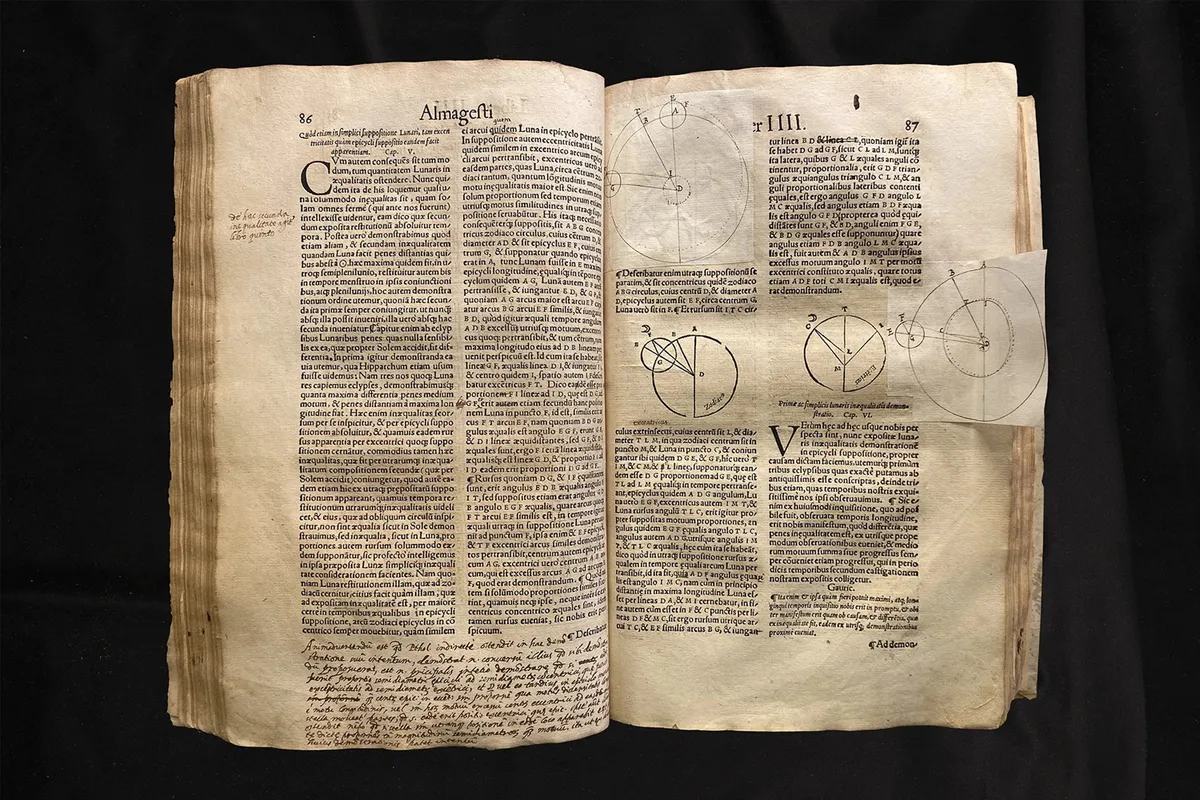
A historian leafing through a 16th-century book in Florence last January noticed something in the margins: handwritten notes that looked familiar. Ivan Malara was holding a 1551 copy of Ptolemy's Almagest—the ancient text that placed Earth at the center of the universe—and the scribbles matched the hand of Galileo Galilei, the astronomer who would spend his life arguing the opposite.
Malara spotted a transcribed Bible verse (Psalm 145) on a loose page, then noticed more annotations scattered through the margins. He emailed two leading Galileo scholars late that night. By morning, they'd confirmed what seemed unlikely: a young Galileo had studied this Earth-centric manual intensely, marking it up as he read.
The discovery matters because it reframes how we understand Galileo's intellectual journey. For centuries, he's been cast as the visionary who rejected ancient ideas outright—the lone genius who saw the sun-centered universe and never looked back. The manuscript tells a different story: one of deep technical study, careful mathematical reasoning, and gradual intellectual evolution.
We're a new kind of news feed.
Regular news is designed to drain you. We're a non-profit built to restore you. Every story we publish is scored for impact, progress, and hope.
Start Your News DetoxA Scholar Who Actually Read the Details
Galileo eventually championed Nicolaus Copernicus' heliocentric model, the correct one. He defended it so publicly that the Catholic Church placed him under house arrest in 1633, where he remained until his death. But these new annotations show he didn't start there. He began by mastering Ptolemy's sophisticated mathematical framework—the very system he would later overturn.
Historian James Evans notes that Galileo has often been portrayed as "a big-picture sort of guy—not interested in the nitty-gritty technical details of astronomy." The margin notes contradict this. They show someone working through complex demonstrations, testing ideas, asking questions in the margins. Michele Camerota, one of the scholars who authenticated the handwriting, called the attribution "fully secure."
The timing matters too. Accounts suggest Galileo prayed before studying the Almagest—a habit that explains the Bible verse's presence. He was young, still forming his ideas, still wrestling with what the ancient authorities claimed versus what he could verify himself. The notes capture that moment of intellectual becoming.
Malara plans to publish a detailed analysis in the Journal for the History of Astronomy, placing these annotations in the context of Galileo's other writings from the same period. It's a small discovery in one library's collection, but it suggests that even the most celebrated scientific revolutions don't start with rejection. They start with someone sitting down with a difficult text, marking it up, asking hard questions in the margins.