For decades, scientists stared at Saturn, scratching their heads. The ringed gas giant seemed to be pulling a fast one, changing its rotation speed depending on how you measured it. Which, if you're a planet, is just plain rude. Planets are supposed to spin at a stable rate. Basic physics, really.
Turns out, the planet wasn't actually changing its mind. It was just putting on a spectacular, self-sustaining light show that made it look like it was. And now, thanks to the James Webb Space Telescope (JWST) and some seriously patient researchers, we finally know the whole story.
Back in 2004, data from NASA's Cassini spacecraft first suggested this rotational weirdness. Fast forward to 2021, and a team led by Professor Tom Stallard at Northumbria University figured out the first piece of the puzzle: high-altitude winds in Saturn's upper atmosphere were creating electrical currents, which in turn produced auroral signals that mimicked a changing spin. Saturn itself was innocent.
We're a new kind of news feed.
Regular news is designed to drain you. We're a non-profit built to restore you. Every story we publish is scored for impact, progress, and hope.
Start Your News DetoxBut that just opened a new can of cosmic worms: What was making those winds in the first place? Enter the JWST, stage left.
The Planet's Own Heat Pump
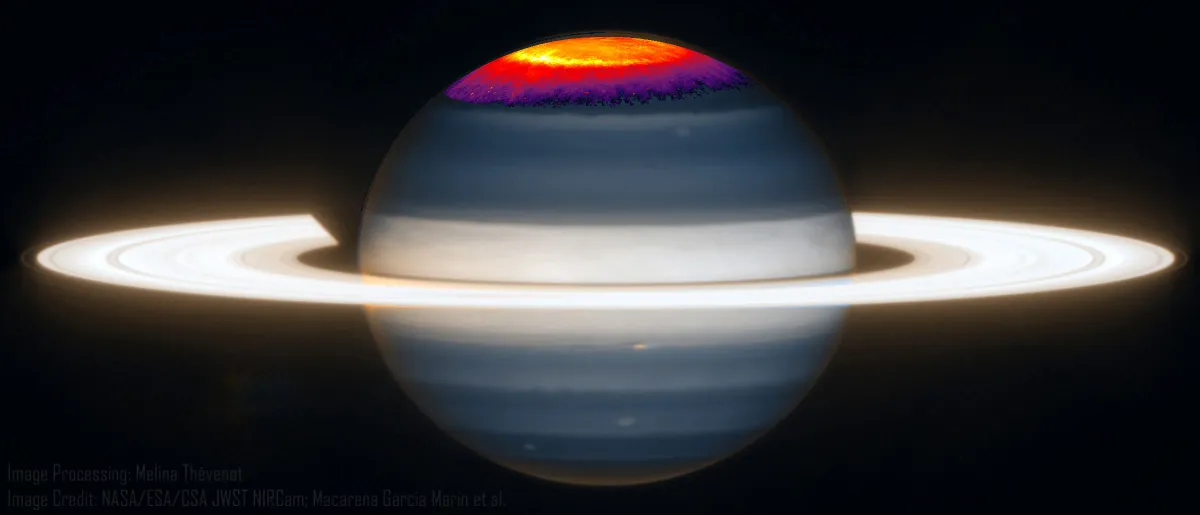
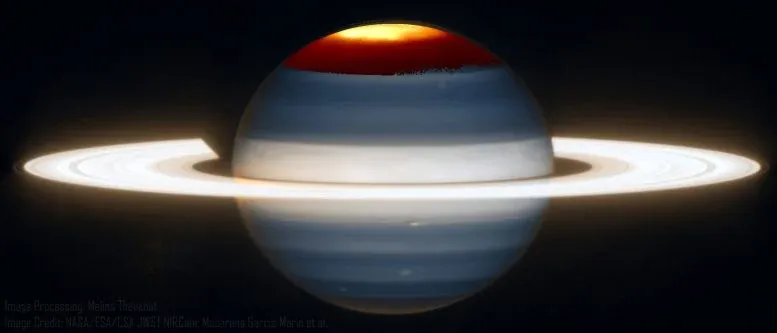
Professor Stallard and his team turned the JWST's gaze onto Saturn's northern auroral region – its very own northern lights. They watched it for an entire Saturnian day, which, for a gas giant, is an unprecedented level of continuous observation.
They weren't just looking at pretty lights. They were tracking infrared light from a molecule called trihydrogen cation, which acts as a natural thermometer in Saturn's upper atmosphere. By doing this, they created the most detailed maps ever of temperature changes and particle density across the aurora. The precision improved tenfold, allowing them to see fine patterns of heating and cooling that had been invisible before.
What they found was a feedback loop so elegant, it's almost cheeky. Saturn's aurora isn't just a pretty show; it's a localized energy source. It pumps heat into a specific part of the atmosphere, raising temperatures. That heating then drives the atmospheric winds. Those winds, in turn, produce the electrical currents that power the aurora. The cycle repeats, keeping the whole system humming along, fooling everyone into thinking Saturn was playing fast and loose with its rotation.
Professor Stallard calls it a "planetary heat pump," and it's a perfect description. It's like Saturn built its own perpetually running engine, disguised as a spectacular light show. For decades, something strange was happening. Then they found the winds. Now, they've found the why.
More Than Just a Light Show
This discovery does more than just solve a decades-long mystery. It highlights a fascinating connection between a planet's atmosphere and its surrounding space environment, or magnetosphere. What happens down in the atmosphere affects the magnetic field, which then sends energy right back to the planet. It's a cosmic conversation, and it's remarkably stable.
This two-way street suggests that similar interactions could be happening on other planets, linking atmospheric behavior with space environments in ways we're only just beginning to grasp. So, the next time you see a picture of Saturn's glowing poles, remember: it's not just a pretty face. It's a self-powered, atmospheric-magnetic feedback system that once convinced scientists the planet was having an identity crisis. Which, if you think about it, is a pretty impressive trick.