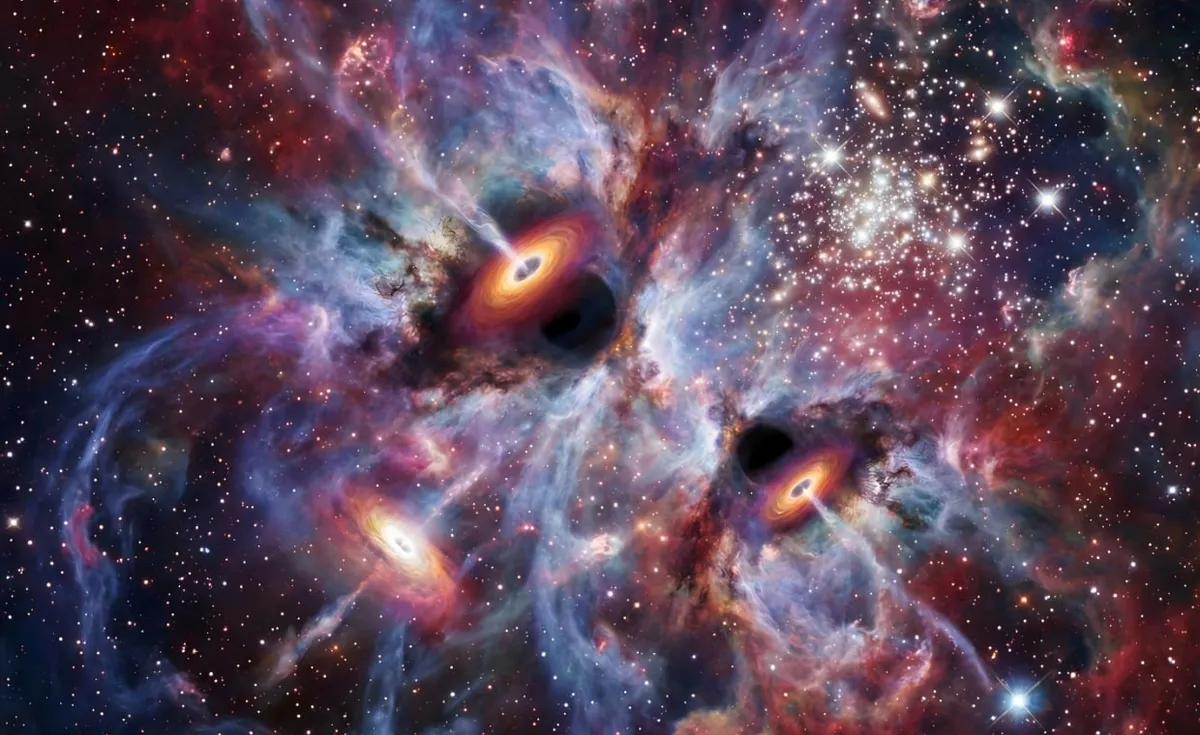
For decades, astronomers have stared at a cosmic contradiction: observations show supermassive black holes existed when the Universe was barely a billion years old, yet the physics didn't add up. These objects should have needed far longer to grow so enormous. A new study from Maynooth University, published in Nature Astronomy, finally offers an explanation—and it rewrites what we thought we knew about the early cosmos.
The answer lies in chaos. In those first moments after the Big Bang, the Universe was far more violent and unpredictable than scientists assumed. Small black holes that formed in this turbulent environment found themselves surrounded by dense clouds of gas. Unlike today's relatively orderly Universe, where radiation pressure from a feeding black hole should push material away, the early Universe's dense conditions allowed black holes to devour matter at extraordinary rates. They grew not gradually, but in feeding frenzies.
"We found that the chaotic conditions that existed in the early Universe triggered early, smaller black holes to grow into the super-massive black holes we see later," says Daxal Mehta, the PhD candidate who led the research. "They were consuming material all around them at remarkable speeds."
We're a new kind of news feed.
Regular news is designed to drain you. We're a non-profit built to restore you. Every story we publish is scored for impact, progress, and hope.
Start Your News DetoxThis matters because it closes a gap that has puzzled astronomers for years. Observations from the James Webb Space Telescope have shown that supermassive black holes—millions of times more massive than our Sun—already existed when the Universe was very young. The problem: conventional models suggested black holes needed to start out either extremely massive (a "heavy seed") or have billions of years to grow. Neither scenario fit the timeline.
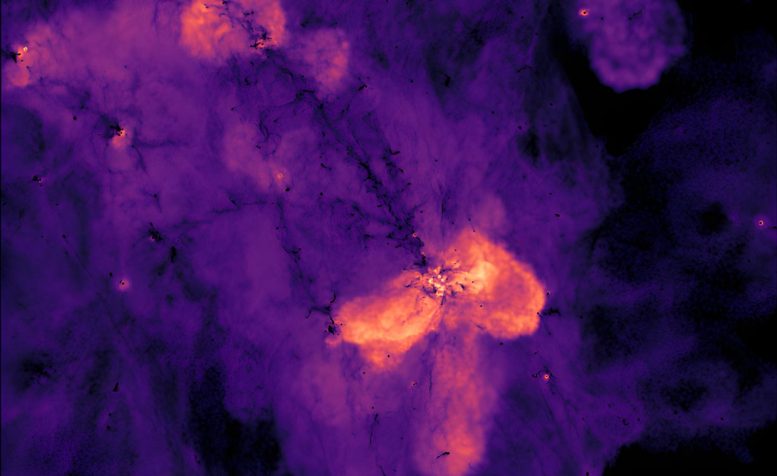
Computer-generated image showing the emergence of cosmic structure in the very early Universe. Credit: Dr John Regan
The Maynooth team's simulations suggest a third path. Ordinary stellar-mass black holes—the kind formed from collapsed stars—could grow spectacularly fast under the right conditions. "Heavy seeds are somewhat exotic and may need rare conditions to form," says Dr John Regan, the research group leader. "But your garden-variety stellar mass black holes can grow at extreme rates in the early Universe."
This reframes how we think about black hole origins. Rather than needing special conditions or exotic physics, the early Universe's natural turbulence did the heavy lifting. The chaotic environment that seems chaotic was actually a perfect incubator for rapid black hole growth.
The findings also point toward what comes next. The European Space Agency and NASA are planning the Laser Interferometer Space Antenna (LISA), a gravitational wave detector scheduled to launch in 2035. This mission might be sensitive enough to detect the mergers of these rapidly growing baby black holes from the early Universe—giving us a new way to test these theories directly.