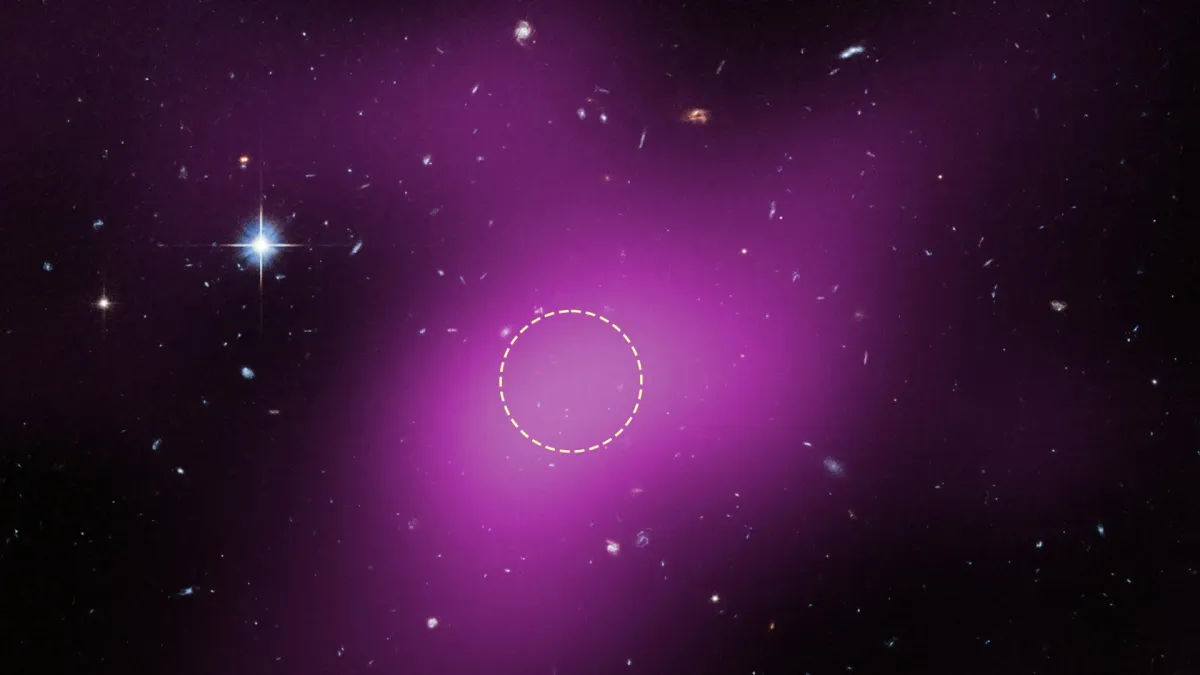
Three years ago, a radio telescope in China picked up something strange: a cloud of gas hovering near the galaxy Messier 94, completely devoid of stars. Scientists named it Cloud-9, and it's been quietly rewriting what we thought we knew about how galaxies are built.
This isn't a failed experiment. It's a window into the invisible Universe.
The ghost at the edge of a galaxy
Most of what we know about galaxies comes from looking at stars. But stars are only the visible part of the story. Cloud-9 contains roughly 1 million times the Sun's mass in hydrogen gas alone—yet not a single star ignites within it. When researchers pointed the Hubble Space Telescope at the cloud to be absolutely certain, they found nothing. No hidden dwarf galaxy masquerading as empty space. Just gas, held together by something we can't see.
That something is dark matter, the invisible scaffolding that makes up most of the Universe's mass. "We know from theory that most of the mass in the Universe is expected to be dark matter, but it's difficult to detect this dark material because it doesn't emit light," explains Andrew Fox, a team member at the European Space Agency. "Cloud-9 gives us a rare look at a dark-matter-dominated cloud."
We're a new kind of news feed.
Regular news is designed to drain you. We're a non-profit built to restore you. Every story we publish is scored for impact, progress, and hope.
Start Your News DetoxFor decades, scientists predicted objects like this should exist. Cloud-9 is the first one we've actually confirmed.
Why this matters
The discovery reveals something humbling: we've been studying galaxies with one hand tied behind our backs. By focusing on starlight, we miss entire structures floating in the cosmic dark. Cloud-9 is small—roughly 4,900 light-years across—and nearly spherical, which makes it stand out from the irregular, sprawling gas clouds usually found nearby. Its compact shape suggests it's being held together by gravitational forces, which means dark matter accounts for most of its 5 billion solar masses.
The cloud sits close enough to Messier 94 that the two appear physically connected, and radio observations hint at subtle distortions in the gas—signs that the larger galaxy may be tugging at it. Whether Cloud-9 will ever collapse into a functioning galaxy depends on whether it gains more mass. Right now, it exists in a narrow sweet spot: too small to have already formed stars through gravity, too large to have dispersed into the void.
Lead researcher Gagandeep Anand, of the Space Telescope Science Institute in Baltimore, calls it "a primordial building block of a galaxy that hasn't formed." Alejandro Benitez-Llambay, the program's principal investigator at Milano-Bicocca University in Milan, frames it differently: "In science, we usually learn more from the failures than from the successes. In this case, seeing no stars is what proves the theory right."
What comes next
Cloud-9 was discovered through radio surveys—first by the Five-hundred-meter Aperture Spherical Telescope in Guizhou, China, then confirmed by telescopes in the United States. As radio astronomy improves, researchers expect to find more of these starless relics scattered throughout the local Universe. Each one offers a clearer picture of how dark matter behaves when it's not tangled up with stars and galaxies. The invisible Universe, it turns out, has been waiting for us to learn how to look.