For decades, astronomers had a theory: the universe's brightest explosions are powered by magnetars—neutron stars spinning so fast and magnetized so intensely they warp spacetime itself. But they'd never actually seen one being born. Until December 2024.
That's when researchers tracking a supernova called SN 2024afav, about a billion light-years away, noticed something strange. As the explosion faded, its light didn't just dim smoothly. Instead, it flickered faster and faster, producing a pattern researchers called a "chirp"—like watching a strobe light accelerate. That pattern was the smoking gun: direct evidence that a magnetar had just formed.
Why the Flickering Matters
When a massive star explodes, its core collapses into something unimaginably dense. Usually it becomes a black hole or a regular neutron star. But sometimes—rarely—it becomes a magnetar: a city-sized object spinning 239 times per second with a magnetic field 300 trillion times stronger than Earth's.
We're a new kind of news feed.
Regular news is designed to drain you. We're a non-profit built to restore you. Every story we publish is scored for impact, progress, and hope.
Start Your News DetoxJoseph Farah's team at UC Santa Barbara watched SN 2024afav with 27 telescopes spread across the globe for 200 days straight. They saw four brightness bumps that kept getting closer together and more intense. The explanation, it turns out, involves Einstein's theory of general relativity.
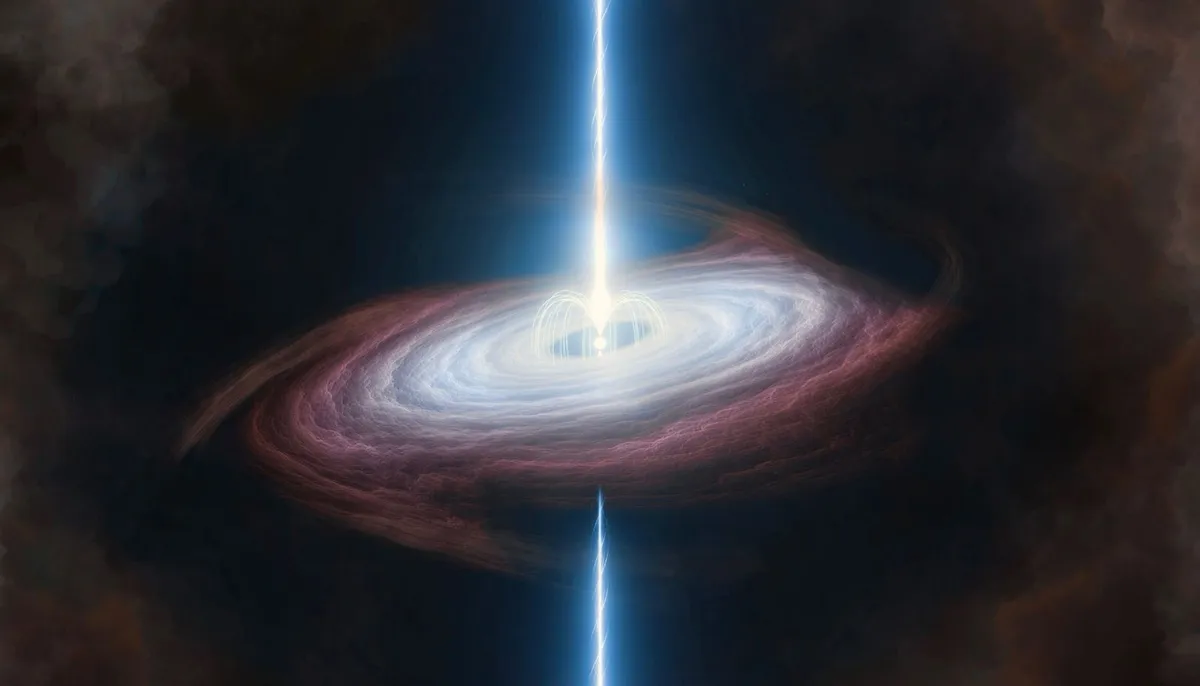
After the explosion, debris fell back toward the newborn magnetar and formed a lopsided ring around it—an accretion disk. Because this disk wasn't perfectly aligned with the magnetar's spin axis, something wild happened: the spinning magnetar literally dragged the surrounding spacetime with it, like stirring honey. This made the disk wobble. As it wobbled, it periodically blocked and reflected light from the magnetar, creating those brightness spikes. And as gravity pulled the disk closer, the wobble got faster, making the spikes come quicker. That accelerating pattern—the chirp—was the fingerprint they'd been looking for.
"If you were an observer trying to sit still around the magnetar, it would be really, really hard because your spacetime is literally being dragged to corotate with the magnetar," Farah explained.
A Physics Laboratory in Space
This matters beyond just confirming a theory. The extreme conditions around this newborn magnetar are basically a natural laboratory for testing general relativity in its most exotic regime—where gravity is so strong that Einstein's wildest predictions become measurable effects.
Dan Kasen, the UC Berkeley theorist who first proposed magnetars could power superluminous supernovas, called it a breakthrough. "The magnetar idea has felt almost like a theorist's magic trick—hiding a powerful engine behind layers of supernova debris," he said. "It was a natural explanation for the extraordinary brightness of these explosions, but we couldn't see it directly."
Not everyone's ready to pop champagne yet. Matt Nicholl at Queen's University Belfast pointed out that no other supernova has shown this chirp pattern. "I don't think it's the final smoking gun yet," he told Science News. "I just would like to see a few more before I declare it is indeed proof of the magnetar."
That confirmation might come sooner than expected. The Vera C. Rubin Observatory in Chile started operations last year and will scan the entire night sky with unprecedented sensitivity. It's expected to find thousands of superluminous supernovas in the coming years—giving researchers plenty more chances to spot that telltale chirp.