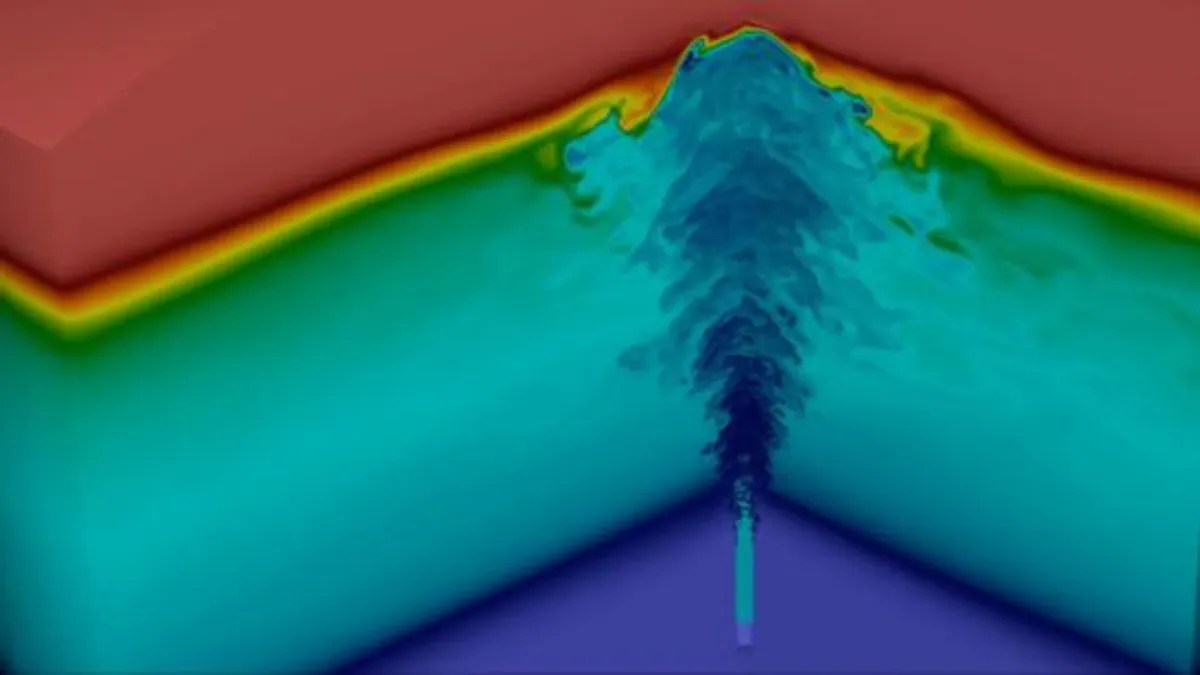
At Argonne National Laboratory, researchers are using supercomputers to improve nuclear reactor safety. They are modeling how fluids and gases move inside reactors. This chaotic movement, called turbulent flow, affects how heat transfers and gases mix.
The team uses special open-source computer programs called Nek5000 and NekRS. Nek5000 runs on CPUs, while NekRS is faster because it uses GPUs. These tools help predict important issues, like how hydrogen behaves in containment structures. This was a big concern after the Fukushima accident.
Argonne's models were proven accurate in an international experiment called PANDA. They correctly predicted how gases would flow without knowing the experimental results beforehand.
We're a new kind of news feed.
Regular news is designed to drain you. We're a non-profit built to restore you. Every story we publish is scored for impact, progress, and hope.
Start Your News DetoxSimulating Turbulence
Turbulence is common, like the swirl in coffee. But inside a nuclear containment building, it is very important for safety. During rare accidents, like the 2011 Fukushima disaster, how hydrogen gas mixes with air can affect the entire facility.
Turbulence impacts heat transfer and gas mixing in a reactor. Older computer models often simplify this chaos. They might miss small, violent eddies that change how heat moves. To fix this, the Argonne team uses Nek5000 and the faster NekRS.
To ensure the simulations are trustworthy, the Argonne team took part in a "blind benchmark" called PANDA. They were given only the shape of a tank and its starting conditions. They had to predict gas flow before seeing the actual results. The team succeeded.
This research helps predict rare accident scenarios, like hydrogen mixing. It also speeds up approval for new reactor designs by reducing the need for expensive physical experiments.
Nuclear Safety
This success caught the attention of the U.S. Nuclear Regulatory Commission (NRC). They were interested in using these tools for complex containment areas where traditional methods often fail. NRC staff worked with Argonne researchers to learn these simulation techniques. This helps them check complex fluid-dynamics data.
Aleksandr Obabko, an Argonne computational scientist, said regulators need reliable tools for rare scenarios that are hard to test. This ensures they have accurate tools to evaluate nuclear safety.
The project is now moving to Aurora, one of the most powerful supercomputers ever built. By shifting simulations from CPUs to fast GPUs, the team can complete weeks of calculations in just days.
Beyond safety, Argonne’s simulations save money. They replace expensive physical experiments with digital models, speeding up the approval process for new reactor designs.
As part of the DOE’s Nuclear Energy Advanced Modeling and Simulation (NEAMS) program, the team plans to add AI and machine learning. This will further improve prediction power and speed. This approach aims to modernize the nuclear industry. It will help regulators and companies adopt the next generation of clean energy technology with confidence.