For three decades, physicists chased a ghost. The sterile neutrino — a hypothetical fourth type of neutrino — had become the leading explanation for weird experimental results that didn't fit the Standard Model. Last year, researchers at the MicroBooNE experiment finally caught up with it. They didn't find it.
The discovery is less "eureka" and more "okay, so that's not it." But in physics, eliminating wrong answers is how you get closer to right ones.
The 30-Year Puzzle
Neutrinos are among the most abundant particles in the universe, yet they barely interact with anything — billions pass through your body every second without leaving a trace. In the 1990s, experiments at Los Alamos and Fermilab noticed something odd: muon neutrinos seemed to be oscillating into electron neutrinos in ways that shouldn't be possible if only three types of neutrinos existed. The most popular explanation? A fourth type that barely interacts with anything at all — a sterile neutrino.
We're a new kind of news feed.
Regular news is designed to drain you. We're a non-profit built to restore you. Every story we publish is scored for impact, progress, and hope.
Start Your News DetoxFor 30 years, this hypothesis sat at the center of particle physics conversations. It wasn't proven, but it fit the data. It explained the anomalies. It felt like the answer.
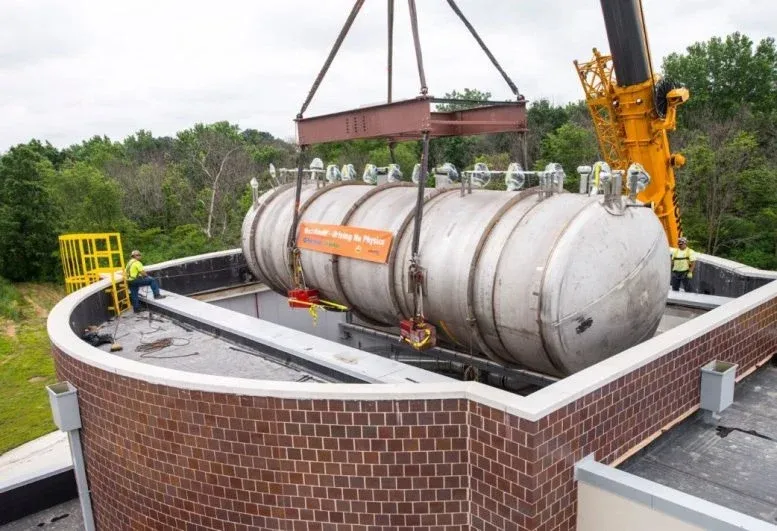
Then MicroBooNE, a liquid-argon detector the size of a school bus, collected data from two neutrino beams at Fermilab between 2015 and 2021. The experiment was designed specifically to catch sterile neutrinos if they existed. Researchers produced muon neutrinos and positioned detectors to maximize the chance of spotting the electron neutrinos that would appear if oscillation into sterile neutrinos was happening. The results, published in Nature in January 2025, showed no such oscillations. The sterile neutrino didn't exist — at least not in the way the data suggested.
"I think it's a bit of a paradigm shift for us," said David Caratelli, a physicist at UC Santa Barbara who coordinated the analysis. Ruling out a 30-year-old hypothesis doesn't feel like progress until you realize what it clears away: an entire false trail that was consuming research attention and resources.
What Comes Next
Now physicists are looking elsewhere. Maybe photons from misunderstood background processes are responsible for the anomalies. Maybe there's new physics entirely. The broader Short Baseline Neutrino program at Fermilab will investigate these questions in greater detail over the coming years.
Meanwhile, the lessons from MicroBooNE are already being applied to something much bigger. The Deep Underground Neutrino Experiment (DUNE), currently under construction a mile underground in South Dakota, will be football-field-scale — vastly larger and more sensitive than MicroBooNE. It will receive neutrinos fired 800 miles through the ground from Fermilab. That scale of precision could solve not just the oscillation mystery, but other deep questions about why the universe contains more matter than antimatter.
"What we learned with MicroBooNE on how to analyze the data directly applies to DUNE," Caratelli said. Sometimes the most useful science is knowing what isn't true.