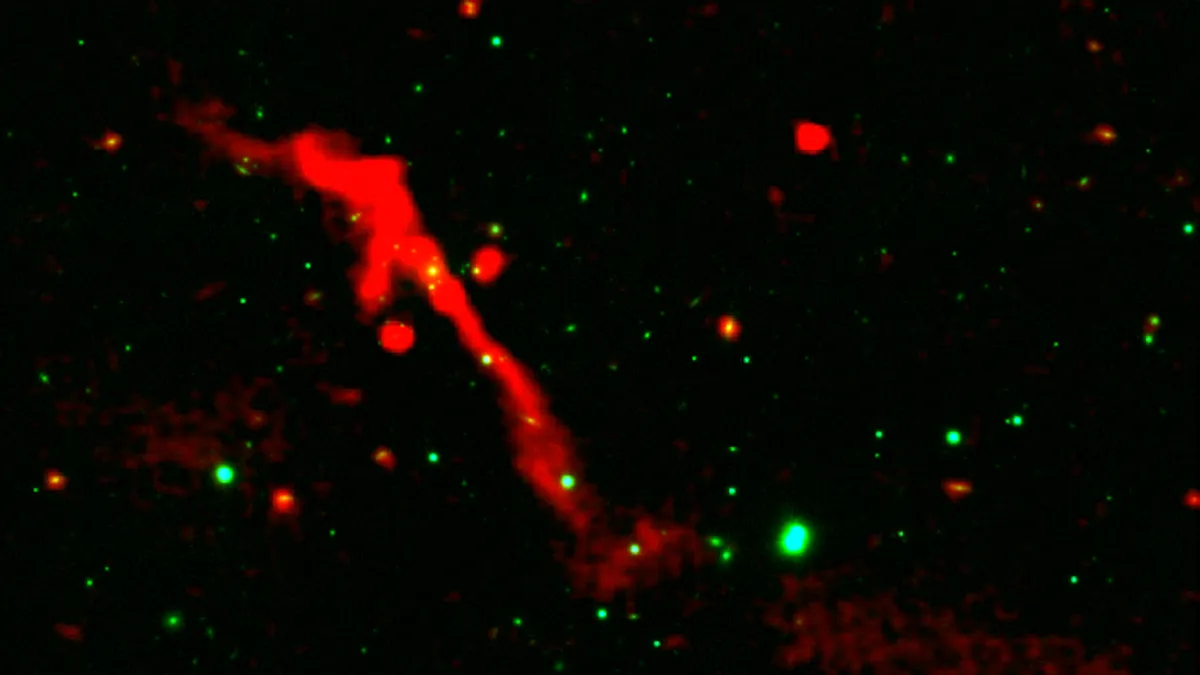
A supermassive black hole 2 billion light-years away is doing something astronomers rarely get to watch: waking up. After roughly 100 million years of dormancy, J1007+3540—nestled in a distant galaxy cluster—has begun erupting again, sending magnetized plasma jets streaming across nearly a million light-years of space.
The discovery, published in Monthly Notices of the Royal Astronomical Society, reveals something fundamental about how these cosmic monsters actually behave. Supermassive black holes don't constantly feed on their surroundings. Instead, they can lie quiet for epochs, then suddenly reactivate—a pattern that's rare enough to study but common enough that it shapes entire galaxies.
Shobha Kumari's team at Midnapore City College in India pieced this story together using radio telescopes in the Netherlands and India. What makes J1007+3540 special isn't just that it's erupting—it's that the eruption has left a readable record. Newer, bright jets sit inside older, fading layers of plasma, like archaeological strata written in radiation. "It's like watching a cosmic volcano erupt again after ages of calm—except this one is big enough to carve out structures stretching nearly a million light-years across space," Kumari said.
We're a new kind of news feed.
Regular news is designed to drain you. We're a non-profit built to restore you. Every story we publish is scored for impact, progress, and hope.
Start Your News DetoxBut here's where the physics gets interesting. The black hole's own forces are incomprehensibly powerful, yet they're not acting alone. The galaxy cluster surrounding J1007+3540 is filled with incredibly hot gas that exerts its own pressure—in this case, stronger than in most other radio galaxies. As the black hole's jets shoot outward, this surrounding gas bends and compresses them like wind warping a stream of smoke. The northern lobe curves visibly to one side, distorted by the galactic pressure around it.
"J1007+3540 is one of the clearest examples of episodic AGN with jet-cluster interaction," said Surajit Paul, a co-author and astronomer at the Manipal Center for Natural Sciences. What that means in plain terms: we're watching a battle between the black hole's internal forces and the universe's external pressures, frozen in time and visible to us across billions of years.
The next step is to use higher-resolution instruments to zoom into the black hole's core itself. That will help astronomers understand how often these reawakenings actually happen and how the newly energized jets navigate through the hot gas surrounding them. For now, J1007+3540 offers a rare, detailed snapshot of a cosmic cycle most galaxies go through but few humans ever get to see.