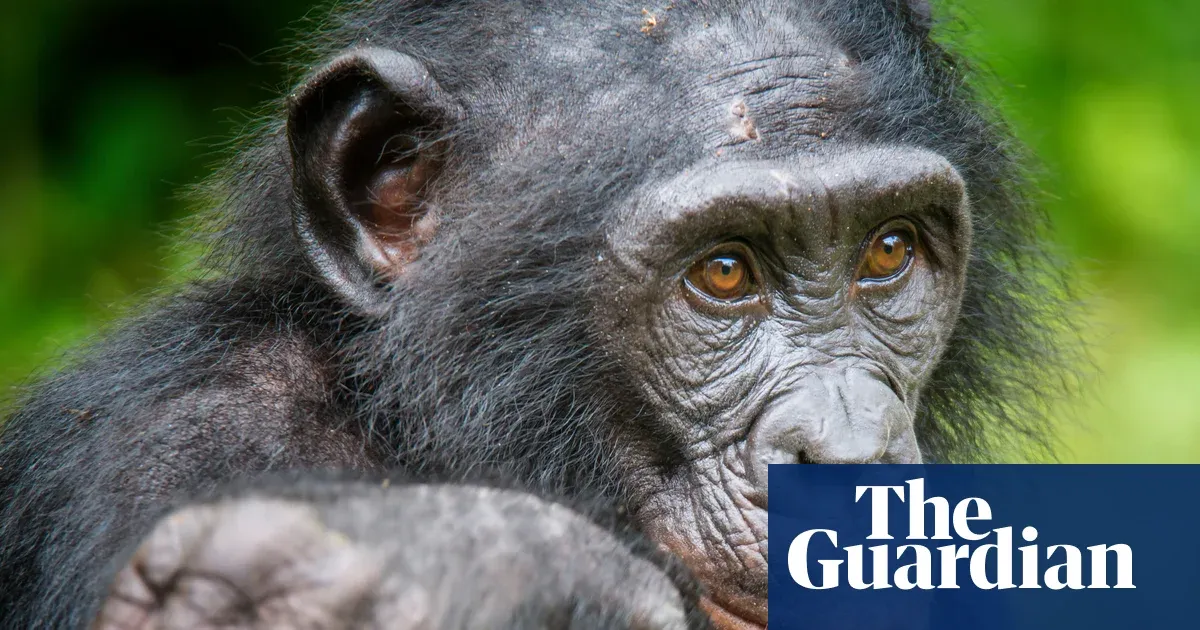
A bonobo named Kanzi just did something researchers thought only human children could do: he understood that an empty cup could represent a full one.
In a series of experiments published in Science, researchers showed Kanzi two transparent cups and pretended to pour juice into one using an empty jug. When asked which cup held juice, Kanzi pointed to the "full" cup 34 out of 50 times—well above chance. More tellingly, he wasn't rewarded for correct answers. He wasn't learning a trick. He was understanding pretense itself.
The Gap Between Imagination and Reality
The researchers pushed further. In another test, Kanzi had to choose between a cup with actual juice and one with imaginary juice. He picked the real one 14 out of 18 times. He could hold both the pretend and the real in his mind simultaneously, and distinguish between them. He also correctly identified the location of an imaginary grape when asked.
We're a new kind of news feed.
Regular news is designed to drain you. We're a non-profit built to restore you. Every story we publish is scored for impact, progress, and hope.
Start Your News DetoxThis matters because make-believe—the ability to represent something that isn't there, to let one thing stand in for another—was thought to be uniquely human. It's a cognitive leap that young children master around age three. It requires understanding that symbols can carry meaning, that imagination has rules, that pretense is a shared understanding between people (or in this case, between a bonobo and researchers).
Dr. Amalia Bastos, who led the study, put it plainly: "This shows that animals are capable of understanding pretence in a controlled experimental setting, which hadn't been done before."
Now, Kanzi is unusual. He was raised around humans, trained to communicate, exposed to language and symbolic thinking from a young age. The researchers are careful not to claim that all bonobos have this ability—that would require testing animals without Kanzi's particular upbringing. But the fact that any non-human animal can do this at all reshapes how we think about the evolution of imagination.
If bonobos can pretend, and bonobos last shared a common ancestor with humans 6 to 9 million years ago, then the roots of make-believe run deep. We didn't invent imagination. We inherited it. The capacity was already there, waiting in our shared evolutionary past, long before humans developed writing, theater, or the ability to get lost in a novel.
The next question isn't whether bonobos can do this—Kanzi has answered that. It's whether the ability shows up in other apes, and whether it emerges in younger or less linguistically trained individuals. That would tell us whether imagination is a gift that evolution gave to the entire ape family, or something more specific to our line.