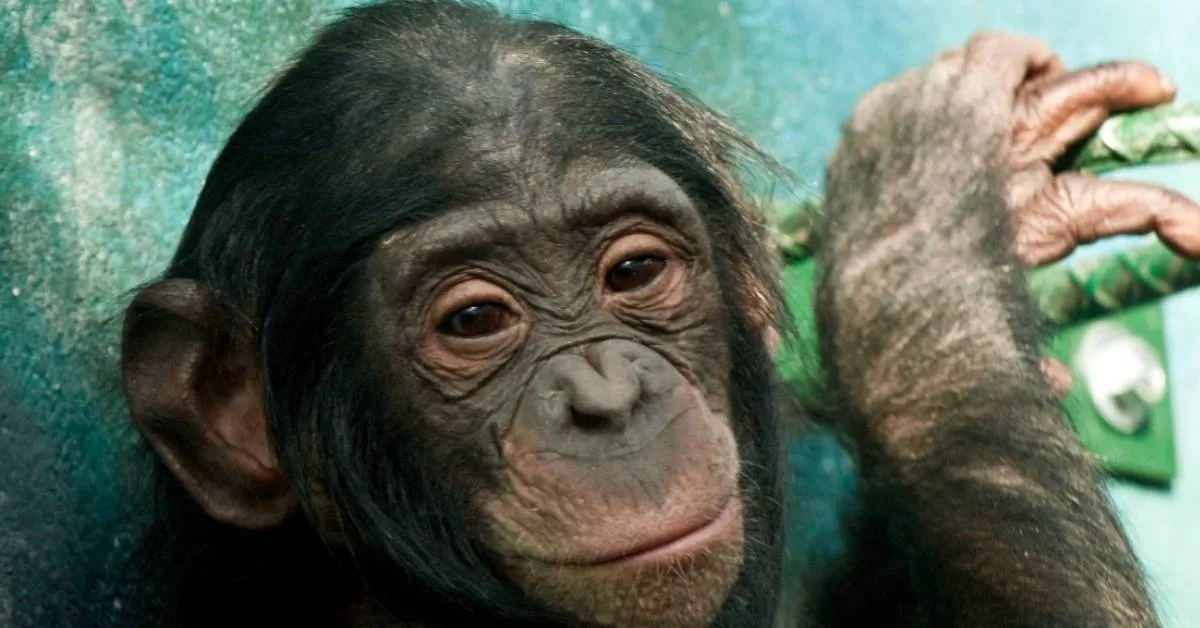
A 43-year-old bonobo named Kanzi sat at a table with empty cups and pitchers, watching researchers mime pouring juice. When asked where the juice was, Kanzi pointed to the correct cup—even after the experimenter switched positions. He was tracking something that didn't exist.
This simple experiment, conducted at Johns Hopkins University, just upended what scientists thought they knew about imagination. For decades, the ability to conceive of things that aren't there—to play pretend, to hold an idea in your mind while knowing it's false—was considered uniquely human. Kanzi, and several other bonobos tested alongside him, proved otherwise.
The invisible object test
The researchers ran multiple scenarios. In one, they pretended to place an imaginary grape into a jar, then asked the bonobos to identify which container held it. Kanzi got it right. The apes weren't just mimicking human gestures; they were tracking an abstract object through a mental space. They understood the game.
We're a new kind of news feed.
Regular news is designed to drain you. We're a non-profit built to restore you. Every story we publish is scored for impact, progress, and hope.
Start Your News Detox"It's extremely striking that the data suggest apes can conceive of things that are not there," said Dr. Amalia Bastos, the study's lead author from the University of St. Andrews. "Kanzi is able to generate an idea of this pretend object and at the same time know it's not real." That's the cognitive leap—not just imagining something, but knowing you're imagining it.
The finding, published in Science, suggests this capacity for abstract thinking didn't emerge with humans. It likely traces back millions of years to a shared ancestor. Which means imagination may be far more ancient than we thought, woven into the mental toolkit of great apes long before language or culture.
"This really invites us to reconsider what makes us special," said Christopher Krupenye, an assistant professor at Johns Hopkins. The question shifts from "Can other animals think abstractly?" to "What did we add on top of that foundation?"
The research also underscores what we stand to lose. Bonobos exist only in the Democratic Republic of Congo, where habitat loss and poaching have pushed them toward extinction. These aren't distant creatures—they're our closest living relatives, sharing roughly 98% of our DNA. Understanding their minds means understanding our own evolutionary path, and that knowledge disappears if the species does.
What started as a tea party with an ape may reshape how we think about consciousness itself.