Imagine a world where your steak doesn't come from a cow, but from a petri dish. That's the promise of cultivated meat, and while we've been able to whip up some lab-grown ground beef for a while, getting a proper, marbled steak has been a scientific Mount Everest.
Well, a team at EMBL Barcelona just found a new path up that mountain. They've figured out how to grow bovine tissues that actually organize themselves into muscle, nerve, and even early blood vessel cells. And they did it all from bovine embryonic stem cells. Because apparently, even tiny future steaks need to learn how to put themselves together.
The Secret Sauce: Embryonic Cells
Most cultivated beef experiments have been using adult stem cells, which are a bit like that one friend who's great at one thing but not much else. They can make muscle, sure, but they don't divide much and are pretty limited in what they can become. Building a complex steak, with all its juicy bits and connective tissues, requires a bit more versatility.
We're a new kind of news feed.
Regular news is designed to drain you. We're a non-profit built to restore you. Every story we publish is scored for impact, progress, and hope.
Start Your News DetoxEnter Miki Ebisuya and her team. They tapped into bovine embryonic stem cells – the cellular equivalent of a blank canvas that can become almost anything. These little overachievers can multiply for ages and differentiate into a whole host of cell types. The researchers gently nudged them to simultaneously create skeletal muscle, neurons, and endothelial cells (the building blocks of blood vessels).
And here's the really wild part: these cells then just... clumped together. On their own. No fancy scaffolding or complex assembly required. As former postdoctoral fellow Marina Sanaki-Matsumiya put it, "Reproducing the complexity of real tissue is one of the biggest challenges in cultivated meat." Apparently, embryonic stem cells are just really good at teamwork.
Tiny Tissues, Big Implications
Developing those endothelial cells is a huge deal. In a real animal, blood vessels are the delivery system, bringing oxygen and nutrients to help tissues grow big and strong. While these lab-grown vessel networks are still pretty basic, they're a crucial step toward scaling up from a microscopic clump to something you might actually want to grill.
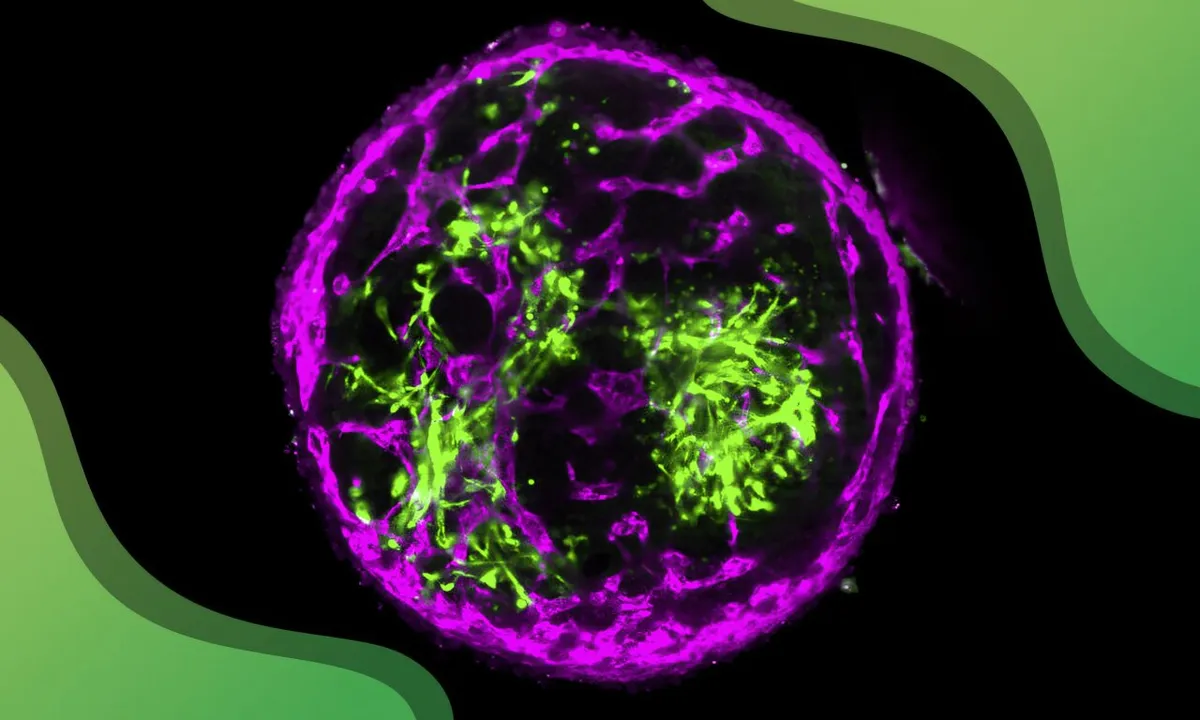
In just 15 days, the team produced 3D clumps about 0.6 mm wide. Which, for the record, is still very, very small. But inside these minuscule marvels were muscle fibers, those endothelial networks, and even spinal neurons interacting with the muscle. It's like a tiny, self-assembling biological orchestra, all playing together from the same original cells.
Now, before you start pre-ordering your lab-grown ribeye, the researchers are quick to point out this isn't a recipe for cultivated steak just yet. "The tissue we generated is still very small," Ebisuya noted. "To produce something resembling a steak, we will need much larger tissues with more mature blood vessel networks that can support continued growth."
And then there's the small matter of cost. Growing these embryonic stem cells is currently quite pricey, which means your future lab-grown sirloin would probably be more expensive than a private jet. But hey, it's a start. And in the meantime, this research is also helping us understand how muscle tissues develop, which is pretty neat in itself. Because sometimes, the path to a better steak also leads to better science.