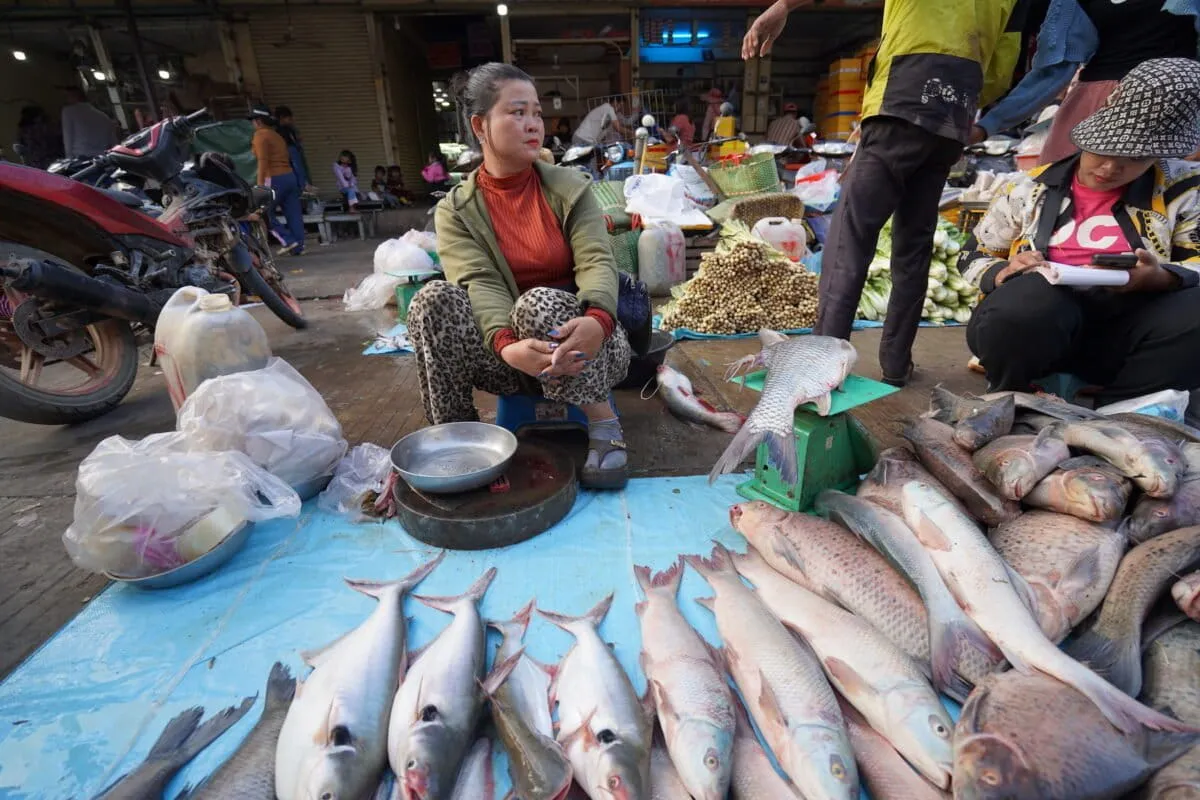
Sunrise hasn't broken over Stung Treng when the first fishing boats arrive at the landing site along Cambodia's Mekong River. By the time light hits the water, the night's catch is already spread across tarps and reed mats on a side street — snakeheads, catfish, barbs, loaches arranged in dense, gleaming rows. Motorcycles crowd the edges. Buyers weave through narrow passageways. Vendors weigh and sort fish for kitchens, restaurants, and traders heading to Phnom Penh.
On a February morning, something different happened at this market and another one 140 kilometers downstream in Kratie. A team of Cambodian and international researchers showed up with notebooks and cameras. They weren't there to buy fish. They were there to document what's swimming in the Mekong — and how it's changed.
What the Markets Reveal
The Mekong is quietly one of the world's most important rivers. More than two million tons of fish come out of it every year, making it one of the planet's most productive freshwater ecosystems. That fish doesn't just feed Cambodia — it feeds millions across Southeast Asia.
We're a new kind of news feed.
Regular news is designed to drain you. We're a non-profit built to restore you. Every story we publish is scored for impact, progress, and hope.
Start Your News DetoxBut here's where it gets interesting: this survey isn't starting from scratch. In 1994, a late ichthyologist named Tyson Roberts did exactly this work — he catalogued every fish species appearing in the Stung Treng market. Three decades later, researchers are doing it again, in the same seasons, at the same markets. That means they can actually see what's changed.
This is the kind of data that usually doesn't exist. Most rivers don't have a detailed snapshot from 30 years ago to compare against today. The Mekong does, and researchers are using it to build a living archive of how the river's biodiversity is holding up — and where it's stressed.