Researchers at the University of Konstanz have found a new way friction can happen. It's a resistance to movement that doesn't need any physical touch. Instead, it comes from how magnets move together.
This discovery challenges Amontons' law, a rule about friction that's been around for over 300 years. Amontons' law says friction always increases as the "load" or weight on an object increases. But this new study, published in Nature Materials, shows that friction can actually reach a peak and then decrease, especially when magnetic forces get complicated.
Rethinking an Old Friction Law
For centuries, Amontons' law has explained why heavier things are harder to push. Think about moving a heavy couch versus a light chair. The common idea is that when you put more weight on something, the surfaces touching each other deform a little. This creates more tiny contact points, which increases friction.
We're a new kind of news feed.
Regular news is designed to drain you. We're a non-profit built to restore you. Every story we publish is scored for impact, progress, and hope.
Start Your News DetoxUsually, these surface changes are small and don't change the material's inner structure much. But what happens if sliding causes big changes inside the material, like in magnets where movement can change their magnetic order?
A Friction Experiment Without Touching
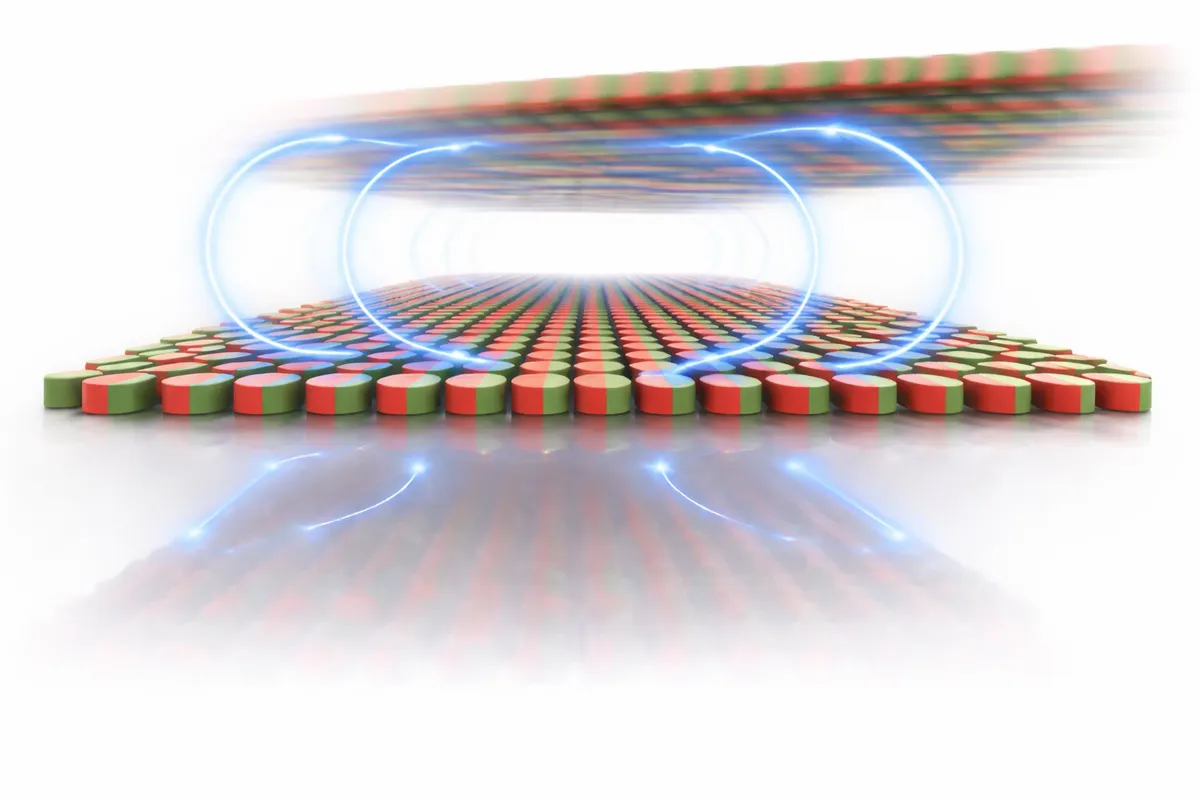
To find out, the team set up an experiment. They used a flat layer of magnets that could spin freely. This layer moved over a second layer of fixed magnets. The two layers never touched, but their magnetic connection created a measurable friction force.
By changing the distance between the layers, the researchers could adjust the "load." They could also watch how the magnets inside changed as they moved.
Hongri Gu, who did the experiments, explained that changing the distance made the magnets constantly rearrange themselves as they slid.
Surprisingly, friction was weakest when the layers were very close or very far apart. But at middle distances, the magnetic forces started to compete. The top layer wanted its magnets to point in opposite directions, while the bottom layer wanted them to point in the same direction. This conflict made the system unstable.
As the layers slid, the magnets kept switching between these clashing states. This switching used up a lot of energy and created a strong peak in friction.
Friction from Magnetic Spin
Anton Lüders, who developed the theory for the study, noted that this system is special because friction doesn't come from physical contact. Instead, it comes from how the magnetic forces move together.
The competing magnetic forces naturally cause the magnets to reorient in a way that depends on their past movements. This leads to a friction force that doesn't just steadily increase with load. So, Amontons' law doesn't hold true here. This breakdown is a direct result of how the magnets behave during sliding.
Clemens Bechinger, who oversaw the project, added that the friction here comes entirely from internal changes. There's no wear, no rough surfaces, and no direct contact. The energy loss is purely from the magnets rearranging themselves.
Because the physics behind this works at different sizes, these findings could apply to very thin magnetic materials. In these materials, even small movements can change their magnetic order. This research opens new ways to study and control magnetism by measuring friction.
In the future, this work could lead to adjustable friction surfaces that don't wear out. By using how magnets remember their past states, friction could be changed remotely and reversibly. This could lead to new ideas like "frictional metamaterials," adaptive shock absorbers, or contactless control systems.
Possible uses include tiny electronic systems where wear limits how long devices last, magnetic bearings, vibration control, and super-thin magnets where movement is closely tied to their internal magnetic order.
More broadly, magnetic friction offers a new way to understand how magnetic forces move together, simply by taking mechanical measurements. This creates a new link between the study of friction and magnetism.
Deep Dive & References
Nonmonotonic Magnetic Friction from Collective Rotor Dynamics - Nature Materials, 2026