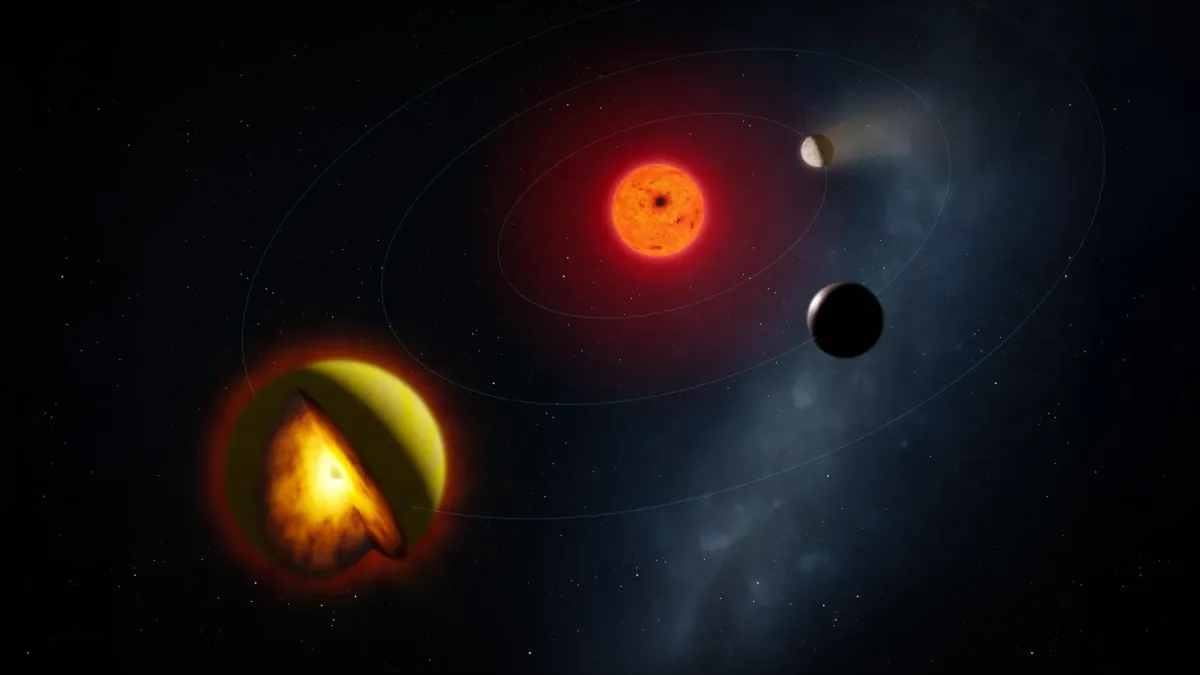
Get this: astronomers just found a planet unlike anything we've ever seen. It's called L 98-59 d, and it seems to have a massive ocean of molten rock under its surface, holding onto tons of sulfur.
The James Webb Space Telescope (JWST) spotted weird, sulfur-rich gases in its atmosphere. Plus, the planet is surprisingly light for its size. It's about 1.6 times bigger than Earth and orbits a small red star 35 light-years away.
A team from the University of Oxford led this wild discovery, publishing their findings in Nature Astronomy. They figured out that this planet basically locks away huge amounts of sulfur inside that long-lasting molten rock ocean.
We're a new kind of news feed.
Regular news is designed to drain you. We're a non-profit built to restore you. Every story we publish is scored for impact, progress, and hope.
Start Your News DetoxA Planet That Just Doesn't Fit
Before this, scientists would have put L 98-59 d into one of two boxes: either a rocky "gas-dwarf" with a hydrogen atmosphere or a watery world covered in deep oceans and ice. But nope.
New evidence shows it's neither. Instead, it's a completely different kind of planet, totally dominated by heavy sulfur compounds. Think of it like a giant, smelly, lava-filled surprise.
To figure this out, researchers used clever computer simulations. They traced the planet's entire life, from its birth almost five billion years ago to today. They combined telescope data with detailed models of what planets are made of and what their atmospheres are like.
Their models suggest L 98-59 d has a core of molten rock, like Earth's lava. And beneath its surface? A magma ocean thousands of kilometers deep. This giant reservoir traps huge amounts of sulfur inside the planet for billions of years.
That magma ocean also helps keep a thick, hydrogen-rich atmosphere around, full of sulfur gases like hydrogen sulfide (which smells like rotten eggs, by the way). Normally, radiation from its star would just blast these gases away into space, but the magma ocean keeps them cycling.
Over eons, chemicals have swapped places between the super-hot inside and the atmosphere. These exchanges explain the weird signals JWST picked up. This could be the first of many such "pungent planets" out there.
Dr. Harrison Nicholls, the lead author, says this discovery means our old planet categories might be way too simple. While this molten planet probably can't support life, it shows just how much variety is out there.
Scientists also think that magma oceans are how all rocky planets, including Earth and Mars, start out. So, studying these distant worlds could teach us a lot about our own planet's early history. It's like looking into Earth's baby album, but for a whole different world.
Professor Raymond Pierrehumbert, a co-author, finds it seriously cool that computer models can show us the hidden insides of a planet we'll never visit. It proves we can reconstruct the deep past of these alien worlds, even finding types not in our own solar system.
JWST is just getting started, and future missions will add even more data. Scientists plan to use machine learning with these observations to map the incredible diversity of planets beyond our Solar System. Who knows what other wild worlds we'll find?