Get this: scientists just found all five basic ingredients for DNA and RNA on an asteroid named Ryugu. This space rock, millions of miles away, holds the very building blocks of life as we know it.
It's a huge clue that asteroids might have seeded Earth with life's essential components billions of years ago. Basically, space delivered the goods.
Cosmic Delivery Service
For a while now, scientists have wondered if space rocks brought life's ingredients to our young planet. This new study, published in Nature Astronomy, makes that idea look even stronger. It's not just Ryugu, either. In 2025, researchers found the same five molecules (called nucleobases) on another asteroid, Bennu. Even meteorites that crashed here had them.
We're a new kind of news feed.
Regular news is designed to drain you. We're a non-profit built to restore you. Every story we publish is scored for impact, progress, and hope.
Start Your News DetoxYasuhiro Oba, a chemist from Hokkaido University who worked on the study, put it simply: these building blocks are everywhere. He told New Scientist that finding them on Ryugu really shows how common they are across our solar system.
Think of asteroids as ancient time capsules. They've kept materials from when our solar system was just forming, about 4.5 billion years ago. That makes them perfect for peeking into cosmic history.
Unlocking Ryugu's Secrets
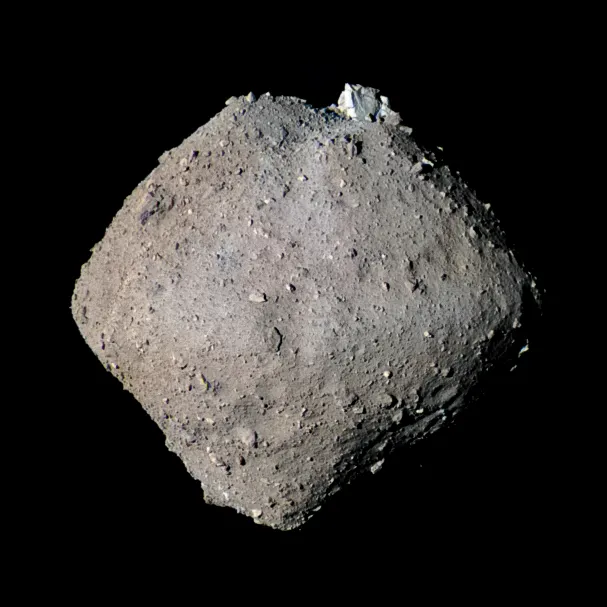
To get a closer look, Japan's space agency (JAXA) launched the Hayabusa2 mission in 2014. A spacecraft flew to Ryugu, even made a crater, and grabbed rocks from beneath its surface. In 2020, a small capsule brought about 5.4 grams of this asteroid dust back to Earth. That's like getting a tiny, precious sample of the early solar system.
Ryugu itself is about half a mile wide, shaped kind of like a diamond, and packed with carbon. When Hayabusa2 got there in 2018, it was about 174 million miles from Earth.
Oba and his team carefully studied the Ryugu samples in a super-clean lab to avoid any contamination. They extracted carbon-based molecules, then purified them. That's how they found the nucleobases. These molecules, when mixed with sugars and a few other things, create RNA and DNA—the genetic code for every living thing on Earth.
Kliti Grice, a geochemist not involved in the work, pointed out that this means the key parts of our genetic material might have actually formed in space. Then, they hitched a ride to early Earth. It means the story of life here is tied directly to the chemistry of ancient space rocks. Pretty wild, right?
A Clue in the Chemistry
The five nucleobases fall into two main types: purines and pyrimidines. The team found similar amounts of both on Ryugu. This ratio was different from what they saw on Bennu and other meteorites. That difference, they realized, might be connected to how much ammonia was in the space rock.
Toshiki Koga, another study author, told Gizmodo this link suggests ammonia played a big role in shaping these genetic molecules. He said no one expected such a connection. It could mean there were totally unknown chemical pathways forming life's ingredients in the early solar system.
Koga hopes future research dives deeper into this connection. It might just unlock more secrets about how life's building blocks first came to be.