Get this: scientists at CERN, the big physics lab in Switzerland, just spotted a proton that's four times heavier than normal. Seriously. It's like finding a super-sized version of one of the universe's most basic building blocks.
They found it by smashing particles together in the Large Hadron Collider (LHC). This machine recreates conditions from right after the Big Bang. That's how they turn pure energy into new particles.
This new heavy proton could unlock secrets about the "strong force." That's the invisible glue that holds every atom together. Think of it like a rubber band that gets stronger the more you try to pull things apart.
We're a new kind of news feed.
Regular news is designed to drain you. We're a non-profit built to restore you. Every story we publish is scored for impact, progress, and hope.
Start Your News DetoxA Faster Way to See the Unseen
The team on the LHCb experiment made this wild find after giving their detector a major upgrade. This new tech made it way more powerful. Professor Tim Gershon, who will lead the LHCb team soon, said the improved detector found this particle in just one year. The old detector couldn't see it in a decade of searching.
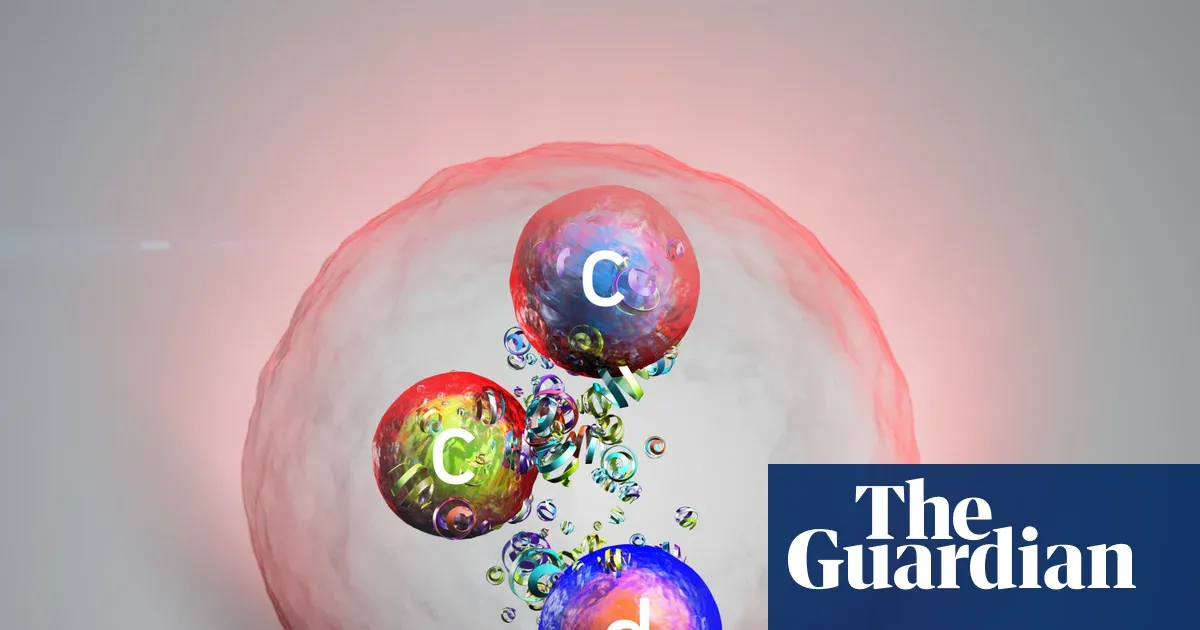
So, what makes it heavy? Regular protons have two "up" quarks and one "down" quark. This new one, called Xi-cc-plus, has two heavier "charm" quarks instead of the "up" ones. It only exists for a tiny fraction of a second before breaking down.
Learning about these fleeting particles helps us understand the strong force better. It's the same force that keeps you, your phone, and everything around you from dissolving into a cloud of quarks. ## The Funding Glitch
Here's the thing: this discovery comes as the UK's main science funder, UK Research and Innovation (UKRI), is facing some heat. They're planning to cut £50 million for the LHCb's next big upgrade. That upgrade would let the detector really shine and make even more discoveries.
Scientists across particle physics, astronomy, and nuclear physics in the UK are seeing their grants cut. This is due to other big projects going over budget. Projects like the LHCb upgrade and a new electron-ion collider with US researchers are on the chopping block.
Chi Onwurah, who chairs the Commons science committee, called these cuts "wholly unacceptable." Professor Gershon stressed that no other experiment, anywhere in the world, can do this kind of physics. Losing this funding would mean missing out on even more game-changing discoveries.