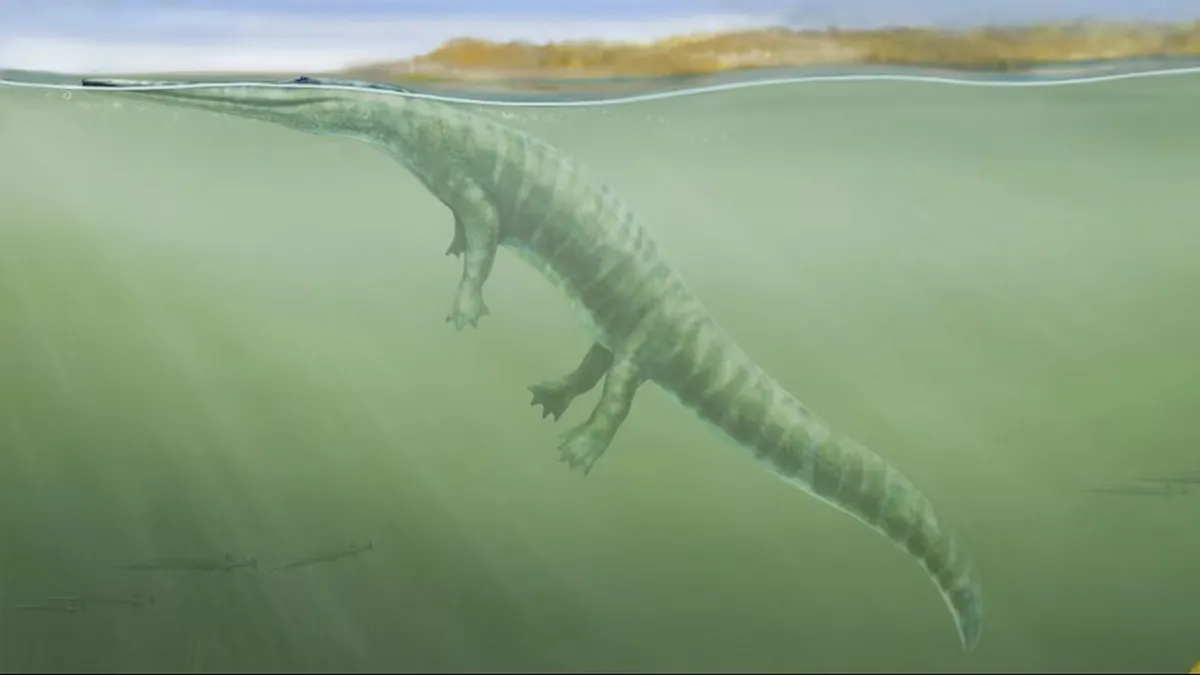
Two hundred fifty million years ago, something remarkable happened in the oceans: a massive, crocodile-headed amphibian called Aphaneramma migrated from the Norwegian Arctic all the way to the west coast of Australia. These creatures looked like oversized, toothy salamanders and hunted with brutal efficiency. Then they died, fossilized, and were promptly forgotten by science.
In 1960, paleontologists dug up several specimens on Noonkanbah Station in Western Australia's Kimberley region—that vast, red-stoned landscape 1,500 miles north of Perth. They correctly identified the creatures as Temnospondyls (an ancient amphibian group) and named them Erythrobatrachus. But here's where the story gets messy: the researchers didn't realize they'd actually found two different species mixed together. The fossils got shipped to institutions around the world, shuffled between storage rooms, and eventually lost to institutional memory.
Fifty years later, something unexpected happened. American museum staff stumbled upon the specimens and reached out to Lachlan Hart, a paleontologist at the University of New South Wales who was researching these exact creatures. "You really have to check your luck," Hart said when describing the moment. It was pure serendipity—the kind where the universe hands you back exactly what you needed, decades after you stopped looking.
We're a new kind of news feed.
Regular news is designed to drain you. We're a non-profit built to restore you. Every story we publish is scored for impact, progress, and hope.
Start Your News DetoxWhy This Matters More Than Ancient History
Temnospondyls aren't just interesting footnotes. They're survivors. This group of animals made it through two of Earth's "Big Five" mass extinctions—including the Permian-Triassic event 252 million years ago, when roughly 90% of all life on the planet vanished. Understanding how creatures like Aphaneramma thrived across continents and endured catastrophe tells us something about resilience itself.
The rediscovery means Hart and his Australian colleagues can finally do what should have happened decades ago: properly study these specimens, untangle which fossils belong to which species, and map out how these apex predators actually lived and moved. It's a small victory for paleontology—a reminder that sometimes the most important discoveries aren't new at all. They're the ones we lost and found again.