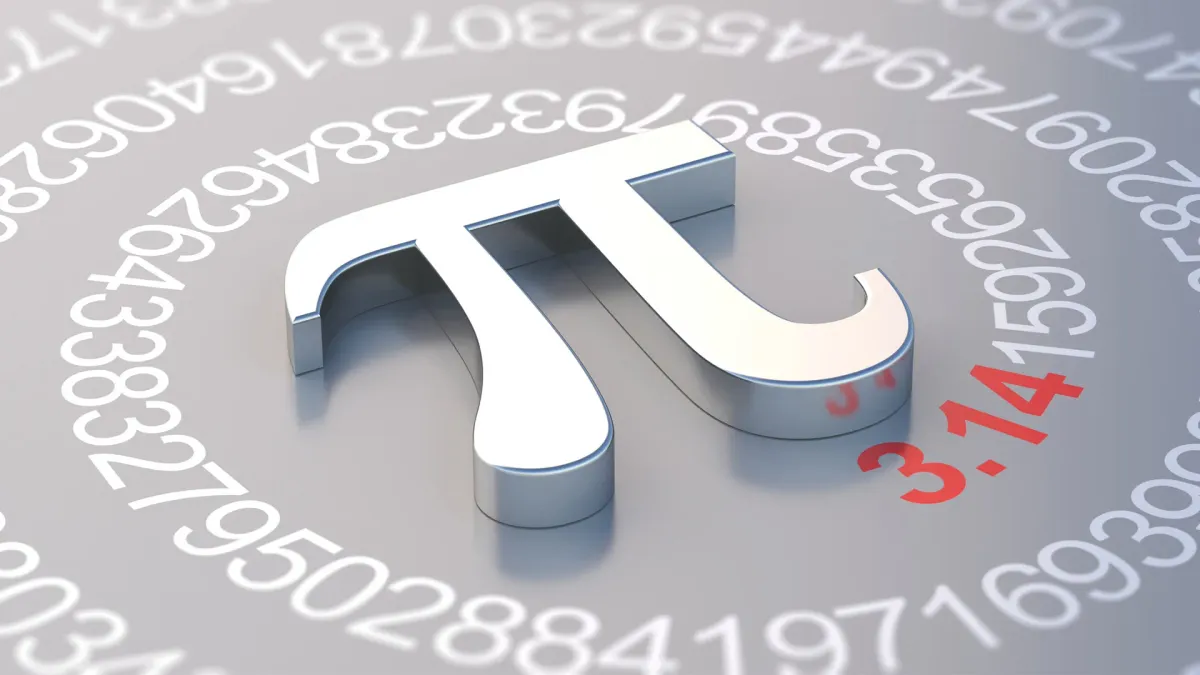
Pi is a famous number that never ends and never repeats. It is best known as 3.14. Computer engineers around the world challenge themselves to calculate as many digits of pi as possible.
A team from StorageReview, a technology testing company, recently set a new world record. They calculated 314 trillion digits of pi. This achievement happened just in time for Pi Day on March 14th.
This many digits are far more than what science needs. NASA's Jet Propulsion Laboratory only needs 37 digits of pi to calculate the universe's circumference with great accuracy. However, the race to extend pi continues. These massive calculations show how powerful and reliable modern computers can be.
We're a new kind of news feed.
Regular news is designed to drain you. We're a non-profit built to restore you. Every story we publish is scored for impact, progress, and hope.
Start Your News DetoxOne Machine, One Huge Calculation
Many past record attempts used large cloud networks. The StorageReview team did something different. Their entire calculation ran on a single machine. This was a Dell PowerEdge R7725 server. It ran continuously for about 110 days.
The server had two AMD EPYC processors, 1.5 terabytes of memory, and 40 high-capacity NVMe solid-state drives. Thirty-four of these drives ran special software called y-cruncher. This software is made to compute mathematical constants with extreme precision.
The software performed complex math operations to generate pi's digits. This created huge amounts of temporary data that had to be stored and retrieved constantly. The server worked day and night for nearly four months without stopping. It finally reached 314 trillion decimal places.
Kevin O Brien, lab director at StorageReview, said their run was unmatched in performance, power use, and reliability. He also noted it was the only large-scale pi record without any downtime.
The Challenge of Moving Massive Data
At such large scales, the biggest challenge is not the math itself. It is moving the data. Calculating trillions of digits creates huge temporary files. The speed of the storage system decides if the calculation succeeds or slows down.
To handle this, engineers connected the NVMe drives directly to the processors. They used high-speed PCIe lanes. This allowed data to move quickly without going through slower shared systems.
This setup provided about 280 gigabytes per second of bandwidth. This helped the machine process huge datasets efficiently. This focus on efficiency helped StorageReview break the previous record. That record was 300 trillion digits, set in 2025 by Linus Media Group and Kioxia. Their system was much larger and used more power.
The new run showed that smart system design can achieve bigger results. O Brien said their server used about 1,600W and 4,305 kWh in total. This is 13.70 kWh per trillion digits. This is much less energy than the previous 300T cluster.
Pi Pushes Machines Forward
Pi will never run out of digits, but the race to calculate them pushes computing technology forward. Huge pi calculations are like stress tests. They force processors, memory, and storage systems to run continuously under extreme workloads.
If there are weaknesses in hardware or software, these long calculations reveal them. This makes the record valuable beyond just math. Techniques developed for handling huge datasets and high-speed storage can help fields like scientific simulations, large-scale data analysis, and artificial intelligence.
The new record is 314 trillion digits. The gap between records has been shrinking fast. With faster processors and storage coming out every year, another team may soon push the digits even further. For pi, there is no finish line.