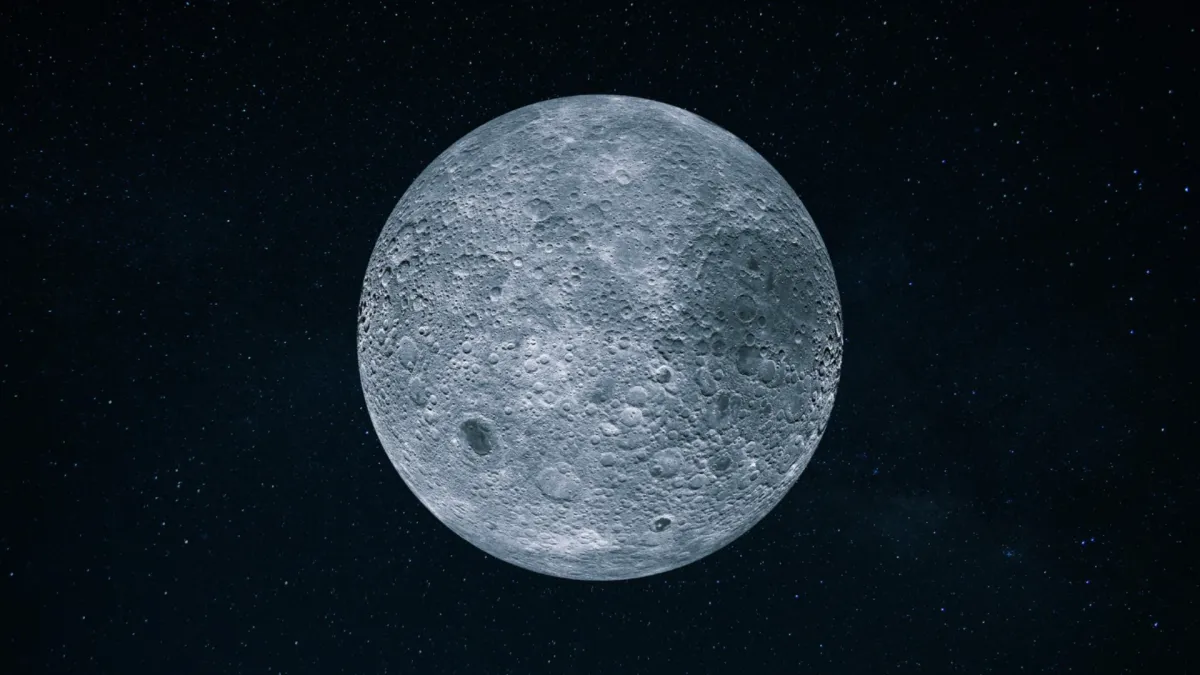
China's Chang'e-6 mission returned the first rocks ever collected from the Moon's far side. Now, AI has turned those four pounds of material into something far larger: a complete chemical map of a hemisphere that's been hidden from human study since the beginning of time.
Nearly half the Moon permanently faces away from Earth, which means traditional satellite imaging can't tell us much about it. The terrain is rougher, the minerals stranger, and the geological story entirely different from what we see from our planet. Until 2024, we had almost no direct samples from this side. That changed when Chang'e-6 touched down in the South Pole–Aitken basin—the Moon's largest impact crater, a scar nearly 1,550 miles across that formed billions of years ago.
Researchers at Shanghai's Institute of Technical Physics took those returned samples and did something clever. They trained an AI model on the chemical measurements and spectral data from the rocks, then fed it high-resolution images from Japan's Kaguya lunar orbiter. The result: the first precise global map of the Moon's major oxides—iron, titanium, aluminum, magnesium, calcium, and silicon—revealing how these elements are distributed across the entire far side.
We're a new kind of news feed.
Regular news is designed to drain you. We're a non-profit built to restore you. Every story we publish is scored for impact, progress, and hope.
Start Your News DetoxWhat the map actually shows
The chemistry tells a story of three distinct regions. There are the dark volcanic plains called "maria," the bright ancient highlands that make up most of the far side's crust, and the vast South Pole–Aitken basin itself. Each region has a different elemental signature, which means each has a different history.
This matters because the differences between the near and far sides are real and dramatic. The far side has less iron and titanium than the near side—the result of different volcanic activity billions of years ago. The near side, facing Earth, experienced more intense heating and melting. The far side stayed cooler, preserving a more ancient crust. These variations support a theory that's been floating around for decades: the Moon once had a global ocean of magma that cooled unevenly, creating a chemical divide between the two hemispheres.
What makes this breakthrough feel significant is how it connects AI to a fundamental human question. We've been staring at the Moon for millennia, but half of it remained essentially unknown. Now, in a single study, we've moved from "we have no idea" to "we have a precise map of its composition." That's not just incremental progress—it's a shift in what's knowable.
The practical applications are already clear. Future lunar missions need to know where to land. Water ice, rare minerals, and stable ground all matter for long-term bases. This chemical map provides the foundation for that planning. Scientists can now target sites based on actual knowledge rather than educated guesses.
What's next is the harder work: understanding what these chemical patterns mean for the Moon's early history, and using that knowledge to plan the next generation of lunar exploration. The far side is no longer a mystery. It's a destination we're finally ready to understand.