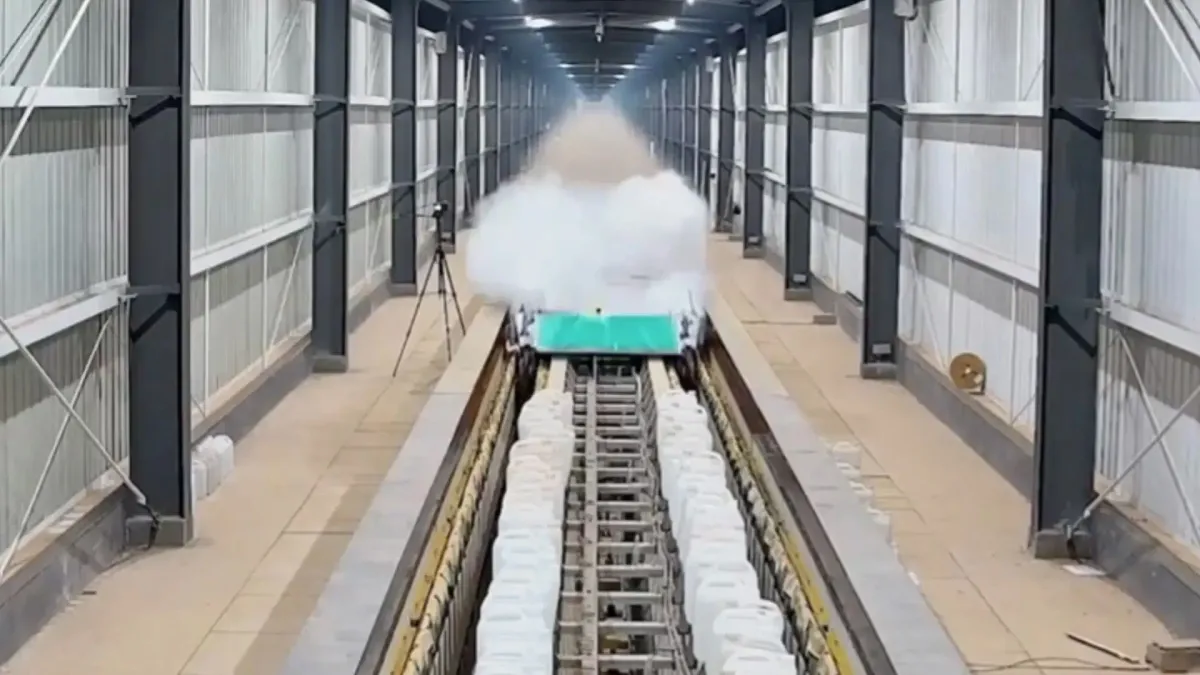
China has achieved what decades of US and Soviet efforts could not: a reliable supersonic electromagnetic launcher. In 2023, the system in Jinan accelerated one-ton test vehicles past Mach 1, and it's still running successfully more than two years later.
The breakthrough sounds simple in hindsight. The problem wasn't the launcher itself — it was that the sonic boom it generates at ground level is powerful enough to destroy any traditional sensor trying to measure what's happening. Lose your data stream at supersonic speeds, and a tiny miscalculation becomes catastrophic.
Instead of bolting on more hardware (the approach the US and USSR both tried), Chinese engineers at the Institute of Electrical Engineering built a "sensorless" system. The launcher reads its own speed by analyzing subtle variations in the electrical signals flowing through its segmented power coils. It's like the machine learning its own vital signs from the inside.
We're a new kind of news feed.
Regular news is designed to drain you. We're a non-profit built to restore you. Every story we publish is scored for impact, progress, and hope.
Start Your News DetoxThe technique fuses readings from multiple neighboring coils, filters out the noise from shock waves, and continuously recalibrates itself in real time. In testing, it tracked speed within 1.1% error at velocities up to 370 meters per second — precise enough to maintain stable control through the sound barrier.
Why this matters: electromagnetic launchers aren't just physics experiments. The Jinan facility is already supporting research into hypersonic flight, next-generation aerospace materials, and space launch systems. A reliable supersonic launcher opens doors that were previously locked.
The achievement also signals a shift in how engineering problems get solved. The US and USSR assumed you needed more sensors, more external hardware, more redundancy. China's team asked: what if the system could monitor itself. It's a different kind of thinking — and it worked.