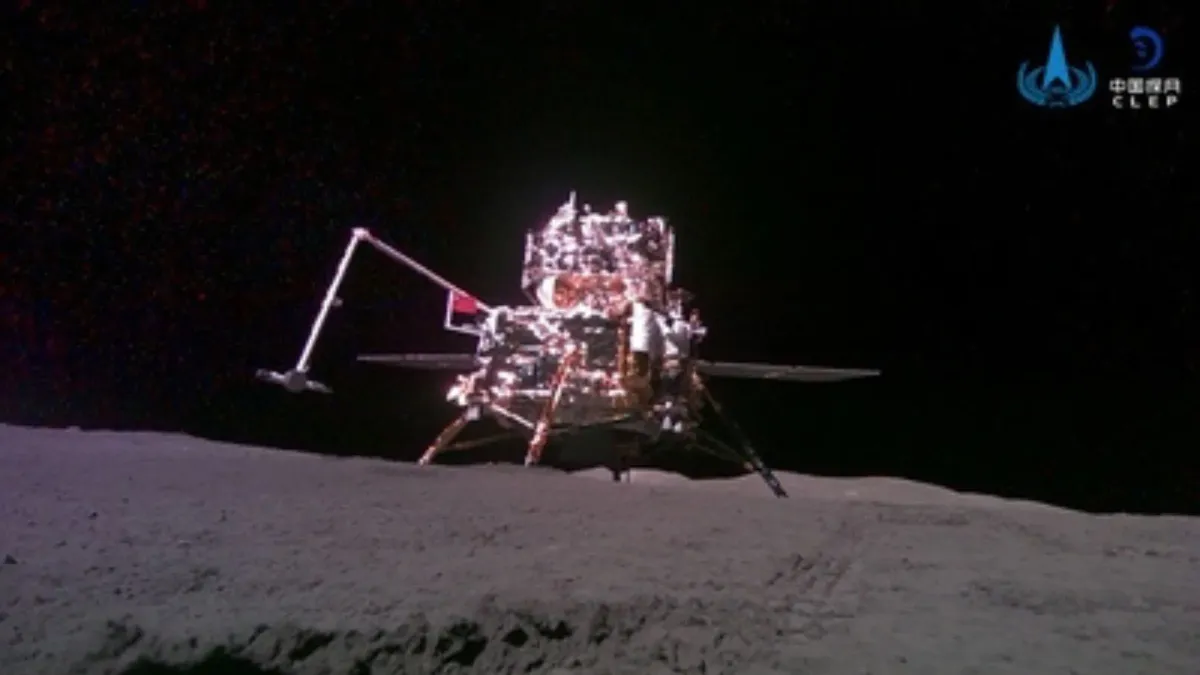
China's Chang'e-6 mission just upended what we thought was possible in materials science. Researchers from Jilin University found single-walled carbon nanotubes in lunar soil samples — the same sophisticated structures we've only ever made in carefully controlled labs on Earth. Until now, scientists assumed nature couldn't build something so perfectly engineered without human intervention.
But the Moon had other ideas.
These nanotubes are essentially cylinders made of a single layer of carbon atoms. On Earth, creating them requires vacuum chambers, precise temperature control, and metal catalysts like nickel or cobalt. It's expensive, finicky, and deeply dependent on human engineering. Yet there they were, in samples brought back from the far side of the Moon, sitting in lunar soil that's been battered by space for billions of years.
How the Moon became a natural nanofactory
The Moon doesn't have labs. It has violence. Micrometeorites slam into the surface at incredible speeds. Volcanic activity once raged across its landscape. Solar wind constantly bombards exposed rock. In these extreme conditions, something remarkable happened: carbon from meteorites and solar wind got vaporized by the heat of impact, then cooled rapidly. Local iron particles acted as natural catalysts, assembling the atoms into perfect tubes.
We're a new kind of news feed.
Regular news is designed to drain you. We're a non-profit built to restore you. Every story we publish is scored for impact, progress, and hope.
Start Your News DetoxIt's the same chemistry as our labs, but powered by cosmic collisions instead of electricity. Researchers used high-resolution microscopy to spot these nanotubes clustered around impact scars in tiny soil fragments — physical evidence that nature had done what we thought only we could do.
What makes this matter goes beyond satisfying scientific curiosity. Future lunar missions won't need to haul expensive electronics and sensors all the way from Earth. If we can learn to extract and process these nanotubes from lunar soil, we could build advanced materials right there — batteries, electronics, structural components — using what's already on the ground. It's the difference between bringing your own tools to a job site and discovering the tools are already waiting for you.
The findings also work in reverse. Understanding how the Moon naturally synthesizes these materials under harsh conditions could inspire cheaper, more efficient ways to manufacture nanotubes on Earth. We don't need to replicate the violence of space impacts, but the principles behind them might point toward simpler chemistry.
The research was published in Nano Letters and represents the first definitive identification of graphitic carbon nanostructures in lunar samples. As deep-space exploration accelerates, this discovery quietly suggests that the resources we need might already be waiting at our destination.