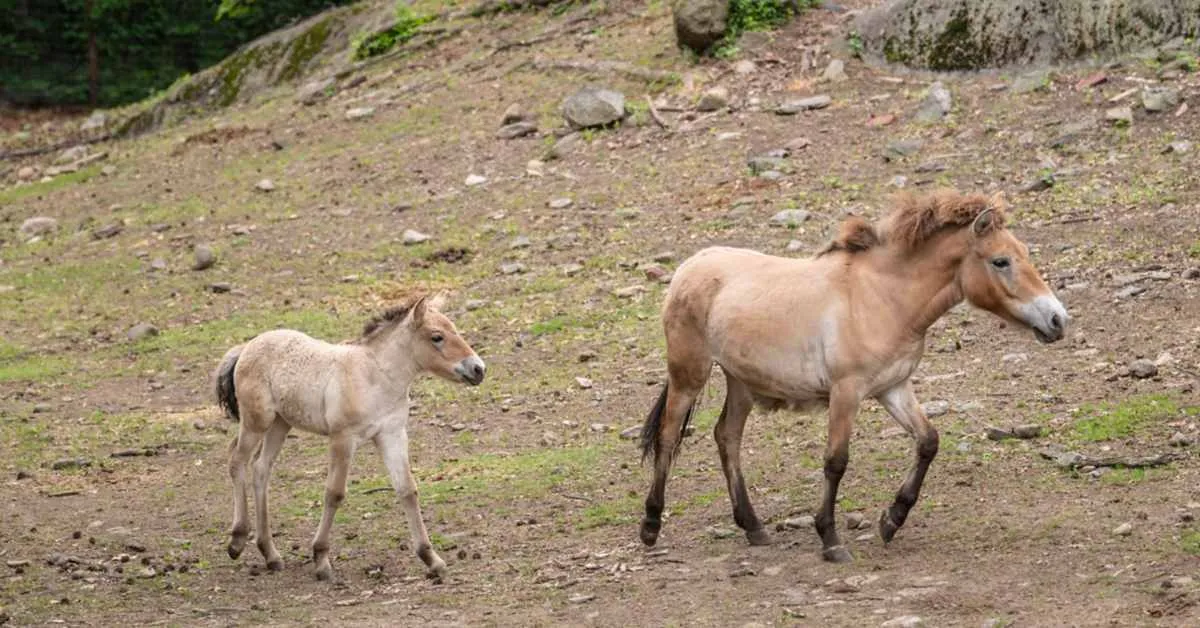
On April 21, the Bronx Zoo welcomed a new foal to its herd of endangered Przewalski’s horses. This birth is a big win for wildlife conservation. Fewer than 2,000 of these horses exist globally.
The Przewalski’s horse (Equus przewalskii) is often called the world’s last "truly wild" horse. It split from domestic horses over 5,000 years ago.
Compared to typical horses, Przewalski's horses are small and stocky. They have a large head, thick neck, and short legs. Their coats are dusky brown with yellowish-white bellies and dark legs. They also have stripes behind their knees and a zebra-like mane instead of a forelock.
We're a new kind of news feed.
Regular news is designed to drain you. We're a non-profit built to restore you. Every story we publish is scored for impact, progress, and hope.
Start Your News DetoxBringing Back a Wild Horse
Przewalski’s horses once lived across Europe and Asia. But human settlements pushed them east. Eventually, they were only found in the Mongolian steppes of the Gobi Desert.
By 1969, the Przewalski's horse was declared extinct in the wild. Conservation efforts then focused on captive breeding.
The Wildlife Conservation Society (WCS) explained that breeding programs helped maintain a diverse population. Thanks to these efforts, zoo-bred horses were returned to China in 1989 and Mongolia in 1992.
Today, all Przewalski's horses, including the new foal at the Bronx Zoo, come from just 14 individuals. The Bronx Zoo has played a key role in saving this species, also known as the Mongolian wild horse.

Reintroduction Efforts
Captive breeding is only one part of the conservation plan. Reintroducing these horses to the wild is also vital.
In 2024, three Przewalski’s horses named Zorro, Zeta II, and Ypsilon traveled 3,000 miles. They went by truck and plane from the Prague Zoo to the Altyn Dala reserve in the Kazakh Steppe. These were the first of 40 horses planned for the reserve.
Albert Salemgareyev from the Association for the Conservation of Biodiversity in Kazakhstan said they had waited a long time for this moment. Much work went into bringing the horses to Kazakhstan.
Conservationists hope this reintroduction will boost the horse population. It should also help restore the steppe ecosystem. The horses spread seeds, graze vegetation, and help maintain biodiversity in the grasslands.
For now, the horses live in protected areas. Veterinarians and researchers monitor their health and behavior. Experts will continue to watch them after their full release to ensure they thrive.
Pavol Šepel’ák, an ambassador of the Czech Republic, expressed happiness about returning this beautiful animal to its habitat. He noted the project has already seen great success.