Scientists at CERN just solved a 20-year mystery about missing light from distant galaxies — and the answer came from creating plasma fireballs in a particle accelerator.
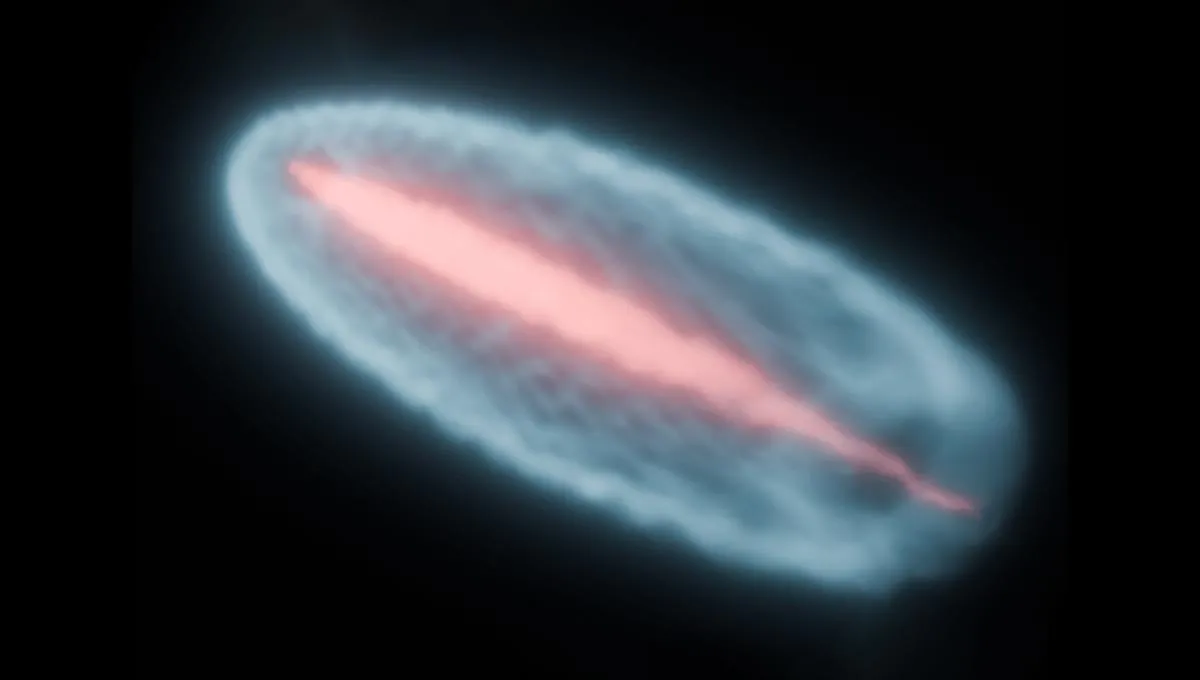
For decades, astronomers have been puzzled by blazars, the most violent objects in the universe. These are galaxies with supermassive black holes at their centers, firing beams of particles and radiation nearly as fast as light directly toward Earth. When these jets release gamma rays with energies in the teraelectronvolt range (a trillion times more energetic than visible light), telescopes on the ground can detect them. But when scientists calculate what should happen next — those gamma rays colliding with starlight as they cross intergalactic space — the math predicts a secondary signal that should arrive at Earth. Fermi and other gamma-ray satellites have been looking for this signal for two decades. They've found almost nothing. The question became: where is all that light going?
Two competing theories
Physicists had two main ideas. The first: weak magnetic fields scattered between galaxies are deflecting the secondary gamma rays away from Earth, like a cosmic shell game. The second: the particle beams themselves become unstable as they travel through the thin plasma of intergalactic space, generating their own magnetic fields that drain energy from the jet before it can produce the expected signal.
We're a new kind of news feed.
Regular news is designed to drain you. We're a non-profit built to restore you. Every story we publish is scored for impact, progress, and hope.
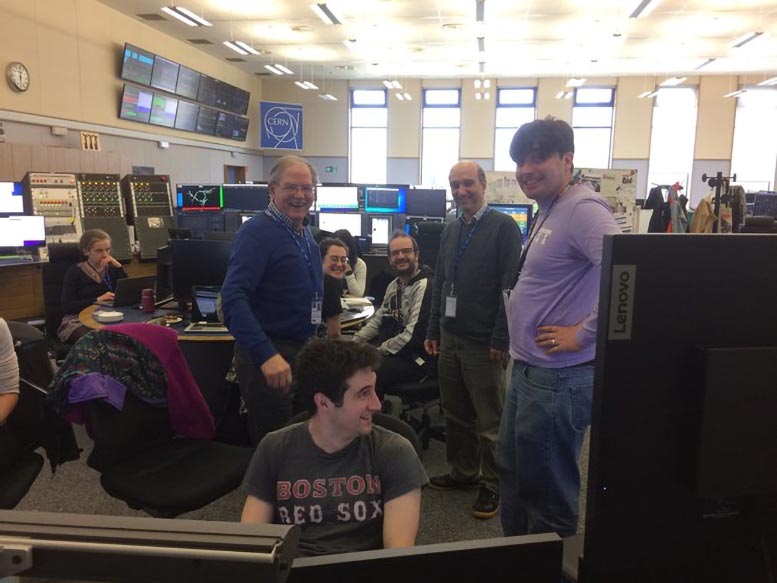
Start Your News DetoxTo test which theory was right, a team led by the University of Oxford did something audacious. They recreated the conditions of a blazar jet inside CERN's Super Proton Synchrotron accelerator in Geneva. Working with colleagues at the Science and Technology Facilities Council's Central Laser Facility, they fired beams of electron-positron pairs through a meter-long region of plasma — a scaled-down laboratory version of what happens across billions of light-years.
The result was unexpected. Instead of the beam spreading out, fragmenting, or generating magnetic fields as the instability theory predicted, it stayed narrow and almost perfectly parallel. The beam was stable.
When the researchers scaled these findings up to cosmic distances, the math showed that plasma instabilities are far too weak to account for the missing gamma rays. That means the first theory — intergalactic magnetic fields — is more likely correct. The universe, it seems, is threaded with magnetic fields that originated in the early universe and are still deflecting light today.
But this raises a new puzzle. The early universe should have been remarkably uniform, making it hard to explain how widespread magnetic fields got there in the first place. Solving that problem might require physics beyond what we currently understand. The next generation of observatories, including the upcoming Cherenkov Telescope Array, should help test these ideas and narrow down what happened in those first moments after the Big Bang.
For now, the experiment shows something just as important: the most exotic questions about the cosmos can be tackled in a laboratory on Earth, with the right equipment and the right international collaboration.