Princeton researchers just cracked why grasshoppers are better at flying than the robots we've been building to mimic them. And it comes down to knowing when to stop flapping.
Most insect-sized robots are modeled after bees — creatures that flap continuously to stay airborne. The problem: that constant flapping drains batteries so fast that these micro-bots need to recharge almost immediately after takeoff. A battery powerful enough to sustain it often weighs more than the robot itself.
Grasshoppers do something smarter. They jump, they flap, and then they glide. That gliding phase is what researchers call "cheap flight" — it lets the robot coast on momentum while the battery rests. Aimy Wissa, an associate professor of mechanical and aerospace engineering at Princeton, led a team that decided to reverse-engineer this approach.
We're a new kind of news feed.
Regular news is designed to drain you. We're a non-profit built to restore you. Every story we publish is scored for impact, progress, and hope.
Start Your News DetoxHow a Grasshopper's Wing Works
The team started with high-resolution CT scans of grasshopper hindwings. What they found was elegant: accordion-style folds that let the wings tuck away tight against the body for jumping and crawling, then deploy with minimal drag when it's time to glide. It's a mechanical design that balances two completely different jobs.
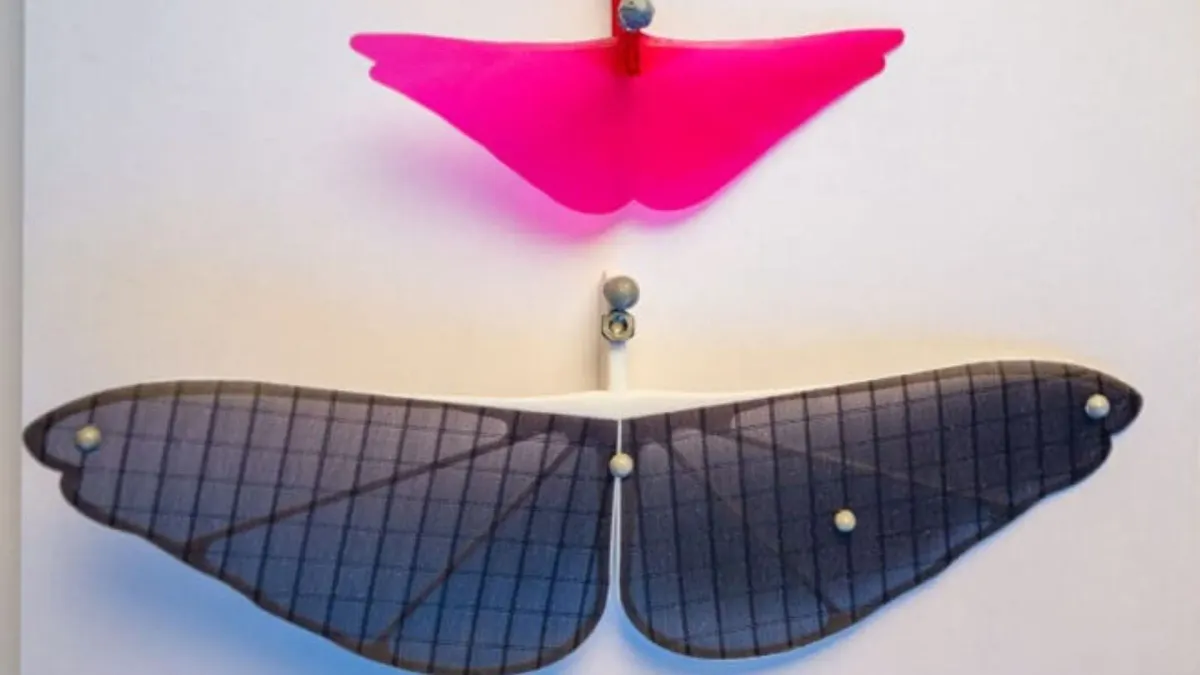
To test whether this could actually work in a robot, the researchers 3D-printed wing designs and submerged them in water channels. Water flow let them map the aerodynamics precisely, refining each curve. Then came the real test: attaching these synthetic wings to lightweight frames and launching them across the lab.
High-speed cameras tracked every movement. The result: their gliders matched the efficiency of real biological grasshoppers. Flight performance, replicated in plastic and aluminum.
One surprise emerged during testing. Real grasshopper wings are corrugated — ridged like a tin roof — but the team's smooth wings actually glided more efficiently. "This showed us that these corrugations might have evolved for other reasons," Wissa noted, possibly to help the wings fold or handle steep angles. Sometimes biology optimizes for multiple problems at once, and we only see one of them.
The next hurdle is automation. Right now, the wings need manual deployment. The team is working on a system that can fold and unfold these wings without adding heavy motors — the weight would defeat the entire purpose. If they solve that, rescue robots won't just buzz around a disaster site. They'll jump over rubble, crawl through tight spaces, and glide across open ground. All on a single charge.
The study was published in the Journal of the Royal Society Interface in early January.