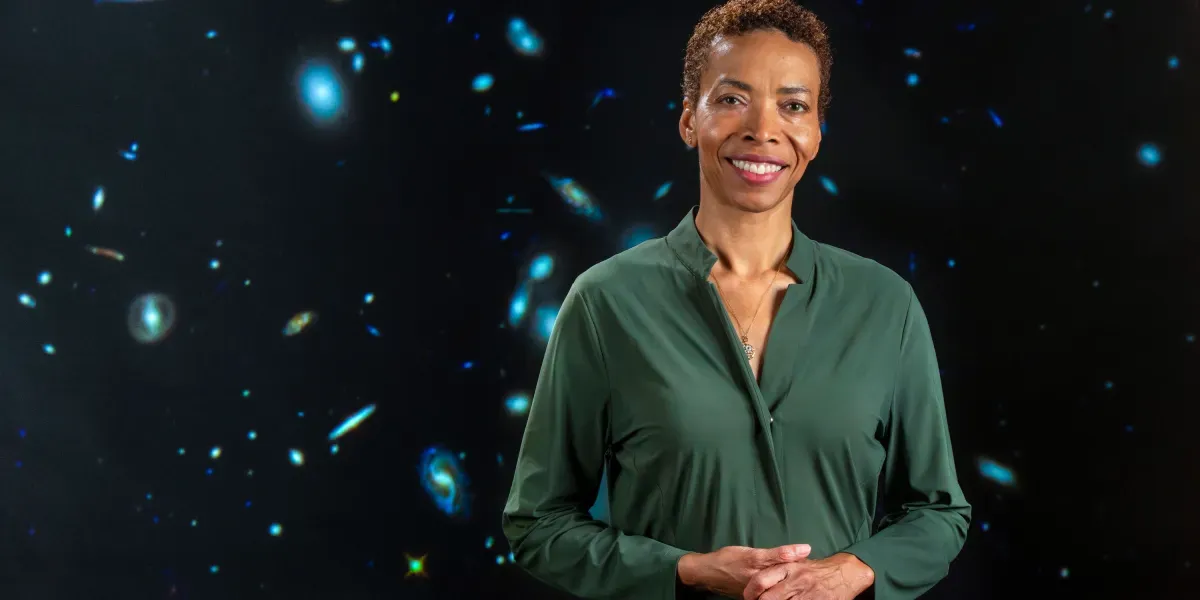
Aomawa Shields looks for life on distant planets for a living. But the path to that work took her through acting, heartbreak, and a decade away from science—and it's that winding route that makes her particularly good at what she does now.
Shields is an associate professor of physics and astronomy at UC Irvine, where she runs a research team using climate models to explore whether exoplanets—planets orbiting distant stars—could support life. She's also published a memoir, given a TED talk that's been viewed nearly 2 million times, launched an educational program for young girls interested in space, and won multiple prestigious academic awards. She plays violin, practices yoga nidra, and is raising a young child. She also somehow sleeps.
The long way around
The astronomer's journey began in the dark of a movie theater. At 12, Shields watched SpaceCamp, a 1980s comedy about kids accidentally launched into space, and decided she wanted to be an astronaut. A few years later, she saw Top Gun and was captivated by Charlotte Blackwood, the astrophysicist character who was, as Shields remembers, "very glamorous, too."
We're a new kind of news feed.
Regular news is designed to drain you. We're a non-profit built to restore you. Every story we publish is scored for impact, progress, and hope.
Start Your News DetoxBut at MIT—where she'd enrolled specifically to pursue astronomy—something shifted. She struggled academically at first and found refuge in the arts, singing in an a cappella group and performing in plays. By senior year, she was genuinely torn: acting or astronomy.
She chose astronomy and headed to graduate school at the University of Wisconsin–Madison. Then a white male professor told her to consider other career options. "That was hard to hear," she says. "I'm going to the other dream because clearly someone's telling me that I don't belong here. Maybe they're right."
She applied to UCLA for an MFA in acting and left astronomy behind for more than a decade. She had some success—a film called Nine Lives screened at Sundance—but the real blow came when she was cast as host of the show Wired Science, only to lose the job when producers decided to change presenters. Around the same time, she applied to NASA's astronaut program and didn't make the first cut.
Then, while working odd jobs to supplement her acting gigs, a mentor pointed her toward a job posting: help desk operator at the Spitzer Space Telescope. It only required a bachelor's degree. "I'd refer the harder questions to the PhDs," she says. "But by taking that job, I got to go to astronomy talks again."
The field had transformed in her absence. Exoplanet research had exploded. She emailed Neil deGrasse Tyson, who told her plainly: without a PhD, she wouldn't have credibility in science television. The message was clear. She went back to school and earned her doctorate in astronomy and astrobiology in 2014 from the University of Washington.
Looking outward
Astrobiology is relatively young—it studies the origin, evolution, and distribution of life across the universe. It's deeply interdisciplinary. Shields explains: "There are astronomers looking for these planets, and also chemists and biologists and oceanographers and geologists who tackle these questions from their own lens. That's why I love it. We don't have to get 15 PhDs. We get to collaborate."
Since the early 1990s, astronomers have discovered 6,000 exoplanets. Hundreds are Earth-sized. A much smaller subset orbit in the "habitable zone"—close enough to their star to keep water liquid, but not so close that it boils away. So far, roughly 100 planets fit that description. The James Webb Space Telescope, launched in 2021, could identify many more by detecting "biosignatures": particular gases in atmospheres or reflections that might indicate water on a surface.
Shields and her team use climate models—the same tools that forecast Earth's weather—to explore parameter space. They feed in observations from telescopes, then test different combinations of variables: what kind of light the planet receives, what its atmosphere might contain, its orbital characteristics. "There's only so much you can tell from telescope information," she explains. "We can explore that parameter space and say: if it has this surface composition, this is what the temperature would be like. This is how habitable it would be across its surface."
The universe contains roughly 10^22 stars across 100 billion galaxies. Most stars have at least one planet orbiting them. "The likelihood that only Earth was able to produce life," Shields says, "I think is pretty low."
The practice of stopping
But looking outward at such scale can exact a cost. When her work schedule became overwhelming, Shields's health suffered. She discovered yoga nidra—an ancient meditation practice that induces a deeply restful state—and trained to become a certified facilitator. She's now working to introduce the practice to academic culture as a daily discipline.
"It's been important to me to share it broadly," she says, "to really try to do my part to introduce the notion of resting as a daily practice."
It's a fitting counterbalance for someone whose mind regularly hurtles to the farthest reaches of the universe. The girl who once wondered if anyone was looking back at her from the stars now helps others learn to look inward.