For over a century, biologists thought lizard armor was ancient — inherited from distant ancestors and occasionally lost. A new study from Museums Victoria Research Institute has upended that assumption entirely.
Researchers analyzing 643 living and extinct species discovered that most lizard bony plates, called osteoderms, didn't come down through inheritance. Instead, they evolved independently at least 13 times across different lizard lineages, often millions of years after ancestors had abandoned them. Some lizards didn't just re-evolve armor — they refined it into lighter, more flexible versions suited to new environments.
The clearest example happens in Australia's monitor lizards, or goannas. These animals lost their armor around 72 million years ago when they shifted to a faster, pursuit-hunting lifestyle that favored speed over heavy plating. Then, roughly 17 to 20 million years ago during the Miocene, several Australian and Papuan monitor lineages evolved armor again — but this time as a lighter form, possibly to reduce water loss in arid regions or reinforce their bodies for climbing and defense.
We're a new kind of news feed.
Regular news is designed to drain you. We're a non-profit built to restore you. Every story we publish is scored for impact, progress, and hope.
Start Your News Detox"This discovery also underscores Australia's role as a hot spot for evolutionary oddities," said Roy Ebel, lead author at MVRI and the Australian National University. "A place where marsupials dominate, where mammals lay eggs, and now, where the only known comeback of reptile osteoderms has occurred."
How researchers traced 320 million years of armor
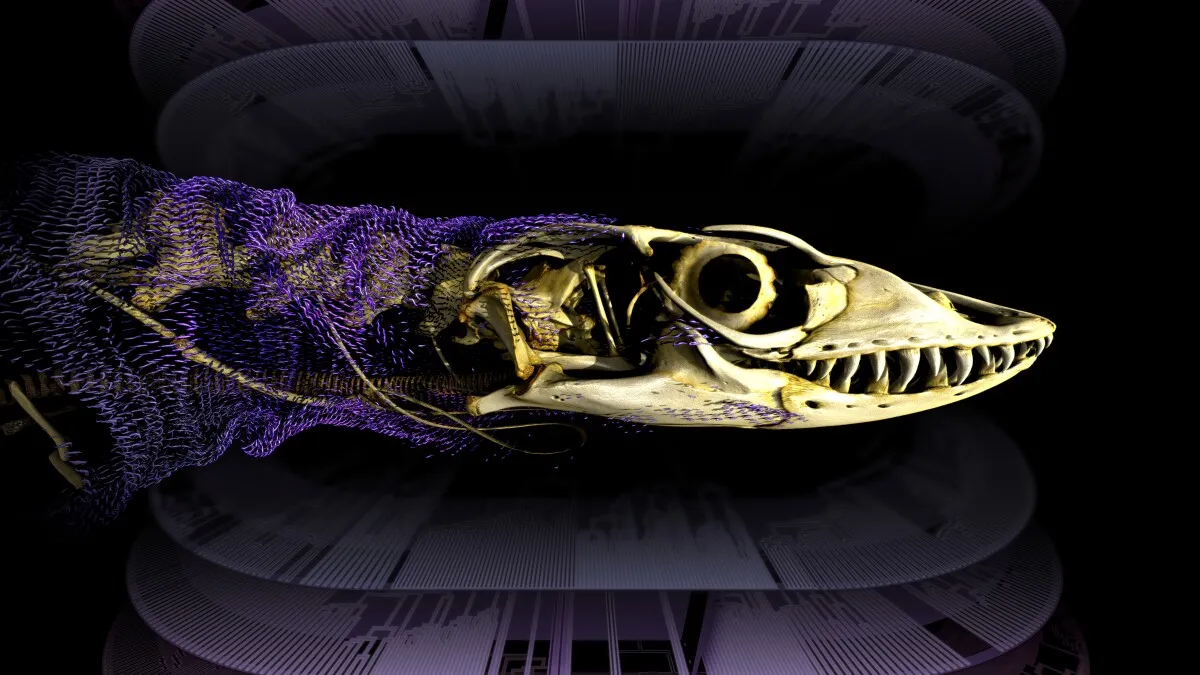
The team used CT-scan data, fossil records, and molecular analysis to reconstruct osteoderm history across squamate reptiles — the group containing lizards and snakes — over 320 million years. What they found was surprising: the earliest lizard ancestors almost certainly had no armor at all. For tens of millions of years after lizards first appeared, they remained unarmored.
Then, in a relatively narrow window around 140 million years ago during the Late Jurassic and Early Cretaceous, armor suddenly appeared in multiple lineages almost simultaneously. Once osteoderms showed up in a lizard group, they usually stayed put. Loss was rare. Comeback was rarer still.
But osteoderms do far more than protect against bites and claws. These bony plates form within skin rather than as part of the skeleton, and they regulate temperature, store calcium, retain water, and even help neutralize acid buildup during long periods underwater. That versatility may explain why they keep getting reinvented.
The findings create an odd pattern: a Gila monster from the US and a shingleback lizard from Australia look nearly identical in their armor, but they arrived at that similarity through completely different evolutionary paths. It's convergent evolution — the same solution discovered twice, independently.
This mirrors how flight evolved at least four separate times in insects, pterosaurs, birds, and bats. Nature, it seems, can solve the same problem in different ways when the conditions demand it.
The research, published in the Biological Journal of the Linnean Society, provides a foundation for understanding not just why osteoderms reappear, but how — what genetic and developmental switches allow armor to evolve repeatedly across different lineages for different reasons. Understanding those mechanisms could reshape how scientists think about evolutionary flexibility and adaptation.