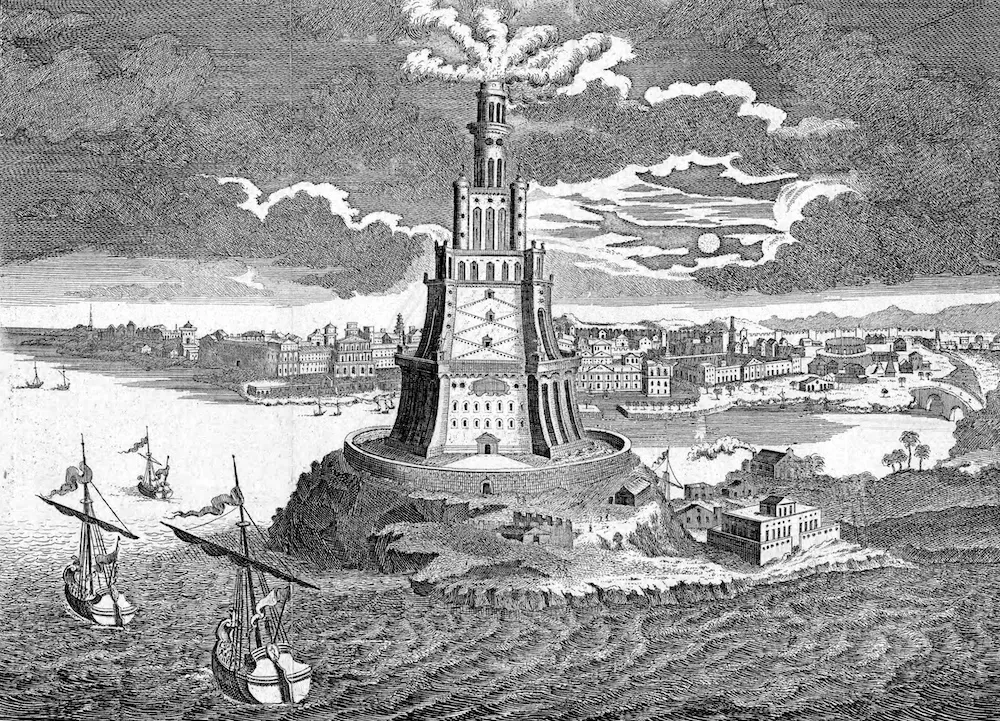
The Lighthouse of Alexandria stood 460 feet above the Mediterranean, second only to the Great Pyramid in height. For centuries, it guided ships into Egypt's most important harbor — until a 1303 earthquake toppled it into the sea.
Now, nearly 750 years later, a team of archaeologists, architects, and programmers is bringing it back, one digital fragment at a time.
Piecing Together a Wonder
Isabelle Hairy, an archaeologist at France's National Center for Scientific Research, leads the Pharos Project — an effort to reconstruct the ancient structure in 3-D. The challenge is immense. The lighthouse's remains are scattered across 18 acres of seabed, buried under rising water and shifting sediment. Last summer, the team used a crane to haul granite blocks and architectural pieces to the surface, where they could be scanned and digitally positioned.
We're a new kind of news feed.
Regular news is designed to drain you. We're a non-profit built to restore you. Every story we publish is scored for impact, progress, and hope.
Start Your News DetoxOne discovery stood out: a pylon that fused Greek construction techniques with Egyptian design — a physical reminder that Alexandria, built by Ptolemy I Soter (a Macedonian general under Alexander the Great) and completed by his son Ptolemy II, was where two cultures met. For 300 years under the Ptolemaic dynasty, the city was the center of Greek learning in Egypt.
The original lighthouse was ingeniously designed: rectangular at the base, octagonal in the middle, cylindrical at the top. Mirrors and a furnace reflected light across the harbor, a technological marvel of the ancient world.
The Long Work Ahead
So far, the team has scanned roughly 5,000 building elements and artifacts from the seafloor. But the Mediterranean isn't cooperating. Visibility is poor, the seabed is uneven, and sediment layers that might help date and place objects are muddled. Future scans will likely require lifting more material from the water — a painstaking process that Hairy estimates will take generations to complete.
What emerges from this work won't be the lighthouse itself, but something equally valuable: a record of how it stood, how it was built, and how it connected two worlds. In an age when digital reconstruction can preserve what the sea has claimed, the Pharos of Alexandria gets a second life.