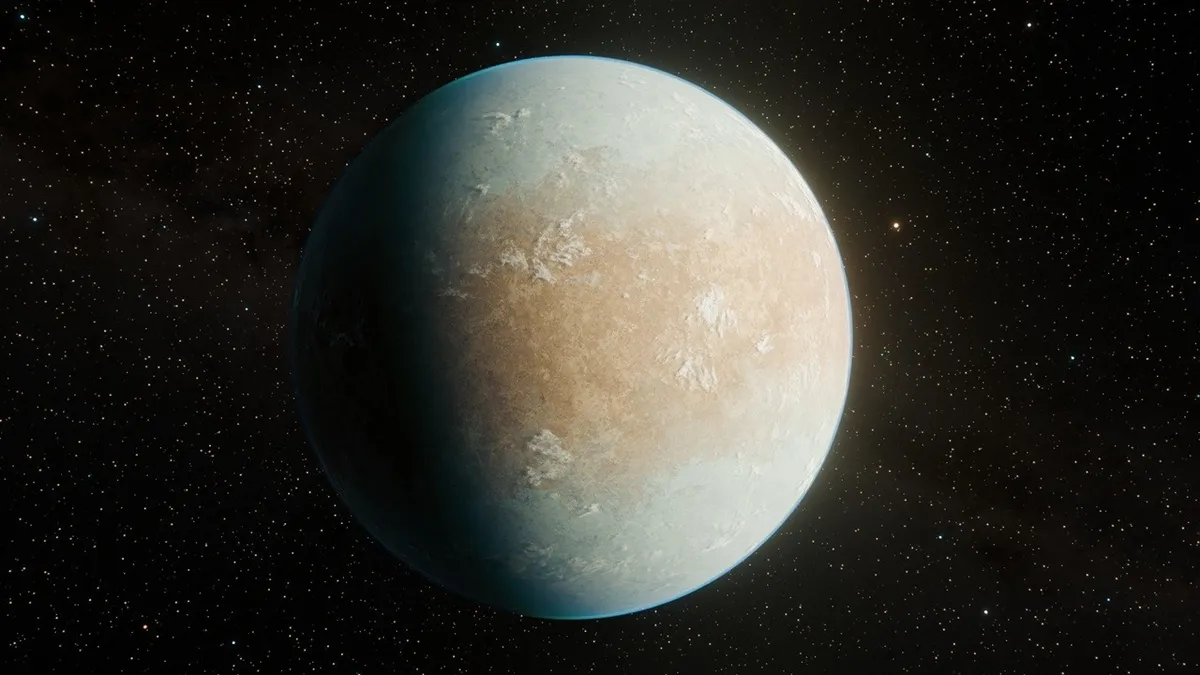
Astronomers working with data from NASA's retired Kepler Space Telescope have identified a promising candidate: a rocky planet slightly larger than Earth, orbiting a Sun-like star in the constellation Boötes. The planet, called HD 137010 b, sits about 146 light-years away—far enough that we're seeing light from when Shakespeare was still writing plays.
What makes HD 137010 b intriguing is its orbit. It takes about a year to circle its star, just like Earth does around the Sun. It also sits near the edge of what astronomers call the "habitable zone"—the orbital sweet spot where a planet could theoretically hold liquid water. But there's a catch: this world receives only about a third of the heat and light that Earth gets. Surface temperatures could plunge to -90°F (-68°C), making it colder than Mars, which we think of as a frozen wasteland.
So why does this icy candidate matter? Because it expands what we think is possible. For decades, the search for habitable exoplanets has focused on planets receiving roughly Earth-like amounts of stellar heat. HD 137010 b suggests we might be missing entire categories of worlds—ones that could harbor life in ways we haven't fully imagined.
We're a new kind of news feed.
Regular news is designed to drain you. We're a non-profit built to restore you. Every story we publish is scored for impact, progress, and hope.
Start Your News DetoxThe key word here is "candidate." HD 137010 b hasn't been confirmed yet. Astronomers spotted it in Kepler's archived data using statistical methods, but seeing the actual planet cross in front of its star—what's called a transit—would be the definitive proof. These transits are rare and faint, which is why the discovery remains tentative. Future telescopes like NASA's TESS and the European Space Agency's CHEOPS mission should be able to catch these rare moments and either confirm HD 137010 b or rule it out.
There's also a genuine uncertainty about whether this world could actually support life. If it has a thick atmosphere rich in carbon dioxide, it could trap enough heat to create a temperate, possibly watery surface despite the distant star. The researchers estimate a 40–51% probability the planet falls within the habitable zone. That's real uncertainty—not a flaw in the science, but an honest acknowledgment that we're working with incomplete information.
What this discovery really shows is how much we're learning to read between the lines of old data. Kepler stopped collecting observations in 2018, yet scientists continue mining its archive for worlds we missed the first time. Each candidate, even the frozen ones, teaches us something about where life might exist in the universe.