Three and a half million years ago, two distinct hominin species shared the same stretch of Ethiopian landscape. One climbed trees with flexible toes and an opposable big toe. The other walked upright in a subtly different way, pushing off on its second digit. They ate different foods. They moved through the world differently. And yet they coexisted, side by side.
This discovery, confirmed by a team led by paleoanthropologist Yohannes Haile-Selassie at Arizona State University, reveals something profound about how human ancestors adapted to survival: there was never just one way to be human.
The evidence comes from foot bones discovered in 2009 at Burtele in Ethiopia. Researchers have now determined these 3.4-million-year-old fossils belong to Australopithecus deyiremeda—a species that lived at the same time as Australopithecus afarensis, the species of the famous fossil Lucy. The Burtele Foot, as scientists call it, is more primitive than Lucy's species in crucial ways. Its toes were longer, more flexible, better suited for gripping branches. But when this ancestor needed to move across open ground, it did so in its own particular way.
We're a new kind of news feed.
Regular news is designed to drain you. We're a non-profit built to restore you. Every story we publish is scored for impact, progress, and hope.
Start Your News DetoxDifferent diets, different paths
Geochemist Naomi Levin from the University of Michigan analyzed the chemical composition of teeth from both species. The results showed something striking: these two hominins ate different foods, reflecting fundamentally different strategies for surviving in the same environment. One species exploited resources the other didn't. One adapted to certain niches while the other adapted to others. Competition didn't eliminate one in favor of the other—instead, they found ways to coexist.
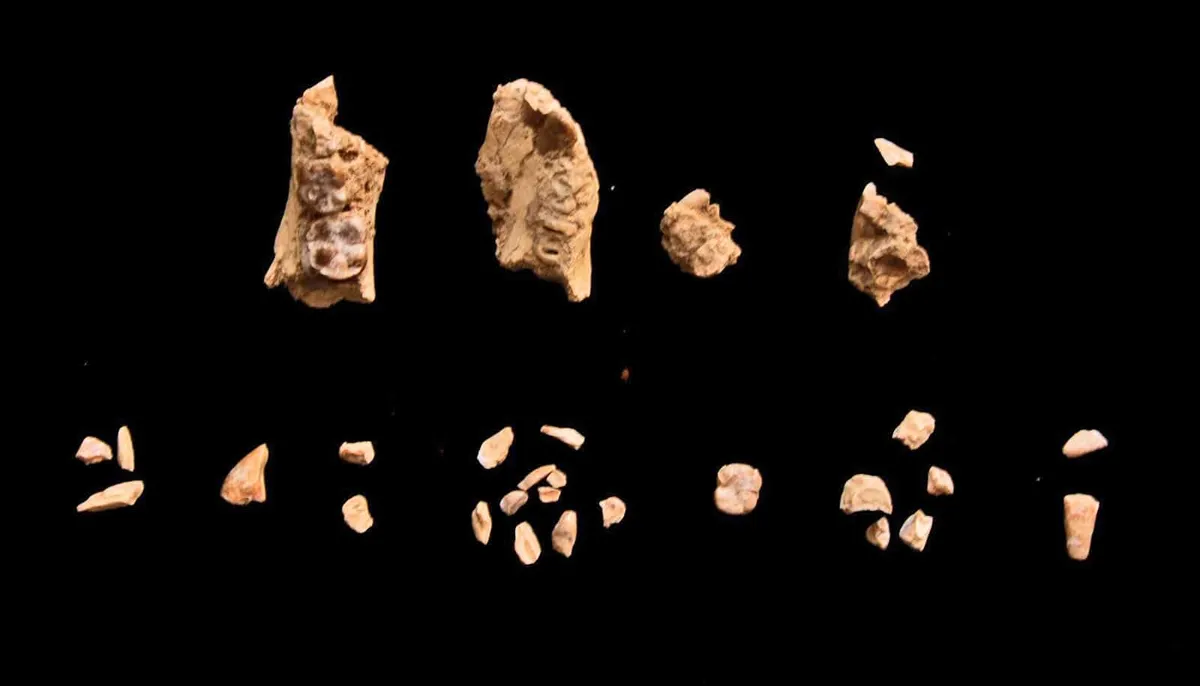
Along with the foot bones, researchers discovered 25 teeth and the jaw of a juvenile A. deyiremeda, confirming this wasn't a one-off find but evidence of a thriving population. What's remarkable is how similar these two species were in their development and growth, even as their anatomy and diet diverged sharply.
"Bipedality—walking on two legs—in these early human ancestors came in various forms," Haile-Selassie explains. "There was not just one way until later."
This matters more than it might seem. We often imagine human evolution as a ladder, each species climbing toward us. But the reality is messier and more interesting: multiple solutions to the same problem, multiple ways of being alive, existing in parallel. Some worked better than others over time. Some disappeared. But for a moment—a geological moment—they coexisted.
The climate during this period was warmer than today, with CO2 levels nearly matching our own. These ancestors lived in a world that was changing, and they responded by diversifying their strategies. Some became better climbers. Others became better walkers. Some specialized in one food source. Others in another.
"If we don't understand how humans have interacted with the environment going back in time, we have no perspective on today," Levin says. The lesson isn't abstract. As our own climate shifts and our world changes, we face a question these ancient ancestors answered through sheer biological creativity: how do you survive when everything around you is in flux. The answer, it seems, is adaptation—not just one kind, but many.