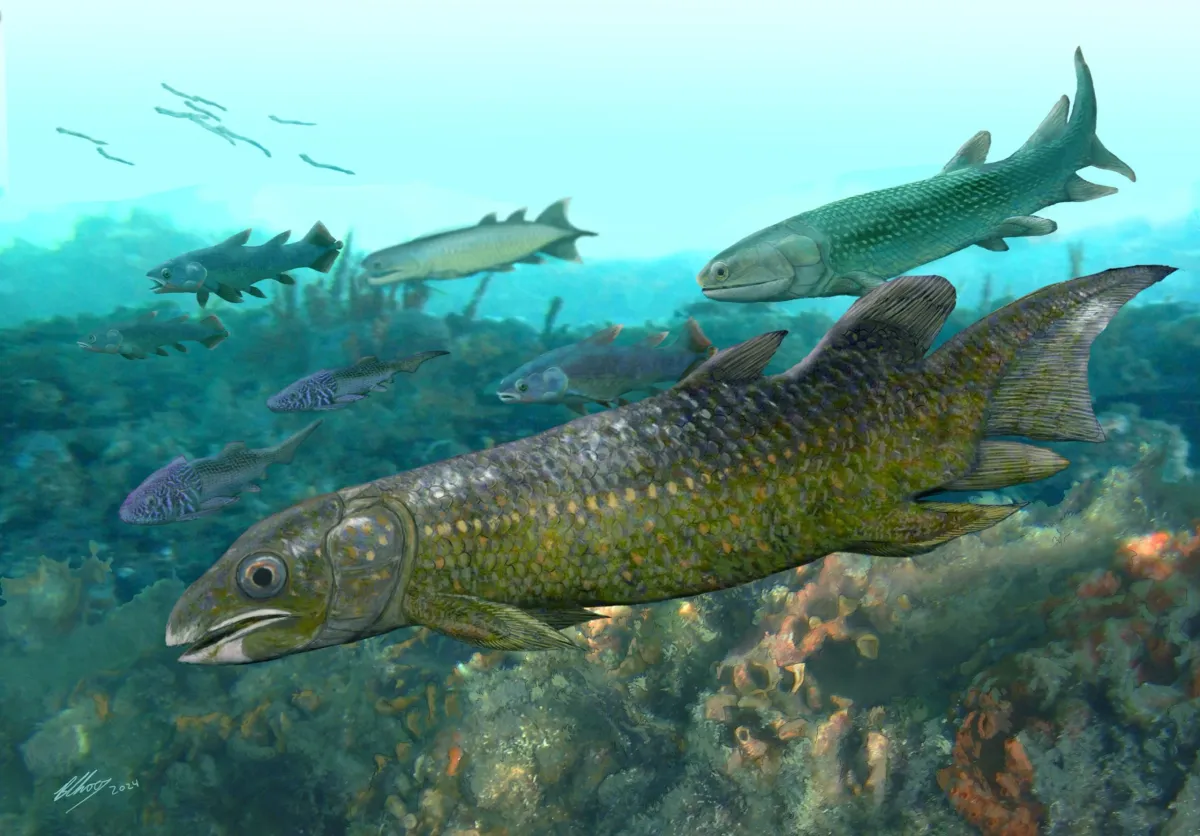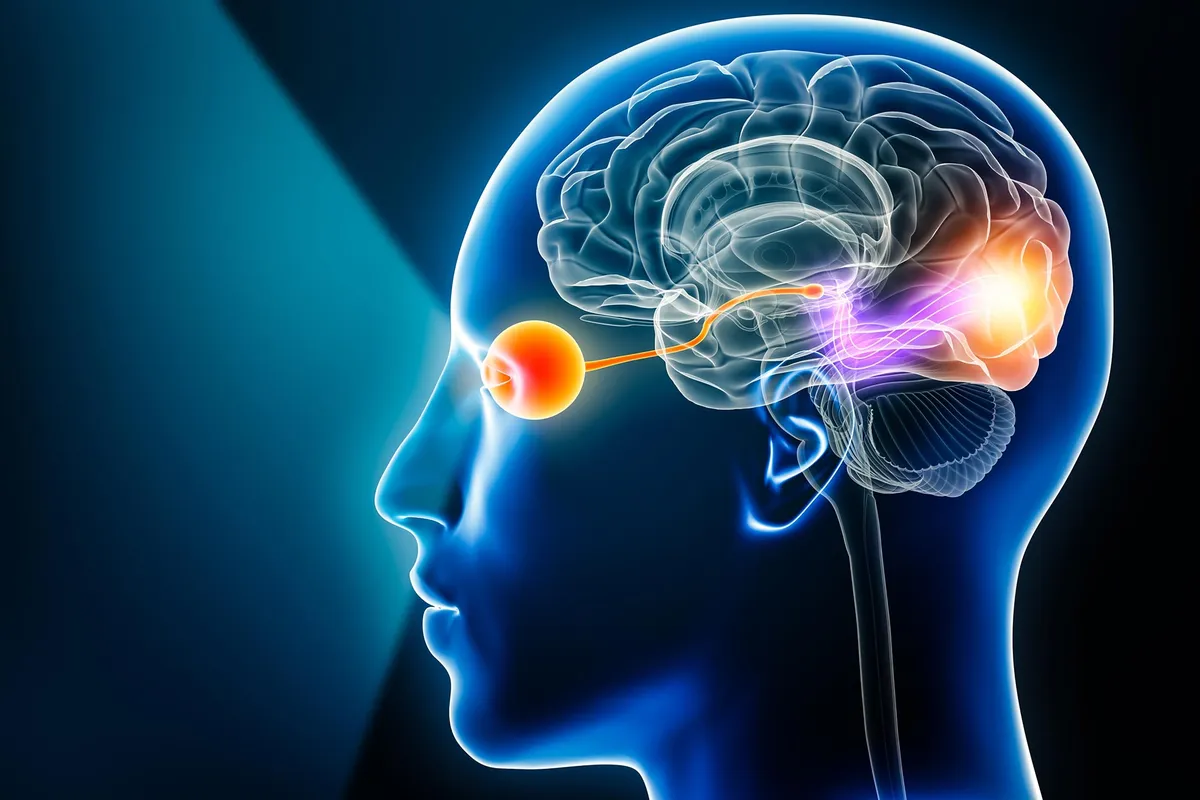
Your ability to notice a movement in your peripheral vision, to lock onto a face in a crowd, to spot danger before you consciously register it — that's not your advanced brain at work. It's ancient hardware, over 500 million years old, doing exactly what it evolved to do.
A new study published in PLOS Biology reveals that the superior colliculus, a brain structure so old it exists in virtually every vertebrate, doesn't just relay visual information to the cortex. It processes and filters it independently, deciding which objects matter and which can be ignored. The cortex, for all its sophistication, isn't the brain's only visual intelligence.
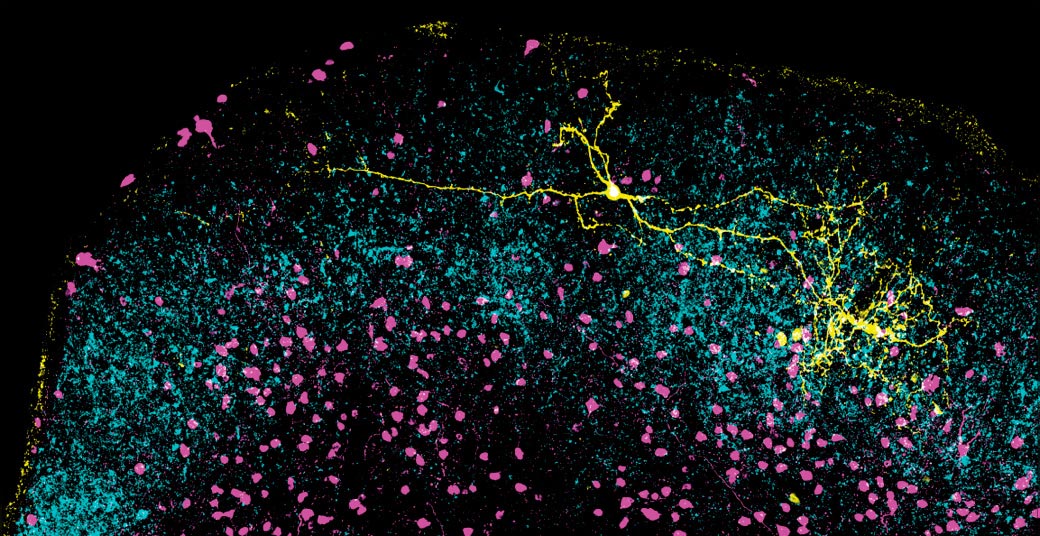
Inhibitory neuron (yellow) extends across the superior colliculus, forming a complex network that may help suppress surrounding visual signals. Retinal ganglion cell terminals are shown in cyan, and other inhibitory neurons are labeled in magenta. Confocal image by Peng Cui. Source: PLOS Biology. Credit: Instituto de Neurociencias UMH CSIC
We're a new kind of news feed.
Regular news is designed to drain you. We're a non-profit built to restore you. Every story we publish is scored for impact, progress, and hope.
Start Your News DetoxThe brain's built-in visual radar
Think of the superior colliculus as a biological early-warning system. It receives signals directly from your retina before they ever reach your cerebral cortex. When something moves, flashes, or suddenly appears in your field of view, this ancient structure is often the first to respond. It's what makes you turn your head toward a sudden sound or snap your eyes to movement — the cortex catches up a moment later.
Researchers at the Instituto de Neurociencias UMH CSIC, working with teams at the Karolinska Institutet, MIT, and KTH Royal Institute of Technology, used advanced techniques like optogenetics and computational modeling to map how neurons in the superior colliculus actually work. By activating specific visual pathways with light and recording the responses in brain tissue, they discovered something elegant: when surrounding areas light up, the brain suppresses its response to the center. This "center-surround interaction" is the fundamental principle that lets your brain detect contrast, edges, and what stands out.
"The superior colliculus not only transmits visual information but also processes and filters it actively," says Kuisong Song, one of the study's lead authors. "This demonstrates that the ability to select or prioritize visual information is embedded in the oldest subcortical circuits of the brain."

IN CSIC-UMH researchers Giovani Usseglio, Teresa Femenía, Andreas Kardamakis and Kuisong Song. Credit: Instituto de Neurociencias UMH CSIC
This challenges a long-held assumption: that complex visual processing happens only in the cortex, the brain's newest layer. Instead, the research suggests the brain works in layers, with ancient structures doing far more than passing messages along. They perform critical survival computations — spotting predators, tracking prey, navigating obstacles — the same computations that kept vertebrates alive for half a billion years.
What this means for attention and beyond
Understanding how these ancestral circuits work has practical implications. When attention mechanisms fail — in conditions like ADHD, sensory hypersensitivity, or some forms of traumatic brain injury — the problem may involve an imbalance between cortical control and these fundamental subcortical circuits. "Understanding how these ancestral structures contribute to visual attention also helps us understand what happens when these mechanisms fail," notes Andreas Kardamakis, one of the researchers.
The team is now moving into studies with living animals to see how the superior colliculus shapes attention and filters out distractions during focused tasks. In a world increasingly saturated with visual stimuli — notifications, ads, feeds designed to capture attention — understanding the biological roots of distraction could matter more than ever.
Evolution, as Kardamakis puts it, "did not replace these ancient systems; it built upon them." The same basic hardware that helped fish and reptiles survive still runs in your brain today, deciding where to look and what to ignore.