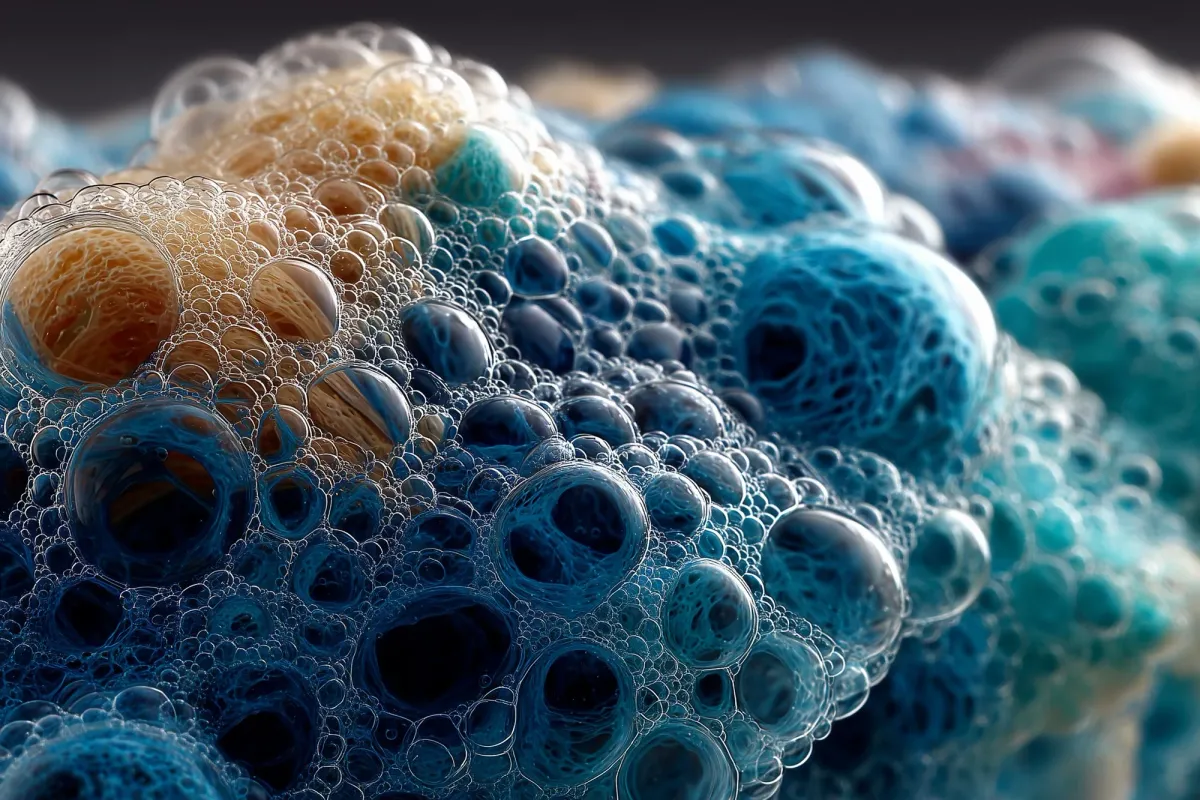
Foam looks still. Bubbles locked in place, stable, done. But look closer — really closer — and nothing's settled at all.
Engineers at the University of Pennsylvania have discovered that the bubbles inside foam are constantly rearranging themselves, even as the foam maintains a stable shape on the outside. More striking: the mathematics describing this hidden motion is identical to the mathematics that allows artificial intelligence systems to learn.
It's the kind of finding that makes you pause. Not because it's flashy, but because it suggests something fundamental about how complex systems actually work — whether they're made of soap, silicon, or cells.
We're a new kind of news feed.
Regular news is designed to drain you. We're a non-profit built to restore you. Every story we publish is scored for impact, progress, and hope.
Start Your News DetoxThe Bubble Beneath the Surface
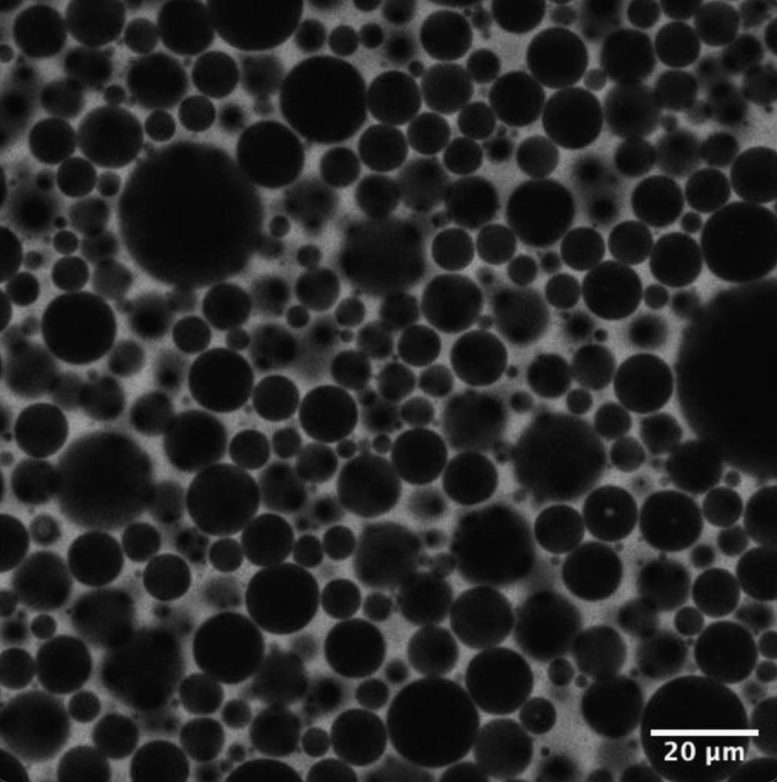
For decades, scientists treated foam like a solved problem. Soap suds, shaving cream, mayonnaise — these materials behaved like glass, they thought. Bubbles got locked into disordered positions and stayed there. A boulder at the bottom of a valley, at rest.
But when John Crocker's team at Penn looked at actual foam data over the past 20 years, something didn't add up. The bubbles weren't behaving the way theory predicted. "When we actually looked at the data, the behavior of foams didn't match what the theory predicted," Crocker says. "We started seeing these discrepancies nearly 20 years ago, but we didn't yet have the mathematical tools to describe what was really happening."
They needed a new framework. And it turned out one was already being built in a completely different field.
When AI Taught Physics a Lesson
Meanwhile, in machine learning, researchers were solving a different puzzle. Early AI systems were trained to find the single best solution — the deepest valley in the landscape, the perfect fit. But models trained this way often failed when faced with new data they hadn't seen before.
The breakthrough came from realizing you don't actually want the deepest valley. "The key insight was realizing that you don't actually want to push the system into the deepest possible valley," explains Robert Riggleman, co-author of the study. "Keeping it in flatter parts of the landscape, where lots of solutions perform similarly well, turns out to be what allows these models to generalize."
In other words: flexibility beats perfection. Systems that wander through many good-enough solutions adapt better than systems locked into one optimal answer.
When Crocker and Riggleman reanalyzed their foam simulations through this lens, the connection became unmistakable. Foam bubbles don't settle into deep, stable positions. They remain in constant motion within broad regions where many configurations work equally well. The mathematics is the same. The behavior is the same.
What This Actually Means
This isn't just a neat coincidence. The finding, published in the Proceedings of the National Academy of Sciences, suggests that continuous learning and adaptation might be a shared principle across nature and technology — a deeper organizing rule that shows up whenever a system needs to stay flexible while maintaining its overall structure.
That matters for materials science. If we understand that adaptive behavior follows these mathematical principles, we can design materials that reorganize themselves over time, that respond to changing conditions rather than remaining static.
It matters even more for biology. Crocker's original passion was the cytoskeleton — the microscopic scaffolding inside cells that must constantly reorganize itself while keeping the cell intact and functional. Like foam, it's a system that never settles, that stays alive precisely because it keeps moving through many possible configurations.
The research doesn't answer why this mathematics appears across such different systems. That's still an open question. But it opens a door. It suggests that the tools we've built to understand learning in AI might illuminate how living systems stay adaptive, how materials can be engineered to be responsive, how complexity itself might organize.
Sometimes the most important discoveries aren't about finding something new. They're about recognizing that what we thought were separate worlds — foam and algorithms, physics and learning, stability and change — might be speaking the same language.