Imagine a cosmic light switch. For about 18 months, a supermassive black hole at the heart of galaxy HE 1237−2252 decided to dim itself, becoming 17 times fainter in X-rays. Then, just as suddenly, it started to re-ignite. Scientists just caught it in the act.
This isn't your average celestial flicker. We're talking about a "changing-look" active galactic nucleus (AGN), where a black hole goes from a ravenous eater to a picky nibbler, and back again, in what — cosmically speaking — is the blink of an eye. Astronomers detailed this dramatic transformation in a recent paper.
The Drama of the Disk
Black holes get their glow from a swirling cloud of gas and dust, called an accretion disk, that's slowly being pulled into their gravitational maw. Usually, these feeding frenzies ebb and flow over thousands of years. But recently, some black holes have decided to speed things up, changing their entire personality in mere months or years.
We're a new kind of news feed.
Regular news is designed to drain you. We're a non-profit built to restore you. Every story we publish is scored for impact, progress, and hope.
Start Your News DetoxThese rapid shifts cause the galaxy to change its "spectral type" — basically, how it looks when scientists analyze its light. Galaxies are generally Type 1 (lots of gas close to the black hole) or Type 2 (gas further away). There are even in-between types like 1.8 or 1.9, which, if you think about it, is both precise and slightly terrifying. When a galaxy switches between these types, it's dubbed a "changing-look AGN" (CLAGN).
Why the sudden mood swings? Scientists aren't entirely sure. It could be a genuine drop in the black hole's dinner plans, or maybe just some local chaos within the accretion disk itself. Perhaps a passing dust bunny caused a temporary eclipse. The universe, after all, is full of surprises.
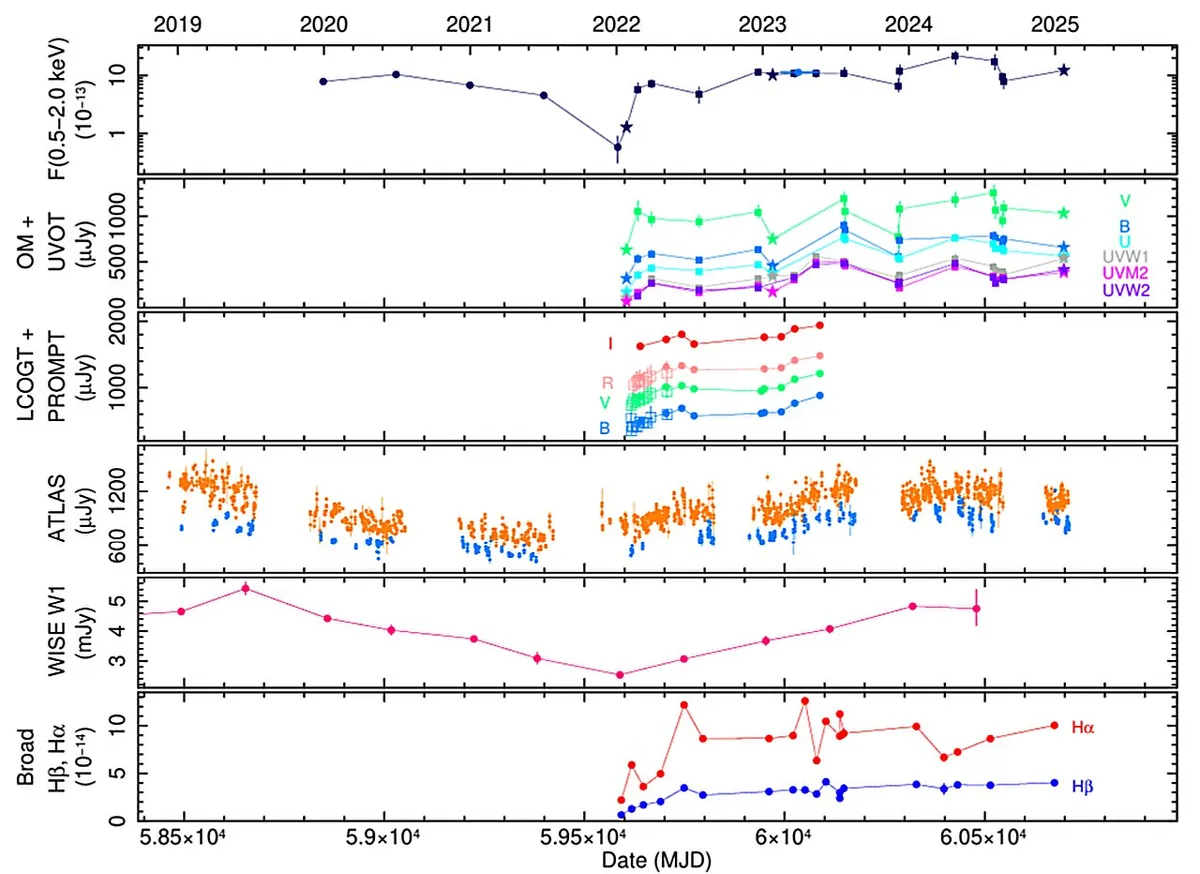
Most of these CLAGNs are spotted by constantly staring at galaxies and watching for changes. Over 150 have been confirmed so far. But in January 2022, astronomers, led by Alex Markowitz, used the eROSITA telescope and caught a Seyfert galaxy (a type of AGN with a very bright center) that had gone dramatically dim.
This particular Seyfert, located about 1.3 billion light-years away, was known as a Type 1.0–1.2. But in 2022, it was observed as a Type 1.8. It wasn't just the X-rays; its infrared brightness also took a nosedive. The team then spent the next three years tracking its slow, dramatic recovery.
The Comeback Kid
The X-ray light snapped back in just three months. The optical, UV, and infrared light, however, took its sweet time — about three years. By late 2024, the galaxy was back to its original Type 1.0 glory, spectral lines fully recovered. As the black hole reignited, researchers even spotted a distinct double-peaked pattern in the hydrogen emission lines, suggesting a ring of gas near the disk was getting all fired up by the recovering corona.
It wasn't a simple dust cloud blocking our view, either. If it were, the X-ray data would have shown signs of absorption, and the infrared light wouldn't have dipped. Both dropped significantly, pointing to a genuine power outage at the black hole's core.
The leading theory? "Cold" and "warm" fronts moving through the accretion disk. A cooling wave temporarily put a damper on the disk's output, then a warming wave gradually brought it back to life.
Researchers say we need more observations (and probably more frequent ones) to fully understand these fickle black holes. But for now, this study offers one of the clearest, real-time views of a black hole throwing a dramatic tantrum, going dark, and then slowly but surely, making its grand return.