Imagine a lighthouse that sometimes flashes predictably, and other times just throws out random, intense bursts whenever it feels like it. Now imagine that lighthouse is 21 million years old, has a magnetic field so strong it makes your head hurt, and is 21,000 light-years away. That, in a nutshell, is RRAT J1574+4703.
Astronomers, using China's enormous Five-hundred-meter Aperture Spherical Radio Telescope (FAST), have been scrutinizing this particular cosmic oddball. And what they've found is that it can't seem to make up its mind: it keeps switching between being a 'rotating radio transient' (RRAT) and a 'normal pulsar.' Because apparently, being one or the other just isn't exciting enough.
Cosmic Identity Crisis
Pulsars, for the uninitiated, are rapidly spinning neutron stars that shoot out beams of radio waves like a cosmic strobe light. RRATs, first spotted in 2006, are their more enigmatic cousins. They're also neutron stars, but they only emit radio waves sporadically – a quick burst here, a longer silence there. Scientists have been scratching their heads about them ever since, largely suspecting they're just pulsars with a bad case of the cosmic hiccups.
We're a new kind of news feed.
Regular news is designed to drain you. We're a non-profit built to restore you. Every story we publish is scored for impact, progress, and hope.
Start Your News DetoxRRAT J1574+4703, discovered just last year, is quite the character. It spins every 0.28 seconds, which is fast, but it's also ancient for a pulsar at 21 million years old. And its magnetic field? A mind-boggling 244 billion Gauss. For context, typical pulsars are nowhere near that level of cosmic magnetism. It's like finding a grandpa who's also a bodybuilder with a super magnet for a heart.
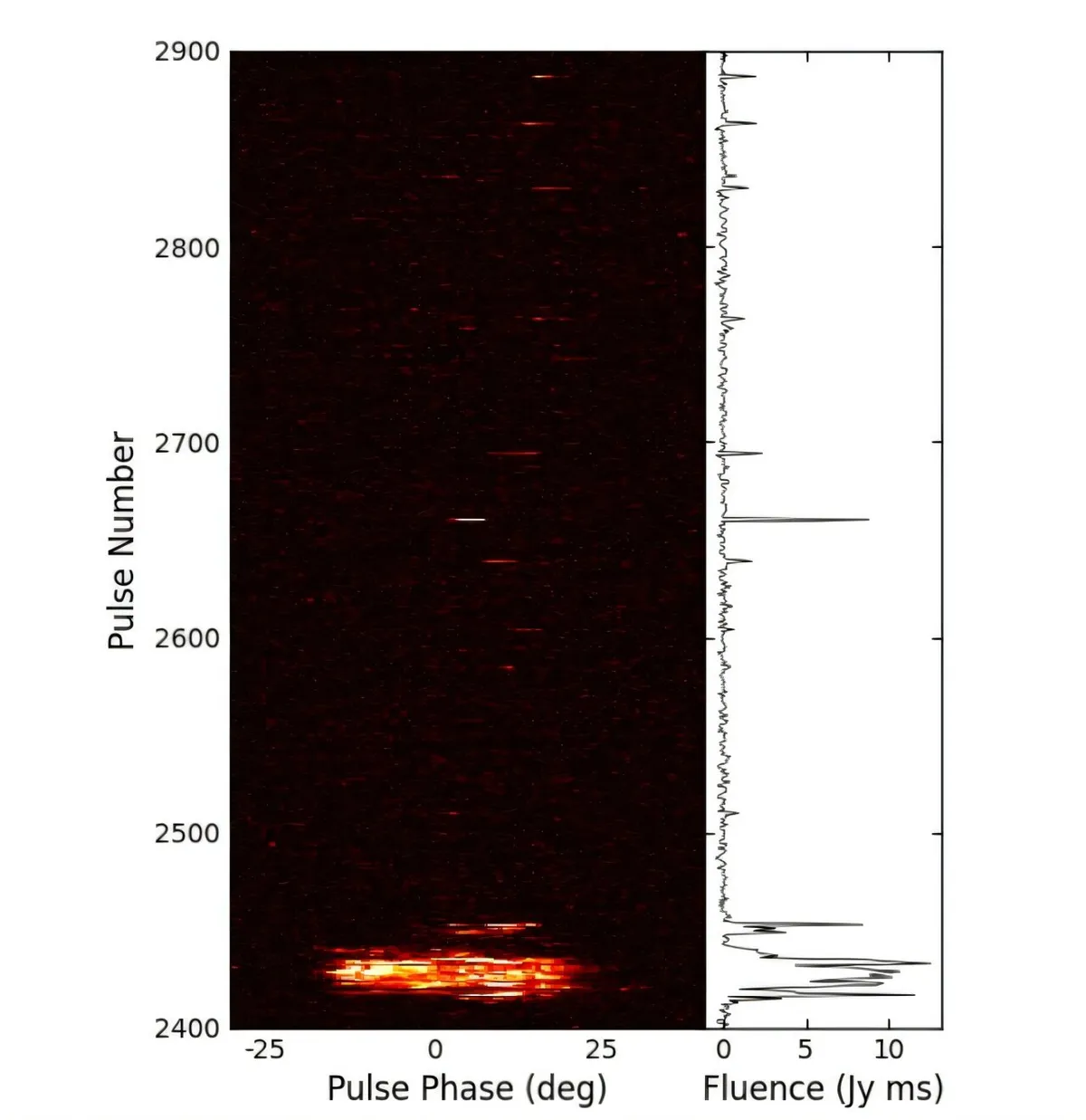
What makes this object truly special is its state-switching. The team, led by Xin Xu from Guizhou Normal University, observed it mostly (98% of the time, to be exact) in its RRAT state, spitting out short, narrow bursts. But then, for brief, unpredictable periods (lasting anywhere from 20 to 170 pulse periods), it would suddenly decide to be a normal pulsar, emitting broader, denser bursts. It's like it's trying on different personalities just to see which one fits.
Even in its 'normal pulsar' phase, it couldn't stick to one thing, showing signs of 'mode switching' within that state. It's almost as if this one object is a living, breathing Rosetta Stone for understanding how pulsars evolve into their more transient, mysterious forms. A cosmic link, if you will, between the well-behaved and the wildly unpredictable. Which, if you think about it, is both impressive and slightly terrifying.