Imagine a place so cold, it makes the vacuum of outer space look like a balmy summer day. Now imagine that place is buried 6,800 feet under an active nickel mine in Canada. Because apparently, that's where we are now.
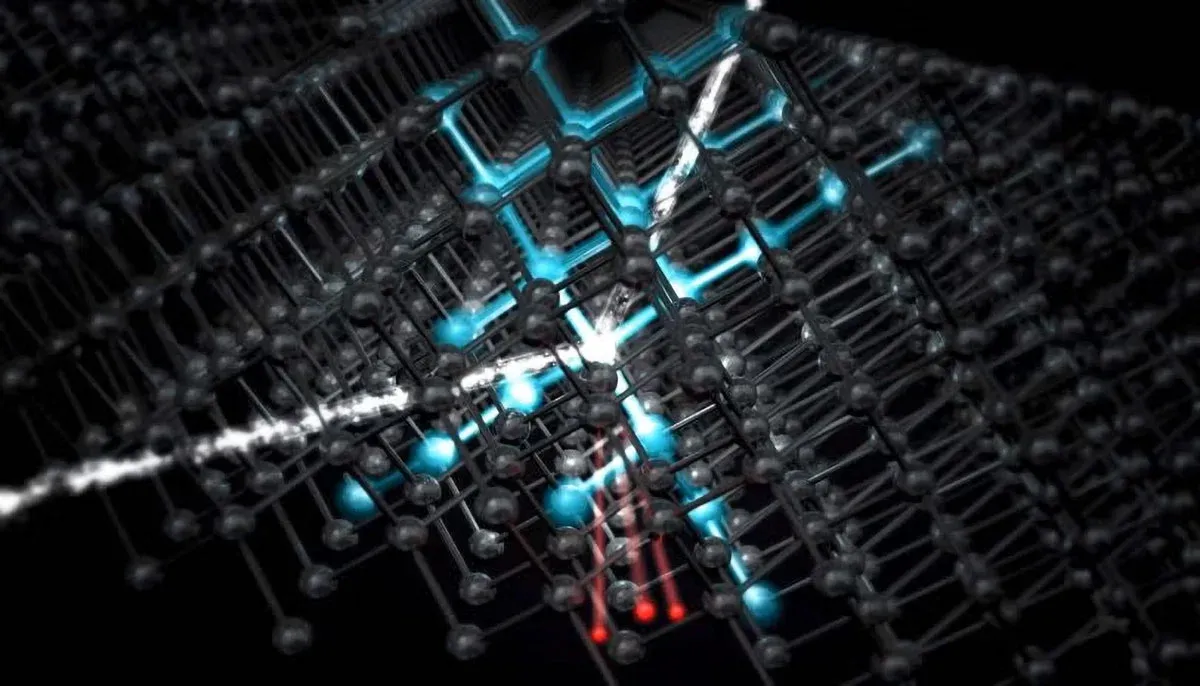
Scientists have just fired up the Super Cryogenic Dark Matter Search (SuperCDMS) experiment, and its detectors are now operating at a mere few thousandths of a degree above absolute zero. That's right, hundreds of times colder than the vast emptiness between stars. Why? To catch the universe's most elusive hide-and-seek champion: dark matter.
The Ultimate Cold Case
Dark matter makes up about 85% of all matter out there, yet it remains utterly invisible to us. We know it's tugging on galaxies, holding them together with its gravitational might, but it doesn't emit, absorb, or reflect light. It's the ultimate ghost in the machine, and scientists are pretty sure it's passing right through Earth, all the time, without so much as a hello.
We're a new kind of news feed.
Regular news is designed to drain you. We're a non-profit built to restore you. Every story we publish is scored for impact, progress, and hope.
Start Your News DetoxThe SuperCDMS experiment is basically a cosmic fly trap designed to detect the one in a gazillion chance a dark matter particle bumps into ordinary matter. To do that, you need an environment so quiet, so still, that even the faintest whisper of an interaction can be heard. At these near-absolute zero temperatures, heat-driven motion inside materials practically grinds to a halt, creating that pristine silence.
Priscilla Cushman, a professor at the University of Minnesota and spokesperson for SuperCDMS, noted that getting to this point took years. Years of building a facility sturdy enough to house these incredibly sensitive detectors, all while keeping them colder than anywhere else on (or off) Earth. It's the kind of dedication that makes you wonder if these scientists ever get cold feet.
Buried for Science
To ensure no pesky cosmic rays or other particles interfere with their ghost hunt, the entire operation is tucked away deep underground at SNOLAB in Sudbury, Ontario. Think of it as the universe's most secure, most frigid, and least accessible vault. The University of Minnesota team even built a four-meter-tall, four-meter-wide cylindrical shield with layers of ultra-pure lead and high-density polyethylene to block any stray radiation or neutrons.
Now, with the detectors humming (or rather, not humming, because it's too cold for that), the team will spend the next few months calibrating and fine-tuning everything. Once that's done, the real search begins. Besides the main event of hunting dark matter, the experiment will also help study rare isotopes and explore new types of particle interactions. Because when you've gone to this much trouble to build the coldest place on Earth, you might as well see what else you can find.
It's a massive collaborative effort, backed by the U.S. Department of Energy, the U.S. National Science Foundation, and Canadian research councils. And if they actually do find dark matter, someone's going to need a very warm celebratory drink.