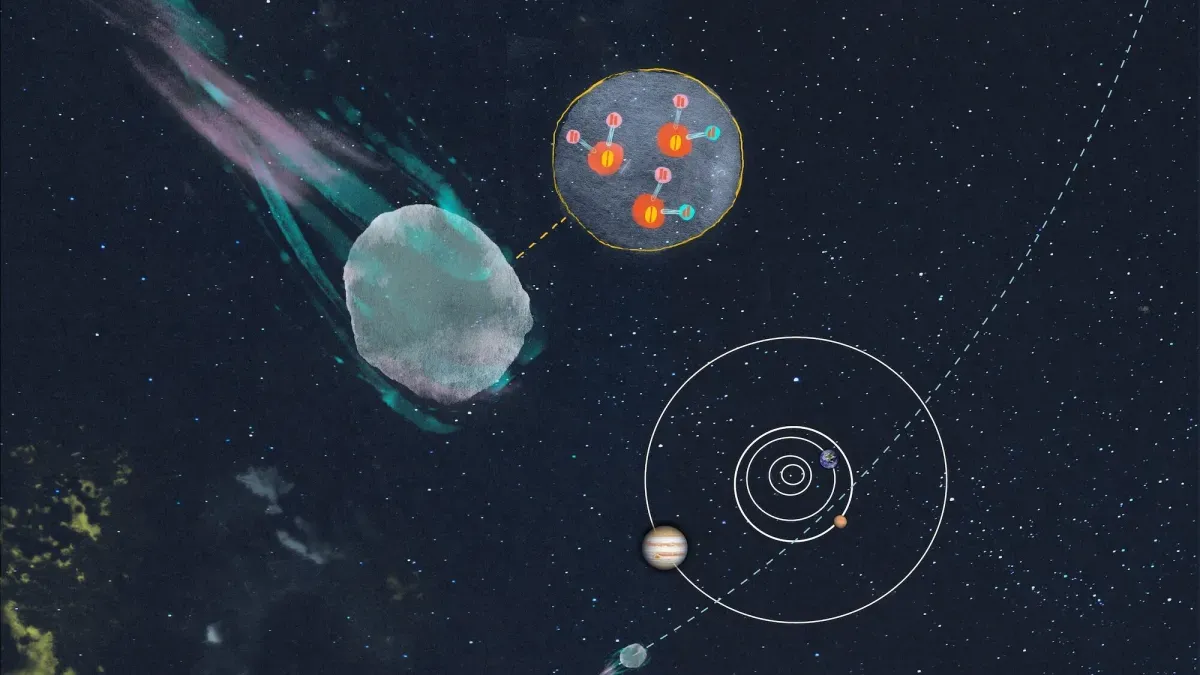
When astronomers first spotted comet 3I/ATLAS in July 2025, they knew it was special. How special? It was only the third interstellar object ever found in our neck of the cosmic woods, meaning it wasn't born in our solar system. Basically, a cosmic stranger passing through, offering a rare peek into how things form out there.
Now, 3I/ATLAS is cruising out of our solar system, but not before dropping some serious knowledge. This thing isn't just fast; it's the fastest comet ever recorded. It also sports ice volcanoes and leaves a delightful trail of methanol and cyanide dust. Because, apparently, even comets have a flair for the dramatic.
The Heavy Water Mystery
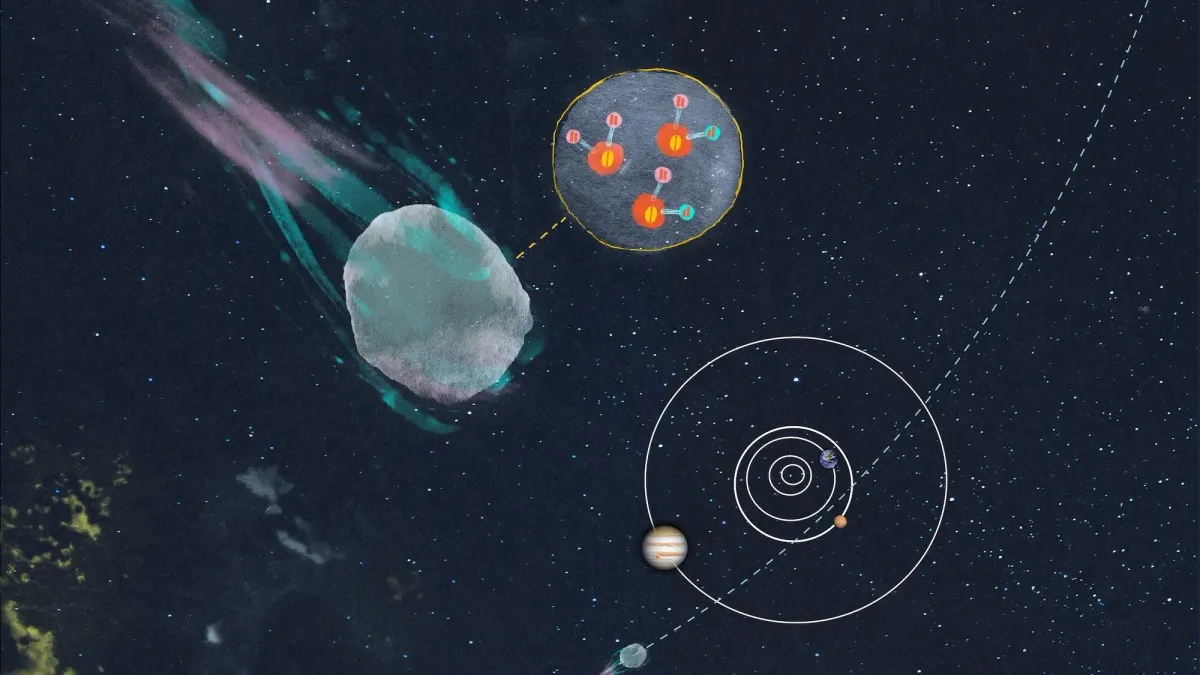
But here's the kicker: The European Space Agency confirmed that 3I/ATLAS is spewing water equivalent to 70 Olympic swimming pools every single day. And it's not just any water. According to astronomers at the University of Michigan, the hydrogen in this comet's water has an extra neutron, making it an isotope called deuterium, or "heavy water."
We're a new kind of news feed.
Regular news is designed to drain you. We're a non-profit built to restore you. Every story we publish is scored for impact, progress, and hope.
Start Your News DetoxOn Earth, heavy water is a bit of a rarity. Its abundance in 3I/ATLAS suggests this comet hails from a place far, far colder than our cozy solar system.
Luis Salazar Manzano, a UM astronomer and co-author of a paper in Nature Astronomy, laid it out: 3I/ATLAS has 30 times more deuterium than other comets and a staggering 40 times more than Earth's oceans. He noted that the ratio of deuterium to regular hydrogen in its water is higher than anything ever observed. Let that sink in.

How You Measure Cold Water From Millions of Miles Away
So, how do you measure tiny particles in a comet millions of miles away? With very sensitive tools, naturally. Manzano and his team used equipment at the MDM Observatory in Arizona, partnering with astronomers at the Atacama Large Millimeter/submillimeter Array (ALMA) in Chile.
ALMA was the hero here, helping the team differentiate between standard and deuterated water. This allowed them to accurately estimate the ratio between the two – a first for an interstellar object. Which, if you think about it, is both impressive and slightly terrifying in its precision.
What Cold Means for Cosmic Beginnings
All this deuterium points to one thing: 3I/ATLAS formed in an incredibly cold environment, likely less than 30 degrees Kelvin (that's -387.67 Fahrenheit) with much lower radiation levels. The study's authors explained that deuterium enrichment happens through specific chemical processes that only occur at those bone-chilling temperatures.
Sure, the Milky Way is vast, so different environments aren't a huge surprise. But as astronomer and study co-author Teresa Paneque-Carreño put it, science needs proof, even for the obvious-sounding stuff. This comet is that proof, confirming that the conditions that birthed our solar system are not, in fact, universal across the cosmos. Turns out, our cosmic neighborhood is just one of many, and some are significantly chillier.