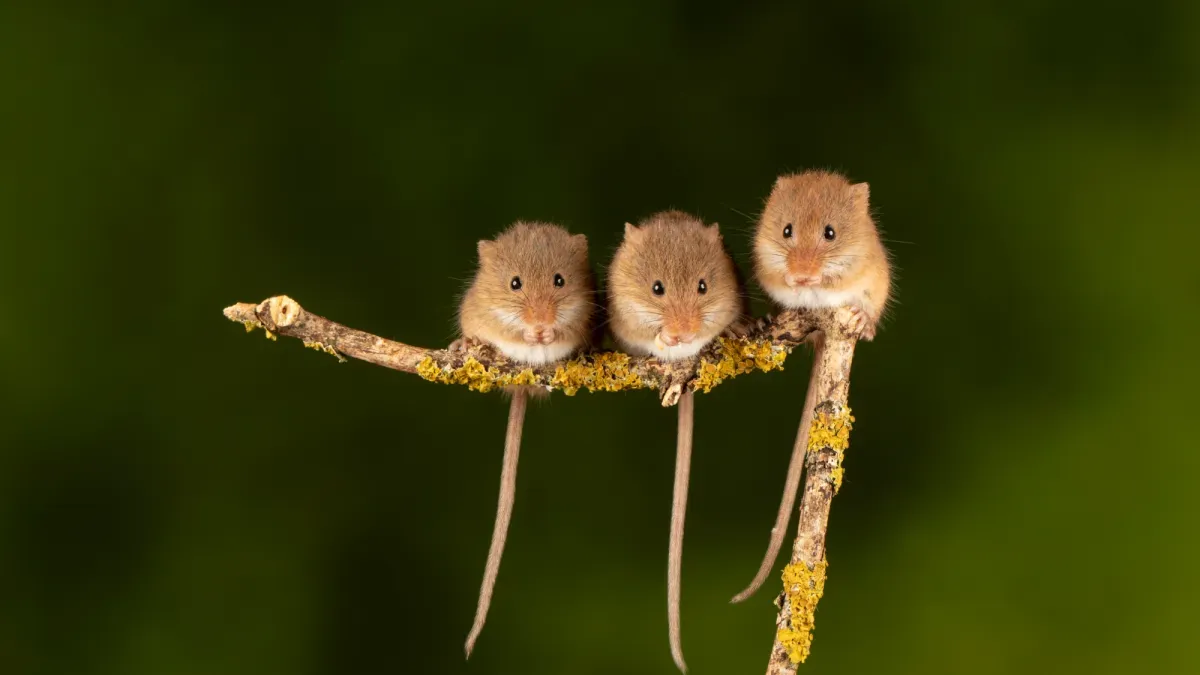
A female house mouse doesn't always stick with one partner. When she mates with several males, her litter becomes a mixed family—half-siblings sharing the same womb. Scientists have long puzzled over why this happens. A new study suggests the answer hinges on survival math: when resources are tight, multiple fathers improve the odds that at least some pups will make it.
Researchers at the Max Planck Institute for Evolutionary Biology in Germany built enclosures that mimicked wild mouse habitats, then split them into two groups. One received high-quality food; the other got the typical, less nutritious diet wild mice actually encounter. They watched what happened.
About one-third of litters in both environments had multiple fathers—so polyandry (the scientific term for females mating with multiple males) wasn't rare. But here's where it got interesting: larger litters only showed up in the lower-quality food habitats. Mothers with access to good nutrition produced large litters regardless of whether they'd mated with one male or several.
We're a new kind of news feed.
Regular news is designed to drain you. We're a non-profit built to restore you. Every story we publish is scored for impact, progress, and hope.
Start Your News Detox"Our results suggested that polyandry provides greater lifetime fitness benefits when resources are of poorer quality," the researchers explained. In other words, when food is scarce, having multiple fathers in one litter is a survival strategy. Different fathers carry different genetic traits. If conditions are harsh, genetic diversity within a single litter increases the chance that at least some pups inherit traits suited to scarcity—better metabolism, efficient digestion, whatever helps them survive lean times. Scientists call this "bet-hedging."
When food is abundant, though, this gamble doesn't pay off. A mother can feed all her pups well regardless of their genetics. The benefit of genetic diversity disappears. So she doesn't bother.
This finding matters because it reveals how animals adjust their mating strategies to their environment. As habitats shift and resources become less predictable—whether due to climate change, human development, or seasonal swings—we should expect animal behavior to shift too. Understanding these patterns helps explain why different species mate differently, and how those differences might change as the world around them changes.