The ocean is vast, and understanding its depths is a huge challenge. Even with buoys, satellites, and advanced computer models, we can only learn so much about the waters covering over two-thirds of our planet.
But sharks, with their deep knowledge of the ocean, might offer a new way to get a clearer picture of what's happening underwater. New research suggests sharks could act as mobile sensor systems. They could collect data to improve our understanding of ocean conditions. This information could then help manage fisheries and other vital activities.
Laura McDonnell, the lead author and a postdoctoral scientist at the Woods Hole Oceanographic Institution (WHOI), explained that sharks already travel through parts of the ocean that are hard for humans to observe. She noted that the data they collect can help fill important gaps.
We're a new kind of news feed.
Regular news is designed to drain you. We're a non-profit built to restore you. Every story we publish is scored for impact, progress, and hope.
Start Your News DetoxSharks as Ocean Data Collectors
For years, scientists have attached sensors to sharks to study the animals themselves. For example, in 2022, a team attached sensors to sharks near Africa to see how their behavior changed in low-oxygen waters.
Neil Hammerschlag, a co-author of the new paper and a marine ecologist at the University of Miami (UM), was using sensors in a similar way. In 2018, he spoke with UM atmospheric scientist Ben Kirtman about using this sensor data to study the ocean instead of just the fish.
Kirtman pointed out that marine predators like sharks naturally seek out dynamic ocean features such as fronts and eddies. These are areas where models often lack enough observations.
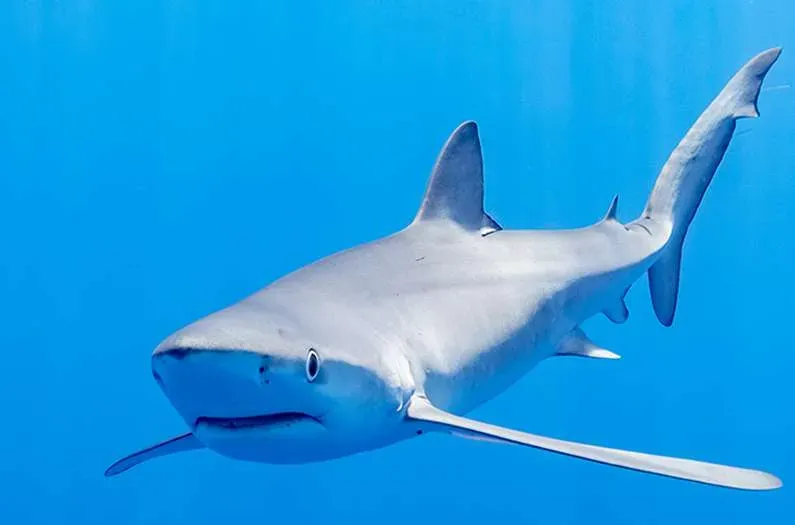
McDonnell, then a Ph.D. student at UM, explored this idea. In October 2021, she and her team attached sensors to the dorsal fins of 18 blue sharks and one shortfin mako shark off the Northeast U.S. coast. They then released the sharks, letting them act like fast-moving drones.
Prionace glauca*) © Diego Delso via Flickr*
Over the next few months, these sensors recorded temperature and depth, two key pieces of data for understanding ocean conditions. When the sharks surfaced, the tags sent this information to satellites, which then relayed it to the scientists. In total, they gathered over 8,200 snapshots of ocean conditions. While most data came from off the eastern U.S. coast north of Virginia, some sharks traveled as far south as Florida and into the mid-Atlantic. They also provided data from depths of almost 2,000 meters during their dives.
Sharpening Ocean Forecasts
The researchers used this wealth of information to improve a computer program that models ocean conditions. This program usually relies on data from buoys and other sources. When tested, the shark-enhanced model was much closer to reality than the standard model in certain ocean areas. This test involved seeing how well the models could simulate past ocean conditions.
The model's performance improved significantly along the shallow continental shelf. It reduced the model's error by 43% in November and 33% in December. This meant the model was about 1.5°C closer to the actual sea surface temperatures. This is a big improvement, as even small temperature changes can cause major ecological shifts.
Camrin Braun, an oceanographer at WHOI who worked on the study, noted that even small improvements in ocean forecasts can make a big difference for fisheries and coastal communities. He explained that reducing uncertainty helps people plan, whether it's where to fish, how to manage resources, or how to react to changing conditions.
McDonnell cautioned that sharks won't replace other data-gathering methods. This was a short experiment, and there are no plans for a larger effort to use sharks for ocean forecasting. However, it does show that tags once used only to study sharks could also help uncover broader mysteries about how the ocean is changing.
Deep Dive & References
Improved seasonal climate forecasting using shark-borne sensor data in a dynamic ocean - npj Climate and Atmospheric Science, 2026