For ages, everyone thought electrons needed perfectly neat materials to zip through. The cleaner the inside, the better the electricity, right?
Turns out, that's not always the case. A new study from POSTECH in South Korea just flipped that idea on its head. They found that adding specific kinds of messiness can actually make electrons move better.
The Power of a Little Mess
The researchers, led by Professor Hyungyu Jin and Professor Hyun-Woo Lee, were looking at something called transverse electron transport. Think of it like this: you push electricity one way, and a voltage pops up sideways. This effect is super useful for things like magnetic sensors and devices that turn heat into power.
We're a new kind of news feed.
Regular news is designed to drain you. We're a non-profit built to restore you. Every story we publish is scored for impact, progress, and hope.
Start Your News DetoxBefore, the smart money said you needed super-special, ultra-orderly materials for this to happen well. Basically, keep it pristine.
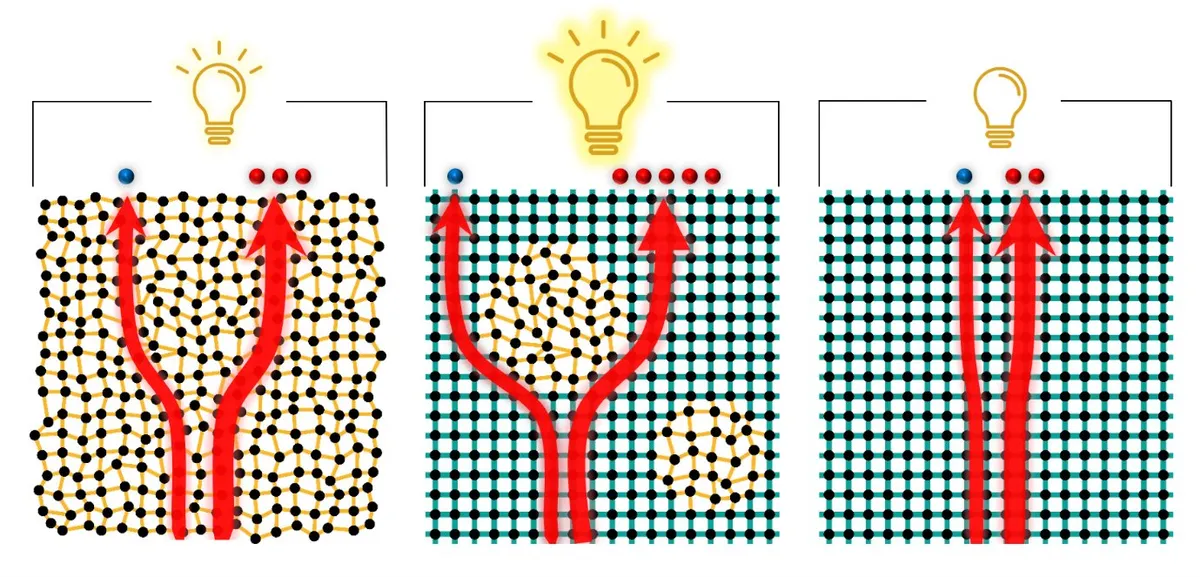
But the POSTECH team tried something different. Instead of cleaning things up, they mixed two magnetic materials. Each material kept its own vibe, but together, they formed a new combo with both messy (amorphous) and neat (crystalline) bits.
And here's the wild part: the sideways electron flow in this mixed-up material became way stronger than in either material alone. Both real-world tests and computer models showed a serious boost.
Winding Paths, Bigger Punch
So, what's happening? The electrons aren't just cruising in straight lines. They're taking twisty, turny paths through all the different structures in the material. As they keep bending and changing direction, their sideways movement gets amplified. It's like they're bouncing around and gaining momentum in the right direction.
This discovery is pretty nuts because it challenges an old rule: that combined materials just average out their properties. This study proves that how you put things together can create entirely new, powerful effects.
Even better, they didn't need any rare, expensive stuff. They used common iron-based magnets, and these showed transverse transport as good as some high-end quantum materials. That's a serious shortcut to designing powerful electronics using everyday ingredients.
Professor Hyungyu Jin put it simply: this opens up a whole new playbook for making high-performance materials without needing exotic components. And Professor Hyun-Woo Lee added that disorder isn't just a problem to avoid; it can be a clever tool in design.
Imagine: using a little bit of chaos to make our tech faster and more efficient. Who knew messy could be so smart?