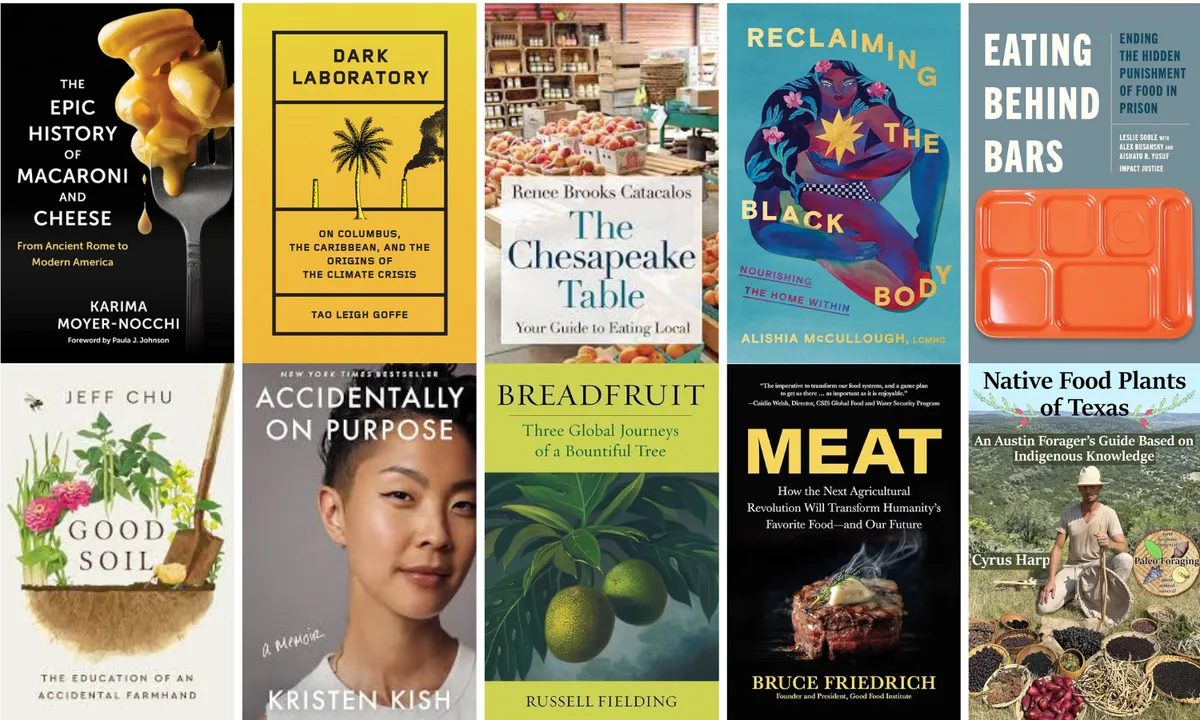
Winter is the season for settling in with a book that makes you see something differently. Food Tank's latest reading list does exactly that—it gathers twenty writers who've spent years thinking deeply about where food comes from, who grows it, who gets to eat it, and what it all means.
These aren't books about following recipes. They're about following threads. A thread from colonial exploitation to today's climate crisis. From a single breadfruit tree's journey across continents to the politics of almonds in California versus Spain. From prison meals as quiet punishment to the science of why we crave what we crave.
Stories that change perspective
Some of these books are memoirs. Kristen Kish writes about finding her voice as an adoptee and a chef. Kevin Boehm traces his rise through Michelin-starred restaurants alongside a turbulent childhood. Jeff Chu learns farming from worms and long beans. These aren't hero narratives—they're honest accounts of how people navigate the food world and what it teaches them.
We're a new kind of news feed.
Regular news is designed to drain you. We're a non-profit built to restore you. Every story we publish is scored for impact, progress, and hope.
Start Your News DetoxOthers are investigations. Tao Leigh Goffe connects colonial systems of extraction to the industrial food systems we inherit today. Leslie Soble exposes how nutrient-poor prison meals become a form of punishment. Hanna Garth spent twelve years researching food justice in South Central Los Angeles and concluded that what's needed isn't well-meaning activism from outside, but structural change rooted in the community itself.
Then there are the histories—the kind that make you realize nothing about food is simple. Fabio Parasecoli traces Italy's foodscape through wars and economic collapse. Karima Moyer-Nocchi follows macaroni and cheese from 18th-century England through the American Civil Rights Movement, showing how a pasta dish can carry the weight of migration and cultural identity. Emily Reisman explores why almonds thrive in Spain but drain California dry, revealing how capitalism and policy shape what we grow where.
Food as a mirror
Several books ask what food says about us. Julia Belluz and Kevin Hall untangle nutrition science from myth—the floods of dietary advice that contradict each other every five years. Alishia McCullough examines how our relationship with food mirrors our relationship with our bodies and culture. Samin Nosrat's cookbook treats cooking not as technique but as ritual and connection.
Bruce Friedrich's Meat poses a question that sits at the center of modern food debates: can we feed the world and satisfy our cravings for animal protein without the current system's ecological cost. Russell Fielding's Breadfruit shows how a single tree embodies resilience and the ties between food and community.
Two books arrive in 2026. Bruce Jennings' Revolutionary Science follows Latin American scientists and farmers building agroecology—a science rooted in cultural respect and traditional knowledge. Hanna Garth's Food Justice Undone asks what justice actually means in a food system, and insists the answer comes from the people most affected by it, not from outside.
Why this matters now
These books share something: they refuse to separate food from everything else. Food isn't just nutrition or flavor. It's labor and justice, history and ecology, identity and power. Reading them in winter—when the days are short and the ground is frozen—creates space to think about these connections before spring arrives and the growing season begins again.
The list includes guides too: Cyrus Harp's Native Food Plants of Texas reconnects readers to wild edibles that sustained Indigenous peoples for millennia. Renee Brooks Catacalos shows how eating locally from the Chesapeake Bay area isn't a burden but an abundance waiting to be noticed. And Tanya Bush's Will This Make You Happy weaves baking recipes with stories of pleasure and self-discovery.
Whether you're drawn to memoir, history, science, or the simple act of cooking with intention, there's a thread here worth following. Winter reading at its best isn't escape—it's the opposite. It's paying attention to what's on the plate and everything behind it.