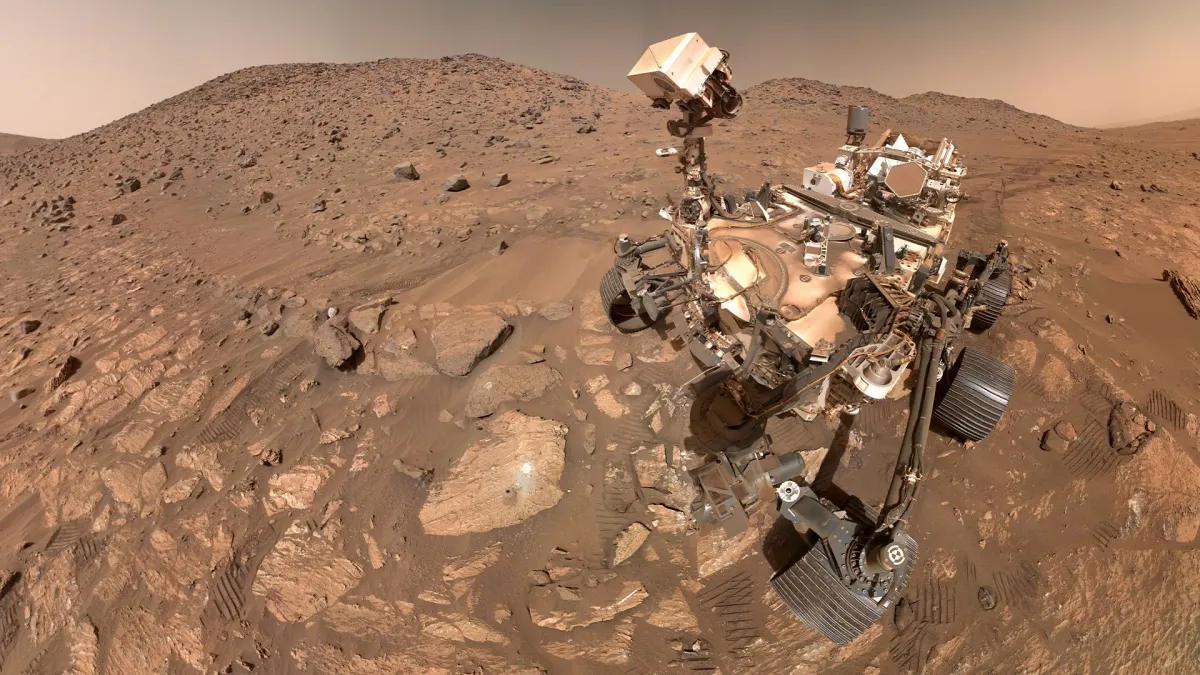
For the first time in its five-year mission, NASA's Perseverance rover drove across Mars without a human-designed route. On December 8th and 10th, the six-wheeled robot followed paths generated entirely by artificial intelligence, proving that machines can now plan their own way across another planet.
The demonstration happened at NASA's Jet Propulsion Laboratory in Southern California, where engineers fed a generative AI system the same data human rover drivers normally use: satellite imagery, terrain maps, hazard warnings. The AI analyzed it all and generated a continuous driving path with safe waypoints. On sol 1,707 (a Martian day), Perseverance drove 689 feet. Two sols later, it covered 807 feet. Both drives stayed within safety limits and performed as expected.
But here's where caution meets innovation: engineers didn't send the AI commands straight to Mars. Instead, they ran every instruction through JPL's digital twin of Perseverance—a virtual replica that checked over 500,000 telemetry variables to make sure the commands wouldn't break anything. Only after that verification did the team upload the instructions to the rover, 140 million miles away.
We're a new kind of news feed.
Regular news is designed to drain you. We're a non-profit built to restore you. Every story we publish is scored for impact, progress, and hope.
Start Your News Detox"This shows how far our capabilities have advanced," NASA Administrator Jared Isaacman said. The real significance isn't that the rover drove itself. It's that as missions push farther from Earth, the communication delay makes human-in-the-loop control increasingly impractical. A command to Mars takes up to 22 minutes to arrive. By then, the rover might have already hit an obstacle. AI that can see the terrain and decide in real time changes that equation.
Vandi Verma, a space roboticist at JPL, described what's coming next: "We are moving towards a day where generative AI will help our surface rovers handle kilometer-scale drives while minimizing operator workload." That matters because longer drives mean more ground covered, more science collected, less time waiting for human instruction from Earth.
This test run is a proof of concept for deeper space. If AI navigation works on Mars, it could transform how we explore the Moon, the moons of Jupiter, or anywhere else where distance makes real-time human control impossible. Future robotic missions—and eventually crewed ones—could move faster, adapt quicker, and take on terrain too complex for pre-planned routes.