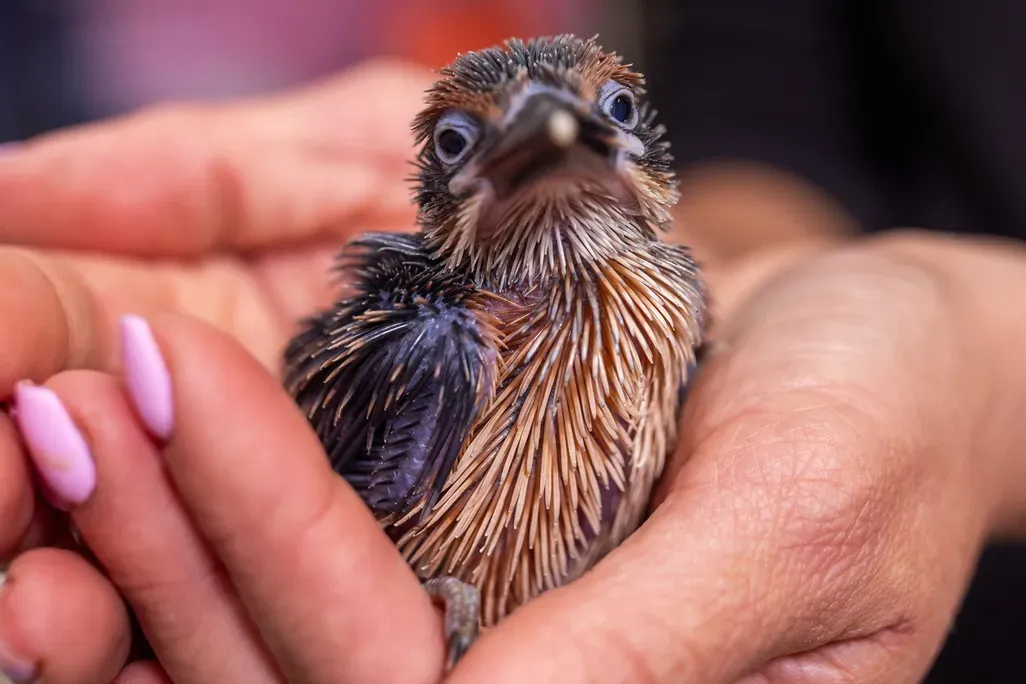
The Guam kingfisher, also known as the sihek, is a very rare bird. It is extinct in the wild. But this spring, its population got a much-needed boost.
Four new sihek chicks hatched at the Smithsonian Conservation Biology Institute in Front Royal, Virginia. The first two hatched on April 12 and April 14. The second two hatched on May 27 and May 28. The parents, Poki and Antonio, are 2 and 5 years old. Neither had bred before.
This year's four hatchlings match the facility's record for sihek chicks in a season. This record was previously set in 2020 and 1985. In total, 33 sihek chicks have hatched at the Conservation Biology Institute over the years. Only about 125 sihek are alive today worldwide.
We're a new kind of news feed.
Regular news is designed to drain you. We're a non-profit built to restore you. Every story we publish is scored for impact, progress, and hope.
Start Your News DetoxMegan Laut, a wildlife biologist, said every new sihek is "incredibly valuable." She noted that young birds are important to replace older birds and become the next generation.
Challenges and Solutions for the Sihek
On their native island of Guam, sihek and many other local species were wiped out by the brown tree snake. This invasive snake was introduced after World War II. It likely arrived on military cargo ships. The snakes multiplied without natural predators and hunted birds, lizards, and bats.

Ten of Guam’s 12 forest bird species were eliminated from the wild by these snakes. Some birds, like the ko’ko’, or Guam rail, and the sihek, only survive today thanks to captive breeding programs.
Erica Royer, an aviculturist at the Smithsonian, cares for the new chicks. She said caring for sihek can be challenging because they are territorial. The parents of these two chicks did not get along last year. But this year, they decided it was their time to breed.
Poki and Antonio are first-time parents. They came to the Conservation Biology Institute from other zoos for breeding. Keepers decided to incubate the eggs and raise the hatchlings themselves. This boosts the chicks' chance of survival.
Keepers gave Poki and Antonio "dummy eggs" to practice on. These were sihek eggshells filled with plaster. Meanwhile, the real eggs were kept at a specific temperature and humidity. They were also hand-turned daily.
Staff feed the hatchlings seven times a day. They are slowly taught to eat on their own. Royer noted that the April hatchlings are still a bit picky.
The new chicks have unique genes. This is good for conservation. Their future breeding will help increase genetic diversity in the sihek population.


A New Home in the Wild
Birds raised in zoos could eventually return to the wild. Some sihek have already done so. Efforts have reduced the brown tree snake population on Guam, but the snake has not been fully removed.
Instead of reintroducing sihek to Guam, conservationists moved them to Palmyra Atoll. This chain of 26 islets is part of the Palmyra Atoll National Wildlife Refuge. It has been cleared of invasive species, making it a safe haven for the birds.
In September 2024, conservationists released nine sihek there. The project involves many groups, including the Guam Department of Agriculture and the U.S. Fish and Wildlife Service.

Royer noted that similar bird translocations expect about 50% survival. However, all the released sihek on Palmyra Atoll have survived so far. Even better, the birds are trying to breed.
In late March 2025, biologists found sihek eggs in a nest on Palmyra Atoll. This made them hopeful about the birds thriving in the wild. None of the eggs hatched, but this might be due to the parents' inexperience. The U.S. Fish and Wildlife Service expects it may take a few more tries for the birds to successfully hatch and raise chicks.
John Ewen, a professor in species recovery, hopes for the first wild chick in almost 40 years. He also mentioned plans to send another group of sihek to Palmyra Atoll.
Experts say every new hatchling is special because of the birds' rarity. The sihek is important to the Indigenous CHamoru people of Guam. It also played a key role in controlling insect and lizard populations.
The sihek has faced major threats but survived with human help. This makes the bird a symbol of both fragility and resilience. Ewen stated that conservation works, even in extreme situations.
Deep Dive & References
- Conserving the Last of Guam's Avifauna: Recovery of the Guam Rail - Smithsonian's National Zoo and Conservation Biology Institute
- Genetic diversity in the pool of living birds - Scientific Reports, 2020
- Sihek Conservation Introduction to Palmyra Atoll - U.S. Fish and Wildlife Service