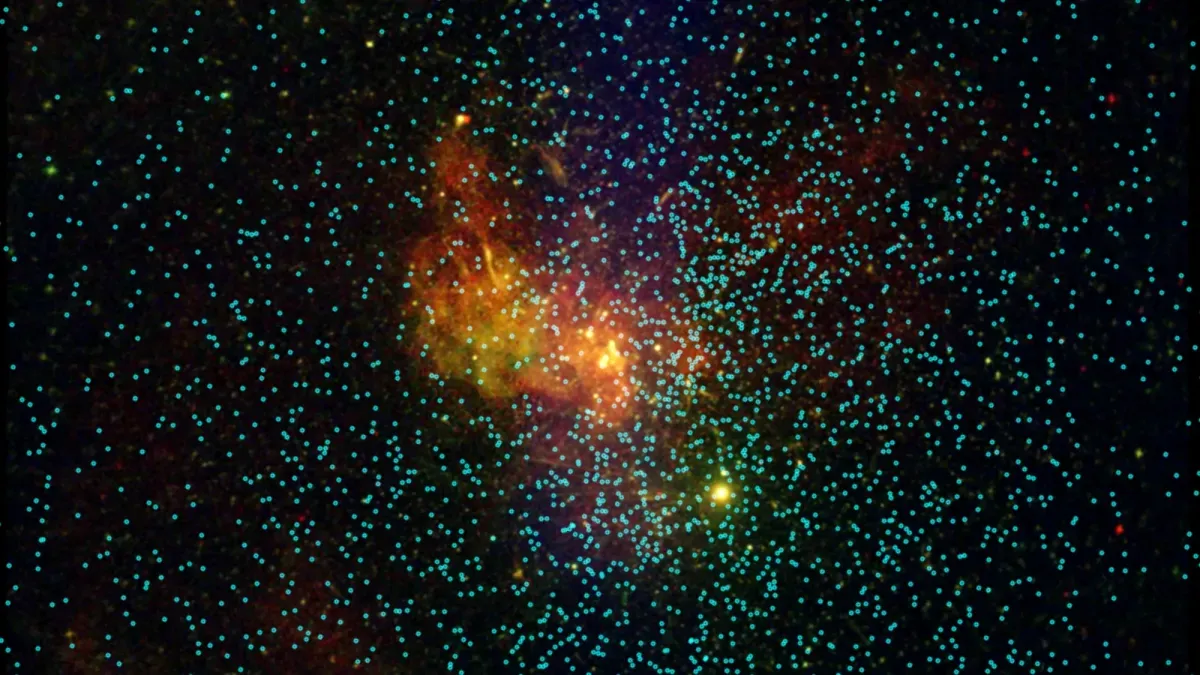
The Chandra X-Ray Observatory has been watching our galaxy's supermassive black hole for nearly three decades, and NASA just released what amounts to a cosmic photo album: over 400,000 previously cataloged X-ray sources, plus 1.3 million individual detections spanning back to 1999.
The most striking example sits at the galactic center. A single image of the area surrounding Sagittarius A* — the black hole anchoring the Milky Way — required 86 separate observations totaling more than 3 million seconds of telescope time. That's roughly 35 days of continuous staring at the same 60 light-year patch of sky. Within that frame, Chandra found more than 3,300 distinct X-ray sources: neutron stars, stellar explosions, and phenomena we don't yet have names for.
What makes this release remarkable isn't just the volume of data. It's that Chandra was only supposed to last five years. Launched in 1999 with a mission window that seemed ambitious at the time, the observatory has kept working, kept improving, and kept delivering observations that reshape how we understand the violent, energetic core of our galaxy. That's 27 years of continuous surveillance of one of the universe's most extreme objects.
We're a new kind of news feed.
Regular news is designed to drain you. We're a non-profit built to restore you. Every story we publish is scored for impact, progress, and hope.
Start Your News DetoxBut here's the catch: most of this data is invisible. X-rays don't reach our eyes. So NASA did something unexpected. They converted 22 years of Chandra observations into sound — a technique called sonification. Repeated observations became different musical notes. The result is less a scientific tool and more an experience: a cosmic choir of tones that somehow makes the scale of what Chandra sees feel more real than any static image.
The archive itself is freely available to astronomers worldwide, which means the real work is just beginning. Every observation in this catalog becomes raw material for someone's next discovery — a pulsar's behavior, a supernova's aftermath, or something we haven't predicted yet. Chandra keeps finding new things in the same patch of sky, which suggests we're still in the early chapters of understanding what's actually happening near the Milky Way's heart.