
Bobby Fischer thought he'd solved chess. In the 1990s, the legendary (and infamous) world champion created Fischer Random Chess—a variant that randomizes the back rank pieces while keeping everything else the same. The result: 960 possible starting setups, each one theoretically fresh enough to stop grandmasters from memorizing their way to victory.
There's just one problem. White still wins more often.
The first-move advantage persists
For centuries, chess players have known that moving first gives white a subtle but real edge. It's not huge—but across thousands of games at the highest level, it adds up. Fischer's variant was supposed to level this playing field by introducing enough variation that memorized opening theory would collapse, and creativity would return.
Marc Barthelemy, a statistical theorist at France's Paris-Saclay University, decided to test whether it actually worked. He fed all 960 possible Chess960 starting positions into Stockfish, one of the world's strongest chess engines, and calculated the best possible moves from each setup. Then he developed a novel statistical method to measure something deeper: how much positional information a player needs to find the optimal move.
We're a new kind of news feed.
Regular news is designed to drain you. We're a non-profit built to restore you. Every story we publish is scored for impact, progress, and hope.
Start Your News DetoxThe results were striking. In 99.6 percent of the 960 setups, white retains a clear advantage. "The advantage conferred by moving first is a robust structural feature of the game," Barthelemy wrote in his forthcoming study.
This doesn't mean Chess960 has failed. Rather, it reveals something about how chess itself works. Over centuries, the standard starting position probably became "standard" partly because it looks balanced and feels memorable—not because it actually is balanced. When Barthelemy mapped the complexity and fairness of all 960 positions, standard chess didn't stand out. It was just... typical.
Finding the fairest game
The analysis did uncover something useful: position 198, where the back rank reads Queen / Knight / Bishop / Rook / King / Bishop / Knight / Rook, comes closest to true balance. Both white's advantage and the asymmetry in decision-making complexity hover near zero.
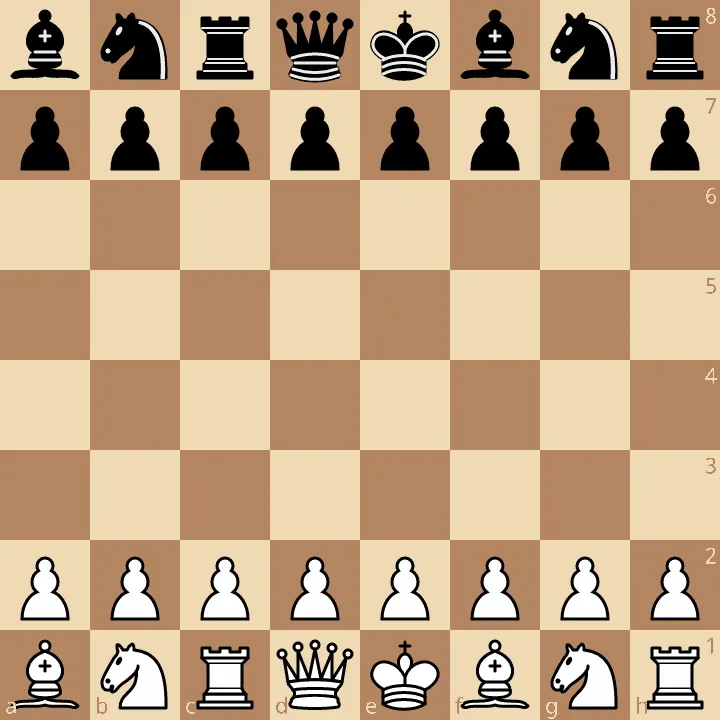
If you want the opposite—maximum complexity, where every decision feels novel—position 226 delivers. The knight and bishop swap places with the queen and rook, creating a setup so asymmetrical that even strong engines struggle to find clear advantages.
Barthelemy's work isn't meant to kill Chess960 or defend standard chess. Instead, it gives tournament organizers concrete data. If fairness is the goal, position 198 gets you there. If you want to see how grandmasters think under pressure, position 226 forces them to improvise. The choice becomes intentional rather than random.