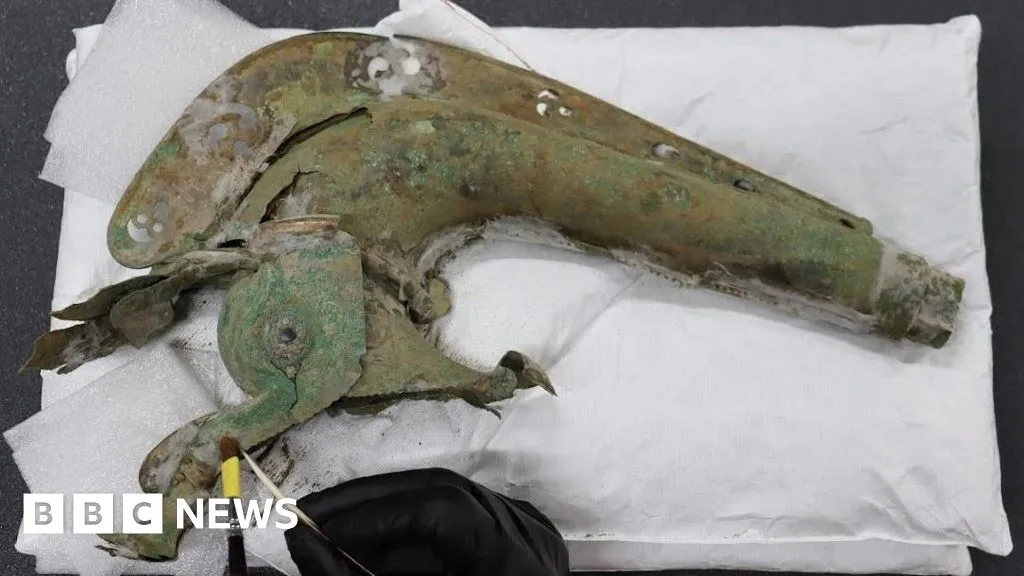
Archaeologists in Norfolk have pulled something extraordinary from the ground: the most complete Celtic war trumpet ever found in Europe, alongside Britain's first-ever boar's head battle standard. Both artifacts emerged from the same hoard near Thetford, frozen in time from around 50 BC to AD 50.
The carnyx—a bronze instrument designed to terrify enemies and rally troops—arrived at the excavation site as a fragile puzzle. After two millennia underground, the metal had become brittle enough to snap under careless handling. The team from Pre-Construct Archaeology lifted the entire hoard as a single soil block, then scanned it before attempting any conservation work. This meant mapping exactly where each artifact sat before touching anything.
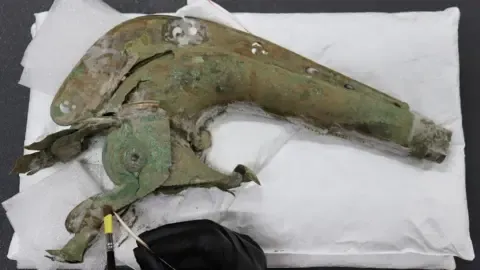
The conserved carnyx head
The carnyx itself is a work of intimidation. Picture a war trumpet shaped like a snarling animal head—mouth gaping, nostrils flared—designed to produce a sound that would carry across a battlefield and into the bones of whoever heard it. Celtic tribes across Europe wielded them. The Romans were so impressed (or unnerved) they kept depicting them as war trophies. This one, made from sheets of bronze so thin they've become brittle, represents the kind of find that conservators describe as "extraordinarily rare."
We're a new kind of news feed.
Regular news is designed to drain you. We're a non-profit built to restore you. Every story we publish is scored for impact, progress, and hope.
Start Your News DetoxBut the boar's head standard might be rarer still. This sheet-bronze flagpole topper—a boar's head held aloft to rally troops—had never been found in Britain before. The boar itself carried weight in Iron Age symbolism. As Dr. Fraser Hunter of National Museums Scotland explains, the boar was "a very fierce animal to face in the hunt, so the symbolism of the boar is a lot about the strength of it—a very appropriate adversary in battle." Holding that symbol high would have meant something to the warriors standing beneath it.
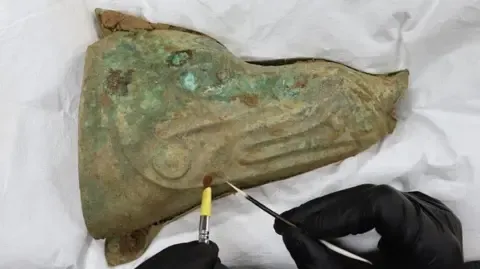
The delicate boar's head standard
What makes this discovery significant isn't just rarity—it's the window it opens. These artifacts belonged to the Iceni tribe, whose territory included what's now Norfolk. Finding two such objects together, intact enough to study, gives archaeologists something they rarely get: the chance to understand not just that these items existed, but how they were actually made, used, and valued. Dr. Tim Pestell of the Norfolk Museums Service calls it an "unparalleled opportunity" to investigate objects that usually survive only as fragments or Roman descriptions.
Historic England, Norfolk Museums, and the National Museum of Scotland are now coordinating the research and conservation. The work ahead will be meticulous—the same care that lifted these artifacts from the earth will guide every step forward.