For ages, scientists have looked at the sense of smell and basically shrugged. While we've had detailed maps for sight, hearing, and touch — how those receptors are arranged and connect to the brain — the nose remained the wild west. A "super-mysterious" system, as Harvard Medical School professor Sandeep (Robert) Datta put it.
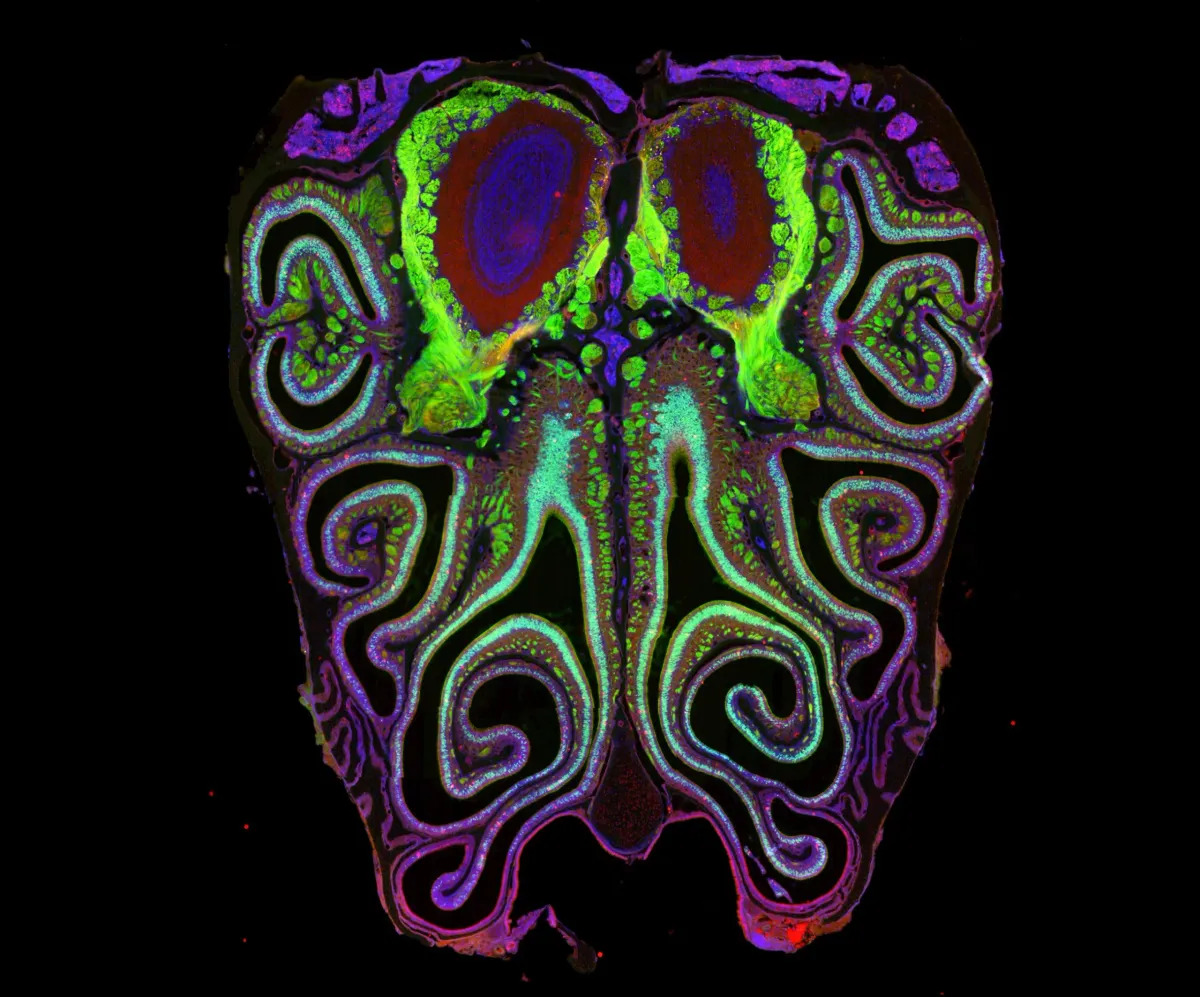
Well, the wild west just got a very precise set of directions. Datta and his team, after meticulously mapping over a thousand different smell receptors in mice, have discovered a hidden, highly organized structure in the nose. Forget the old idea of randomly scattered neurons; these receptors are arranged in neat, horizontal stripes, with similar types grouped together.
Which, if you think about it, is both impressive and slightly terrifying that we've been sniffing around for so long without knowing.
We're a new kind of news feed.
Regular news is designed to drain you. We're a non-profit built to restore you. Every story we publish is scored for impact, progress, and hope.
Start Your News DetoxThe Grand Olfactory Design
This isn't just some quirky nasal interior design. This striped arrangement in the nose perfectly mirrors how smell information is organized in the brain's olfactory bulb. It's like finding a secret key that unlocks how scent signals actually make their journey from a whiff of coffee to a full-blown memory.
The complexity of smell is partly why this map took so long to find. Mice, for example, have about 20 million olfactory neurons, utilizing over a thousand different receptor types. Compare that to color vision, which only needs three main receptor types. Each smell receptor is a specialist, detecting a very specific group of odor molecules.
For 35 years, since smell receptors were first identified in 1991, researchers tried to find order. Early attempts saw receptors in broad zones, leading to the assumption that it was all a bit chaotic. But with new genetic tools, Datta's team decided to go back to the drawing board.
They analyzed some 5.5 million neurons from over 300 mice, using single-cell sequencing to identify receptors and spatial transcriptomics to pinpoint their locations. Datta called it "arguably the most sequenced neural tissue ever." And what did all that data reveal? A clear, consistent pattern of tight, overlapping horizontal stripes across all the animals.
The Molecule Behind the Map
So, how does this incredibly precise map get built? The team found a key player: retinoic acid. This molecule, known for controlling gene activity, forms a gradient in the nose, effectively guiding neurons to express the right receptor based on their position. Mess with the retinoic acid levels, and the whole receptor map shifts. It's like the nose's very own internal GPS.
This breakthrough, published in Cell (alongside a corroborating study from Catherine Dulac's lab, also at Harvard), isn't just for science nerds. It lays the groundwork for understanding and, crucially, treating loss of smell — a condition that impacts safety, nutrition, and mental health, and for which treatments are currently, well, pretty much non-existent.
Because, as Datta points out, "we cannot fix smell without understanding how it works on a basic level." And now, for the first time, we actually have a map. Which, if you think about it, is a pretty big deal for something we take for granted every single day.
Now, if they could just figure out why some people smell burnt toast when there's no toast... that's a whole other map we'll need.