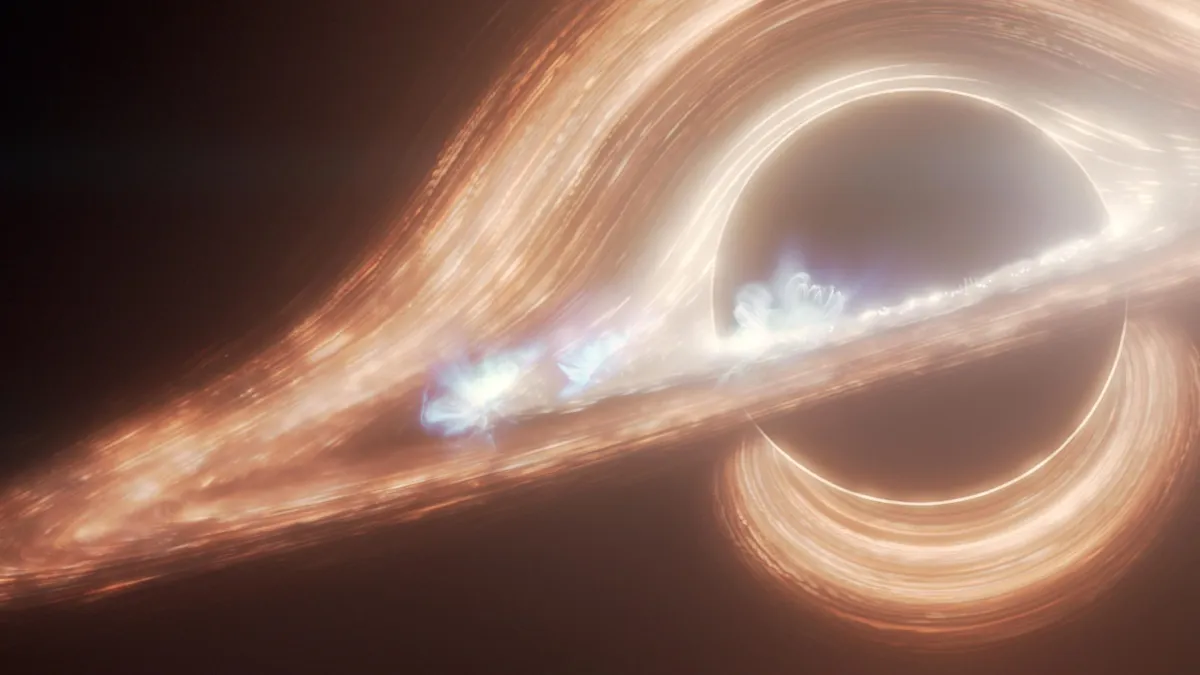
Astronomers have found that a massive binary star near the Milky Way's center might be creating mysterious gas clumps. These clumps drift towards Sagittarius A*, our galaxy's supermassive black hole.
New observations and computer models show that this binary star is making a series of gas clouds. These compact clumps help feed Sagittarius A*.
The Milky Way's Busy Center
The center of the Milky Way is a very crowded and active place. Sagittarius A* (Sgr A*), the supermassive black hole, sits at its core. Stars, gas, and dust move around it in an intense gravitational field. This area lets astronomers study how matter behaves near a black hole. It also shows how black holes get the material that keeps them active.
We're a new kind of news feed.
Regular news is designed to drain you. We're a non-profit built to restore you. Every story we publish is scored for impact, progress, and hope.
Start Your News DetoxOver the last two decades, astronomers have seen several small, dense gas clouds close to Sgr A*. These clumps might explain how gas moves towards the black hole. But their origin and how they formed were not clear.
A Family of Gas Clouds
In 2012, astronomers first found a compact cloud of ionized gas called G2. It has a few Earth masses of material and glows with hydrogen and helium light. This is typical for hot gas mixed with dust. G2 orbits Sgr A* on a stretched-out path and has a faint tail called G2t.
Later, astronomers looked at older data and found a similar object, G1. It followed a similar path. G1, G2, and G2t seem to be dense knots within the same stream of gas. Even small changes in density can make a gas cloud look lumpy. This is because its brightness increases with the square of its density.
More recently, researchers found that material from G2's tail formed a third compact clump. This clump is on a similar path. Together, these objects form a connected structure, the G1–2–3 streamer. It shows gas moving through the Galactic Center.
Models suggest that if one clump falls inward about every 10 years, carrying one Earth mass of material, it could feed Sgr A*. This amount of gas would maintain the black hole's current activity. So, understanding how these clumps form is key to knowing how the black hole is fueled.
Finding the Source
Astronomers thought of several possible sources for the clouds. These included winds from massive stars, explosions like novae, and material pulled away by Sgr A*'s gravity. To check these ideas, a team used special instruments called SINFONI and ERIS. These can create detailed infrared spectra.
The team focused on the hydrogen Brackett-γ emission line. They used the clouds' positions and speeds to map their orbits.
The results showed that G1, G2, and G2t move on orbits with almost the same shape and direction. It is very unlikely that three unrelated objects would share such specific orbital properties by chance. This suggests all three clumps came from the same place.
A Binary Star is the Creator
By tracing the gas streamer backward, researchers found a likely source: IRS 16SW. This is a massive contact binary star in the disk of young stars orbiting Sgr A*. The small differences in the G cloud orbits can be explained by the binary star's own movement.
Computer simulations support this idea. They show that gas clumps can form when the binary star's winds hit nearby material. This creates a shock between the two stars. In that area, gas builds up, gets compressed, and then breaks off as separate clumps. These clumps move inward, just like the G1–2–3 streamer.
What This Means
These findings suggest that massive stars near the Galactic Center might constantly send material towards the black hole through their stellar winds.
This discovery connects how stars evolve, how gas moves, and how black holes are fed. It shows how star formation and black hole activity can be linked even within our own Milky Way galaxy.
Deep Dive & References
The gas streamer G1–2–3 in the Galactic center - Astronomy & Astrophysics, 2026