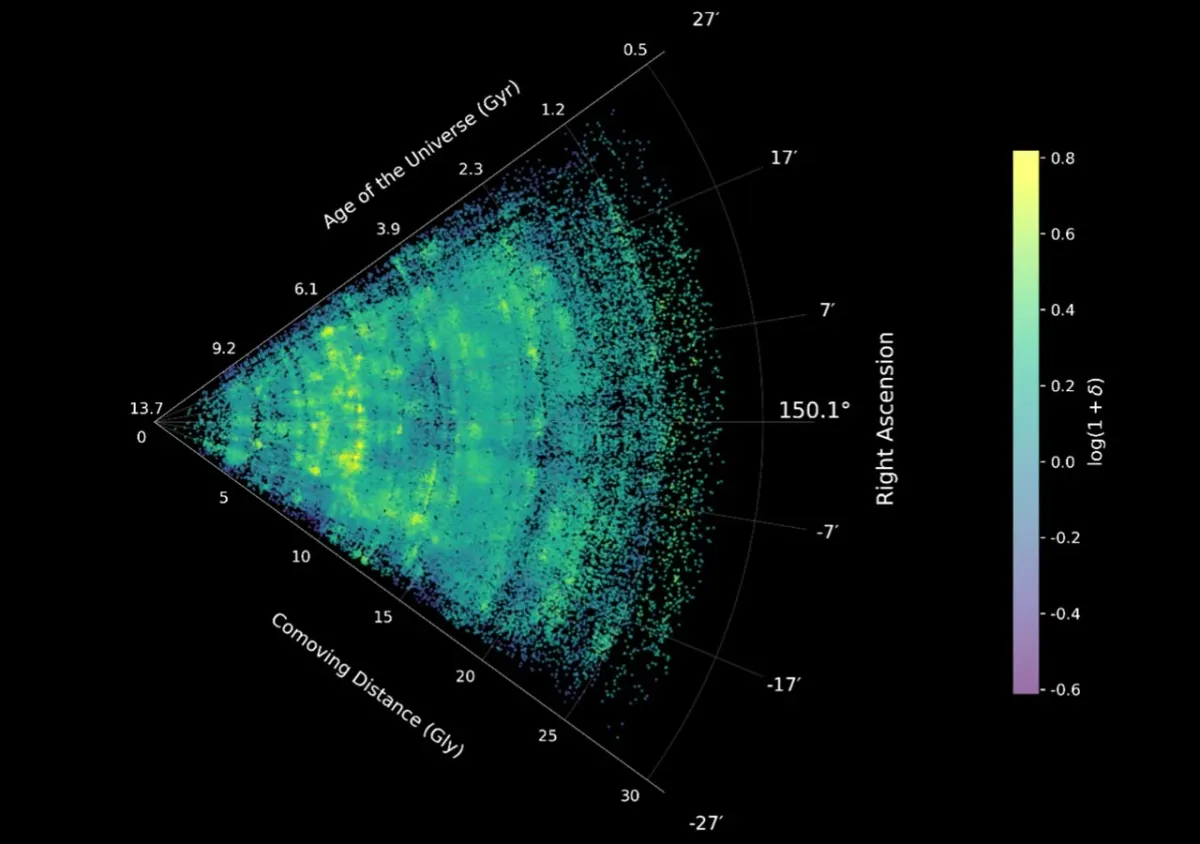
Imagine a giant, invisible spiderweb stretching across the entire universe, connecting everything you've ever seen (and a whole lot you haven't). That's the cosmic web, and astronomers just created its most detailed map yet, thanks to the James Webb Space Telescope.
This isn't just some theoretical sketch. We're talking about a vast network of dark matter and gas that acts as the universe's scaffolding, linking galaxies and clusters over truly mind-boggling distances. And now, for the first time, scientists have traced this cosmic architecture back to when the universe was barely a toddler, just one billion years old.
Unveiling the Cosmic Spiderweb
Led by researchers at the University of California, Riverside, the team used the largest JWST survey ever conducted, aptly named COSMOS-Web. This isn't just a casual glance; it's a deep dive designed to understand how galaxies formed and evolved within this sprawling network over 13.7 billion years.
We're a new kind of news feed.
Regular news is designed to drain you. We're a non-profit built to restore you. Every story we publish is scored for impact, progress, and hope.
Start Your News DetoxSince its launch in 2021, JWST has been pulling off some genuinely astonishing feats. Its infrared eyes can spot faint, distant galaxies that older telescopes simply couldn't touch, letting us peek further back in time and through the universe's dusty curtains. Which, if you think about it, is both impressive and slightly terrifying.
Hossein Hatamnia, a graduate student and lead author, put it plainly: JWST has completely rewritten our cosmic playbook. COSMOS-Web was specifically designed to give the wide, deep view needed to actually see this cosmic web. We're talking about studying galaxy evolution in clusters and filaments from the universe's infancy right up to our cosmic neighborhood (that's about a billion light-years from Earth, for those keeping score).
What did they find? Well, according to Bahram Mobasher, a UCR professor, the new data shows cosmic structures in far greater detail than even previous Hubble observations. What once looked like a blurry splotch now resolves into multiple distinct structures. It's like upgrading from a flip phone camera to, well, the James Webb Space Telescope.
This insane leap in clarity comes from two key JWST superpowers working in tandem: the telescope finds many more faint galaxies, and it measures their distances with far greater accuracy. This means each galaxy can be slotted into its precise cosmic time slice, making the overall map incredibly sharp.
In true open-science spirit, the team has made these maps publicly available. So, if you've ever wanted to explore the universe's skeleton, now's your chance. They've released the tools, a catalog of 164,000 galaxies, and even a video showing the cosmic web evolving over billions of years. Because apparently, that's where we are now: casually watching the universe grow up in high definition.