Imagine trying to fix a super complex computer, but you have no idea how any of the wires are connected. That's essentially been the challenge with the human brain — until now. Scientists have developed a new technique that uses tiny molecular "barcodes" to map thousands of brain cell connections, faster and in more detail than ever before.
This isn't just a cool party trick for neuroscientists; it could fundamentally change how we understand brain networks and, crucially, what goes wrong in diseases like Alzheimer's.
Boxuan Zhao, a professor at the University of Illinois Urbana-Champaign and the lead on this study, put it pretty plainly: understanding the brain's wiring is like understanding a computer's CPU. You need the blueprint to fix it or make it better. Their new tech, Connectome-seq, maps connections with surgical precision, which could unlock new treatments. The findings just hit the journal Nature Methods.
We're a new kind of news feed.
Regular news is designed to drain you. We're a non-profit built to restore you. Every story we publish is scored for impact, progress, and hope.
Start Your News DetoxThe Brain's New Barcode Scanner
Mapping the brain has always been less "high-tech detective work" and more "frantically trying to reassemble a shredded photograph." Researchers used to painstakingly slice brain tissue and then, effectively, try to glue the pathways back together by hand. Newer tools helped, but often showed a neuron's general direction, not its precise connection point. Which, if you're trying to find a specific broken circuit, isn't all that helpful.
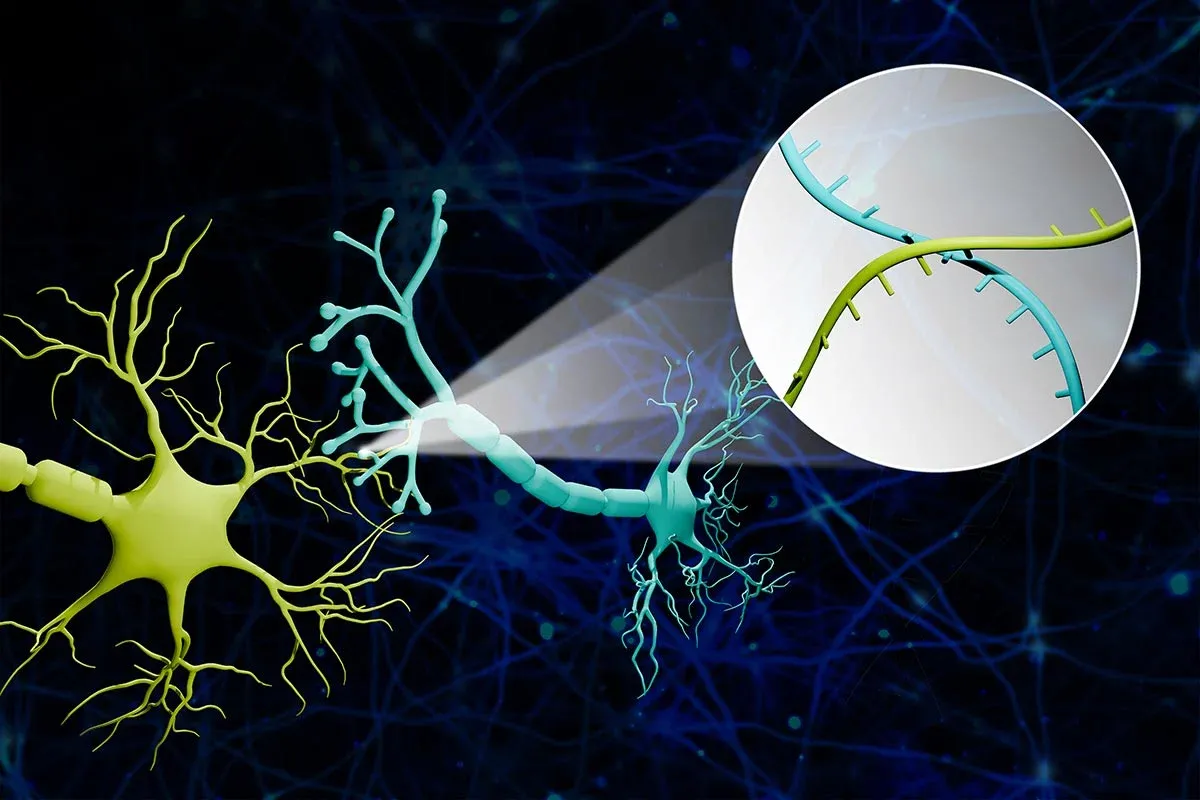
Zhao's team basically gave every neuron its own unique ID tag. These RNA "barcodes" travel from the main part of the neuron right to the synapse — the actual point where neurons connect. Scientists then collect these connection points, scan the barcodes, and if two barcodes show up together, bingo: those two neurons are connected.
Zhao offered a delightful analogy: picture balloons, each with a unique sticker. If two balloons are tied together, their stickers meet at the knot. Snip the knots, read the stickers, and suddenly you know which balloons are connected. They're doing this with thousands of neurons. Let that satisfying image sink in.
Using Connectome-seq, the team mapped over 1,000 neurons in a mouse brain circuit, uncovering direct links between cell types previously thought to be unconnected in adult brains. They're hoping to eventually map an entire mouse brain. Because apparently that's where we are now.
A Glimmer of Hope for Brain Disorders
Because this barcode method is fast and can cover vast areas, it could supercharge research into brain diseases. Imagine comparing a healthy brain's wiring to one in the early stages of Alzheimer's. Scientists could potentially spot subtle changes in brain circuits long before symptoms even appear.
Zhao noted that the reduced time and cost mean they can analyze many brains, identifying where connections fray or where the brain is most vulnerable. If they can find the exact "weak link" that kicks off a disease, they might just be able to reinforce those connections, slowing or even stopping the damage. Which, if you think about it, is both impressive and slightly terrifying in its implications.